Charles de Gaulle was a French general and statesmanA senior political leader who plays an important role in shaping a nation’s government and policies. who became the central figure of French resistance to Nazi Germany and then served as the first president of the Fifth RepublicThe French government system created in 1958 with a stronger president, which still shapes French politics today. from January 8th, 1959, to April 28th, 1969.
 FactsthatCrunch
De Gaulle refused to accept France's surrender to Germany in 1940 and broadcast a call from London urging French people to keep fighting, which became the founding moment of the Free French resistance. He led the French National Committee of Liberation and worked to ensure France was recognized as a major allied power at the end of the war.
Charles de Gaulle – Early Life
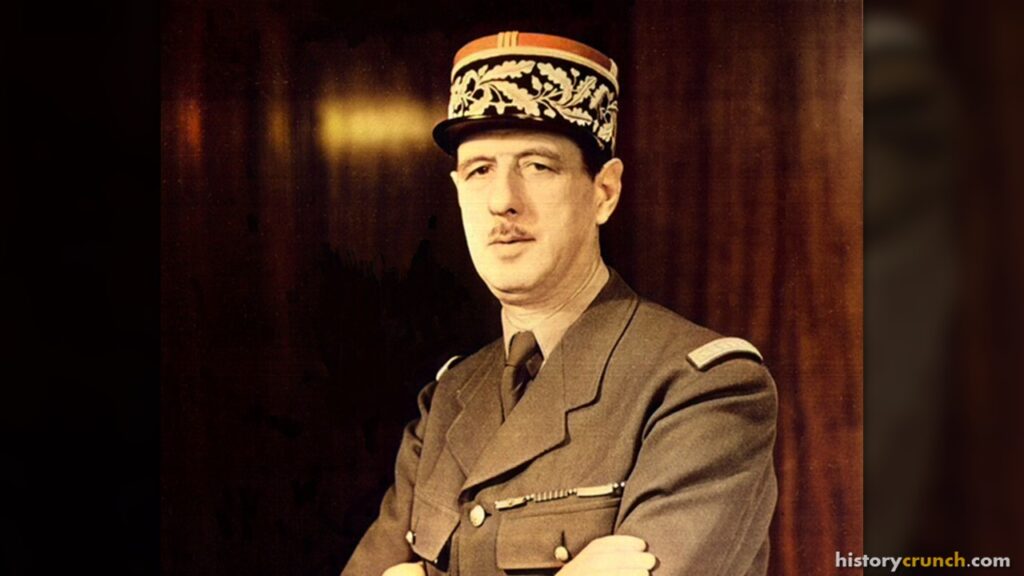
Charles André Joseph Marie de Gaulle was born on November 22nd, 1890, in Lille, France. He grew up in a conservative Catholic family, and his father was a teacher who encouraged strong interest in history, literature, and national identity. These early influences helped shape de Gaulle’s deep sense of French greatness and duty.
As a young man, de Gaulle chose a military career and entered Saint-Cyr, one of France’s leading military academies, in 1909. He later became an army officer and fought in World War I, where he was wounded several times and was eventually captured by German forces at the Battle of Verdun in 1916. Therefore, long before he became a political leader, de Gaulle had already built a reputation as a serious and determined officer.
FactsthatCrunchWhy was Charles de Gaulle captured and held as a prisoner in World War I?
De Gaulle was fighting as a French army officer when he was captured by German forces at the Battle of Verdun in 1916. He had already been wounded several times before he was taken prisoner. His capture came during one of the longest battles of World War I, where German and French forces fought for control of the Verdun region in northeastern France.
Charles de Gaulle – Rise in the French Army
After World War I, de Gaulle remained in the French army and developed a strong interest in military theory. He argued that future wars would require speed, armor, and mobile forces rather than only the defensive strategies that many French leaders still preferred. This made him an unusual figure because some of his ideas were ahead of his time.
During the interwar years, de Gaulle also wrote books and gained notice as a thoughtful military officer. However, he did not fully rise to national prominence until World War II. In May of 1940, as Germany invaded France, de Gaulle was promoted to brigadier general and briefly served in the French government as under-secretary of state for war and national defense. This placed him in an important position just as France was collapsing.
FactsthatCrunchDe Gaulle's argument that future wars would be won by fast armored and mobile forces was ahead of its time, but France did not act on it before Germany proved him right in 1940.
Charles de Gaulle – World War II and Free France
When France fell to Nazi Germany in June of 1940, Marshal Philippe Pétain moved toward an armisticeAn agreement between enemies to stop fighting, often seen as accepting defeat.. De Gaulle rejected surrender and went to Britain, where he delivered his famous Appeal of June 18th, 1940, over BBC radio. In that speech, he urged the French people to continue resisting Germany. This was significant because it became one of the founding moments of Free FranceThe resistance movement de Gaulle built abroad to keep fighting Nazi Germany after France’s military defeat in 1940. and the wider French Resistance.
At first, de Gaulle had limited support, and only a minority of French people actually heard the June 18th broadcast live. Even so, he gradually built Free France into an important resistance movement and worked to unite French forces and colonial territories that opposed Vichy France and Nazi control. As stated above, this mattered because it allowed France to remain part of the Allied struggle even after the military defeat of 1940.
As World War II continued, de Gaulle became the leading symbol of French resistance abroad. He headed the French Committee of National Liberation and then the Provisional Government of the French Republic from June 3rd, 1944, to January 26th, 1946. After the liberation of Paris in August of 1944, he helped restore French republican government and insisted that the French Republic had never legally disappeared, even during the Vichy years.
FactsthatCrunchIn June of 1940, Charles de Gaulle stood in Britain after France fell to Nazi Germany, having just delivered his Appeal of June 18th, 1940, over BBC radio urging the French people to keep resisting. Only a minority of French people had heard the broadcast live, and de Gaulle had no army, no territory, and no official recognition from the major Allied powers. Free France was a movement in name only, and de Gaulle had to decide whether it could survive at all.
Charles de Gaulle – Return to Power and the Fifth Republic
After World War II, de Gaulle grew frustrated with the political weakness and instability of the Fourth Republic. He resigned from government in January of 1946 because he believed France needed a stronger executive branch. For several years he remained outside direct power, although he stayed an important public figure and continued to criticize the existing political system.
De Gaulle returned to power in 1958 during the crisis caused by the Algerian War and political instability in France. On June 1st, 1958, he became head of government with full powers to oversee constitutional change, and later that year a new constitution created the Fifth Republic. He then became its first president in January of 1959. This was important because the Fifth Republic still shapes French politics today.
As president, de Gaulle worked to strengthen the French state, increase presidential authority, and restore national confidence. He also pushed France toward a more independent role in world affairs, including development of French nuclear power and a foreign policy less dependent on either the United States or the Soviet Union. Therefore, de Gaulle was not only a wartime leader but also an architect of modern French political identity.
One of the most difficult issues of his presidency was Algeria. Although many people first expected him to defend French Algeria, de Gaulle gradually moved toward self-determinationThe right of a people to decide their own political future and independence. for Algerians. In 1959, he declared that Algerians had the right to determine their own future, and after years of violence and crisis, Algeria became independent in 1962. This was significant because it ended one of the most painful colonial conflicts in modern French history.
De Gaulle remained president until 1969. After French voters rejected his proposed constitutional reforms in a referendumA direct public vote in which citizens approve or reject a specific government proposal. on April 27th, 1969, he resigned the next day, as he had promised he would. This showed that even after years of strong leadership, he still tied his authority to direct national approval.
FactsthatCrunchAfter World War II, de Gaulle left power, then came back during a crisis and built a new system of government called the Fifth Republic.
Charles de Gaulle – Later Years and Death
After resigning, de Gaulle retired from active politics and returned to Colombey-les-Deux-Églises. He spent much of his final period out of public life and continued work on his memoirs. His withdrawal from politics marked the end of a major era in French history.
Charles de Gaulle died on November 9th, 1970, at Colombey-les-Deux-Églises, France. By the time of his death, he was already widely seen as one of the most important French leaders of the 20th century.
Charles de Gaulle – Significance
Charles de Gaulle was significant because he represented France during two of its most important modern turning points: the struggle against Nazi occupation and the rebuilding of the French state after political crisis. He led Free France during World War II, helped restore the French Republic after liberation, and then built the Fifth Republic in 1958.
At the same time, de Gaulle remains a debated historical figure. Some people admire him for his patriotism, leadership, and determination to make France strong and independent. Others focus on his strict style of rule and the tensions surrounding decolonization, especially in Algeria. Regardless, Charles de Gaulle stands as one of the most influential leaders in modern French history.
Historians and the French public still debate Charles de Gaulle. Is each of these something people admire him for, or something critics point to?
Explore World War I
Keep exploring World War I with these History Crunch resources.
Key Vocabulary
Statesman
Armistice
Free France
Vichy France
Self-determination
Fifth Republic
Referendum
Frequently Asked Questions
Who was Charles de Gaulle?
Charles de Gaulle was a French general and statesman who led French resistance to Nazi Germany. He later became the first president of the Fifth Republic. He served in that role from January 8th, 1959, to April 28th, 1969.
What was the Appeal of June 18th, 1940?
The Appeal of June 18th, 1940, was a radio speech de Gaulle gave over BBC radio from Britain. In it, he urged the French people to keep resisting Germany after France fell. The speech became one of the founding moments of Free France and the French Resistance.
What was Free France?
Free France was the resistance movement de Gaulle built after Nazi Germany defeated France in 1940. It opposed both Vichy France and Nazi control. The movement allowed France to stay part of the Allied struggle even after its military defeat.
Why did de Gaulle create the Fifth Republic?
De Gaulle created the Fifth Republic because he believed France needed a stronger executive branch. He returned to power in 1958 during the Algerian War and deep political instability. A new constitution gave the president more authority, and that system still shapes French politics today.
How did de Gaulle handle the Algerian War?
De Gaulle gradually moved toward self-determination for Algerians, even though many expected him to defend French Algeria. In 1959, he declared that Algerians had the right to decide their own future. Algeria became independent in 1962, ending one of modern France’s most painful colonial conflicts.
When did Charles de Gaulle die?
Charles de Gaulle died on November 9th, 1970, at Colombey-les-Deux-Églises, France. He had resigned the presidency in 1969 after voters rejected his proposed reforms in a referendum. By his death, he was already seen as one of the most important French leaders of the 20th century.
Cite This Article
To cite this article as a source, use one of the formats below.
MLA: Millar, B. “Charles de Gaulle: A Detailed Biography.” HistoryCrunch, 3 October 2026, https://historycrunch.com/charles-de-gaulle/.
APA: Millar, B. (2026). Charles de Gaulle: A Detailed Biography. HistoryCrunch. https://historycrunch.com/charles-de-gaulle/
Chicago: Millar, B. “Charles de Gaulle: A Detailed Biography.” HistoryCrunch. October 3, 2026. https://historycrunch.com/charles-de-gaulle/
Sources
- Antony Beevor, The Second World War.
- Max Hastings, Inferno / All Hell Let Loose.
- Imperial War Museum
- Gerhard L. Weinberg, A World at Arms.