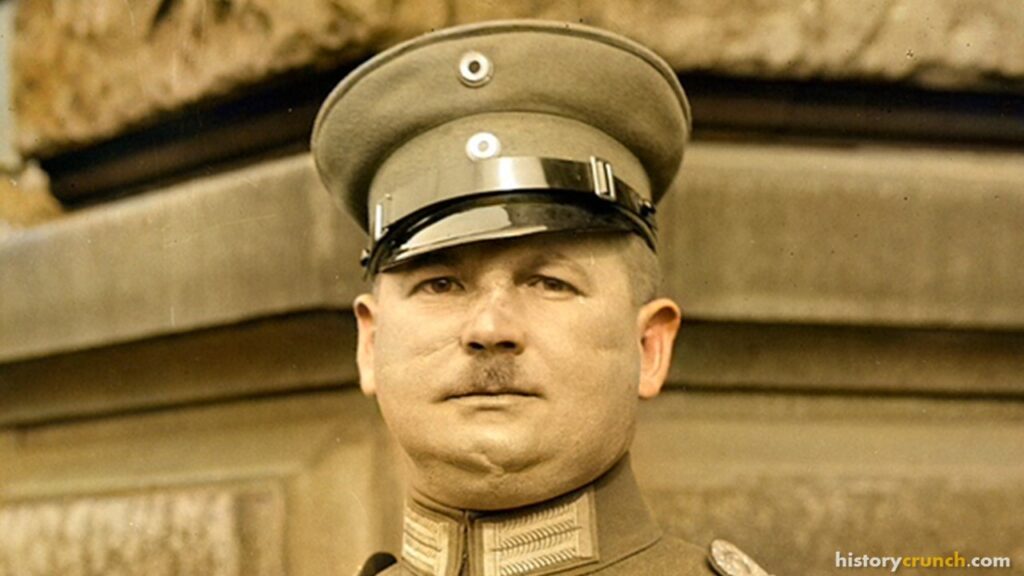
Ernst Röhm was an important early figure in the rise of the Nazi Party in Germany. He was born in Munich, Germany on November 28th, 1887, and later became one of the leading organizers of the Sturmabteilung, which was better known as the ‘SA’ or the ‘Brownshirts’. Röhm is significant because the SA helped Adolf Hitler and the Nazi Party gain power during the unstable years of the Weimar Republic.
ERNST RÖHM – EARLY LIFE
As stated above, Ernst Röhm was born in Munich, Germany on November 28th, 1887. He entered military service in 1906, served in World War I, was wounded several times, and eventually reached the rank of captain. This was significant because Röhm’s military background made him value violence, discipline, and armed organization.
Like many German veterans, Röhm struggled with the aftermath of World War I and the impacts of the Treaty of Versailles. In fact, in the years after Germany’s defeat, many former soldiers joined paramilitary groups and extreme political movements. This larger atmosphere mattered greatly because it created the conditions in which men like Röhm could move from military service into radical politics in Germany. His later work in the Nazi movement reflected the anger, nationalism and instability that existed in Germany after the First World War. This anger also led to the rise of Adolf Hitler and the Nazi Party.
ERNST RÖHM – NAZI MOVEMENT
Ernst Röhm became an early member of the Nazi movement and developed a close relationship with Adolf Hitler. He was active in right-wing nationalist circles in Munich and helped connect Hitler with other armed supporters. This was significant because Hitler needed men like Röhm in the early 1920s. Hitler had political skill and public speaking ability, but Röhm helped provide access to organized force. That combination made the Nazi Party far more dangerous than many other extremist groups of the time.
Röhm was also connected to the events of the Beer Hall Putsch in November of 1923, which was Hitler’s failed attempt to seize power by force. The putsch failed, and Hitler was imprisoned for treason. However, the event still mattered in the long run because it became a famous part of Nazi mythology, and Röhm remained associated with Hitler’s early attempt to overthrow the government. This helped strengthen Röhm’s status inside the Nazi movement during its early years.
ERNST RÖHM – THE SA
The most important part of Röhm’s career was his role in building and leading the SA. The SA was the original paramilitary organization of the Nazi Party and was often called the ‘Brownshirts’. It emphasized physical force, military training and absolute loyalty. As the Nazi movement grew, the SA became the party’s muscle in the streets and often carried out violence in the name of growing the Nazi presence in German society and politics. This was significant because the SA helped protect Nazi rallies, break up opposition meetings, and intimidate political enemies, especially during the years when Hitler was trying to transform the Nazi Party into a national force.
By the early 1930s, the SA had become enormous. As Nazi support grew during the crisis years of the Great Depression, the SA expanded rapidly and gave the party a strong presence across Germany. Röhm’s leadership was important because he helped turn the SA into a mass organization that projected power and violence. In this way, he was one of the figures who helped make Hitler’s rise to power possible.
ERNST RÖHM – NIGHT OF THE LONG KNIVES
After Hitler became Chancellor in January of 1933, the relationship between Hitler and Röhm began to change. The SA had been useful during the struggle for power, but once Hitler was in office, many conservative elites, army leaders, and industrial supporters became nervous about the SA’s size and radicalism. Röhm and other SA leaders seemed to want a more sweeping revolution in Germany, while Hitler increasingly wanted stability and cooperation with the regular army and powerful traditional elites. This was significant because it revealed a major division inside the Nazi regime.
Röhm’s position became even more dangerous because the SA had grown to millions of members and seemed to threaten the authority of the regular German army. Army leaders, along with important Nazi figures such as Heinrich Himmler and Hermann Goering, viewed Röhm as a problem. This was significant in the larger story of Nazi Germany because Hitler still needed the support of the army in order to strengthen his dictatorship and prepare Nazi Germany for future expansion. In other words, Hitler had to decide whether he would stand with Röhm and the SA or with the army and conservative elites.
The conflict between Hitler and Röhm came to a violent end in June of 1934 during the event known as the Night of the Long Knives. On June 30th, 1934, Hitler ordered a purge against Röhm and other SA leaders. The killings continued into July of 1934, and Röhm himself was shot on July 1st, 1934 after being arrested near Munich. This was one of the most important turning points in the history of Nazi Germany because it showed that Hitler was willing to murder even longtime allies in order to secure his own power.
The purge had major consequences. It greatly reduced the power of the SA, strengthened the position of the SS, and helped Hitler gain the confidence of the army. This was historically significant because it helped Hitler move closer to absolute control over Germany.
ERNST RÖHM – LEGACY
Ernst Röhm is remembered today mainly for two reasons. First, he was one of the early builders of the Nazi movement and one of the key organizers of the SA. Second, his downfall in 1934 marked a decisive moment in Hitler’s consolidation of power. These two parts of his life are both important because they show how the Nazi Party rose through violence and then turned that same violence inward once it had taken control of the state.