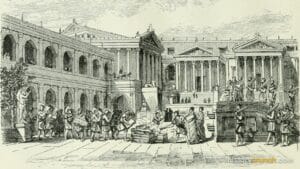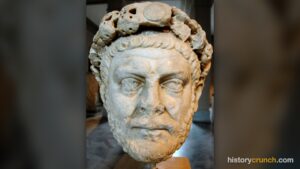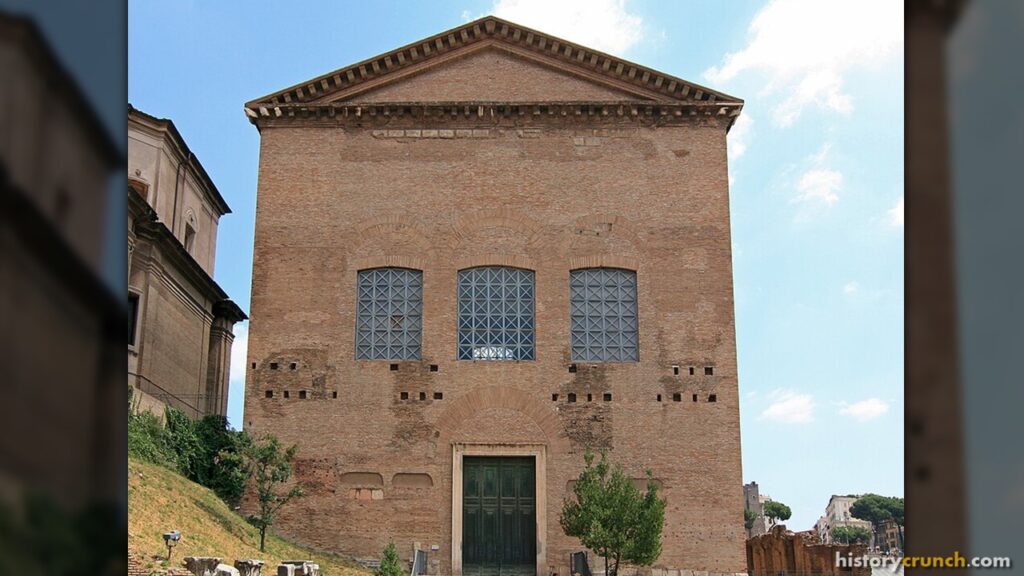
Government in Ancient Rome was one of the most important aspects of life in the ancient Roman Empire. Over the course of more than a thousand years, it changed from a small monarchy into a vast empire that ruled over much of Europe, North Africa and the Middle East. Furthermore, the history of government in Ancient Rome highlights its significance on the development of governance and rights throughout the history of the western world.
GOVERNMENT IN ANCIENT ROME – ROMAN KINGDOM (753 TO 509 BCE)
Government in Ancient Rome is generally divided into three periods of history. The Roman Kingdom was the first of these periods and lasted from 753 BCE to 509 BCE. The earliest form of government during this time was monarchy, which, began with the founding of Rome in 753 BCE. During this period, Rome was ruled by kings who held supreme power but were advised by a Senate, which was a council of elders from noble families. The kings were responsible for leading the army, performing religious duties and making laws. However, the monarchy ended in 509 BCE, when the Romans overthrew their last king, Lucius Tarquinius Superbus, due to his tyranny and abuse of power. As a result, the people of Rome vowed never again to be ruled by a king. Historians point out that this idea led to one of the most significant political systems in the form of the Roman Republic.
GOVERNMENT IN ANCIENT ROME – ROMAN REPUBLIC (509 BCE TO 27 BCE)
The next period in the history of government in Ancient Rome was the Roman Republic, which lasted from 509 BCE to 27 BCE. In fact, the Roman Republic became one of the most advanced and influential forms of government in all of the ancient world. It was based on the idea that power should rest in the hands of elected officials and that laws, not individuals, should govern the state. In fact, the Roman Republic established a system of checks and balances to prevent any one person or group from gaining too much power. Furthermore, the government was divided into three main branches: the magistrates, the Senate, and the popular assemblies.
The magistrates were elected officials responsible for enforcing laws and managing public affairs. The two most powerful magistrates were the consuls, who served as co-leaders of the government and commanders of the army. Their one-year term and shared authority ensured that neither could become a dictator. The Senate, composed mainly of wealthy and influential citizens, advised magistrates, controlled finances, and guided foreign policy.
Meanwhile, the assemblies represented the Roman people and had the power to elect officials, pass laws and make decisions on war and peace. Over time, social conflicts between the upper class (patricians) and the lower class (plebeians) led to important reforms, such as the creation of the Tribune of the Plebs, an office that protected the rights of common citizens.
Although the Senate’s decisions favored the rich mainly because most members of the senate were from rich families and thus they could influence decision-making, the lower classes did not question the set up. Additionally, whilst the Senate was in power, Rome grew in power and size and so few people wanted the setup to change.
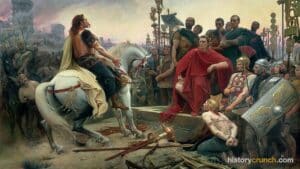
The Republic’s system encouraged civic duty, debate and participation, but it was also fragile. As Rome expanded its territories through conquest, its government struggled to manage the growing empire. Wealth and power became concentrated among a few elite families, which led to corruption, social unrest and political rivalries. Civil wars erupted, and ambitious generals such as Julius Caesar, Pompey and Crassus began to challenge the authority of the Senate.
In 49 BCE, Julius Caesar’s rise to power marked the end of the Republic’s political balance. After his assassination in 44 BCE, his adopted heir, Augustus, emerged as the sole ruler of Rome, beginning the next great phase of Roman government: the Roman Empire.
GOVERNMENT IN ANCIENT ROME – ROMAN EMPIRE (27 BCE TO 476 CE)
The third and final period in the history of government in Ancient Rome was Roman Empire, which lasted from 27 BCE until 476 CE. The Roman Empire was governed by an autocracy which means that the government was made up of a single person. In Rome, this person was the emperor. The Senate, which was the dominant political power in the Roman Republic, was kept but the Senate lacked real political power and so made few real governmental decisions. The Roman Empire was characterised by imperial administration and had a hierarchy of magistrates and provincial governors. The emperor controlled the army, finances, and administration, ensuring stability across a vast empire. This period, which began with the rule of Augustus, led to the Pax Romana, which was a time of two centuries of relative peace, prosperity and unity within Rome.
After Emperor Augustus, most of the Roman emperors came up through the military after using their power in the army to become powerful and secure their rule. The empire’s centralized government allowed for efficient administration, tax collection and law enforcement across territories stretching from Britain to Egypt. Governors appointed by the emperor oversaw the provinces, maintaining order and ensuring loyalty to Rome. Despite its authoritarian nature, the imperial government provided stability and infrastructure that benefited millions of people throughout the empire.
The Roman Empire continued for many years, but in 395 CE the empire split into two parts, the Eastern Empire and the Western empire. One part of the empire was stayed in Rome while the other moved to Constantinople, which today is the modern city of Istanbul in the country of Turkey. Following this split, Rome lost power and the Western Empire fell apart in 476 CE. The Eastern Empire lasted for nearly a thousand years longer, but never became the power house that Rome was in its hay day. The Eastern Empire became known as the Byzantine Empire.