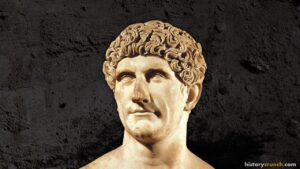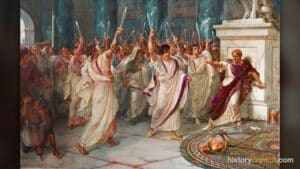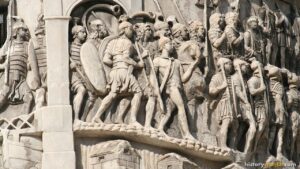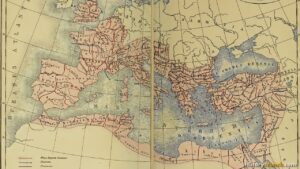
The Gallic Wars were one of the most important military campaigns in the history of the Roman Republic, and they helped transform both the map of Europe and the political future of Rome. Fought between 58 BCE and 50 BCE, these campaigns were led by the Roman general and politician Julius Caesar against the many tribes of Gaul, a large region that covered most of modern France and Belgium, along with parts of Switzerland and Germany. Over roughly eight years of fighting, Caesar conquered the whole of Gaul for Rome, gained enormous wealth, and built a loyal army that would later carry him to supreme power.
The term “Gallic Wars” refers to the series of battles, sieges, and expeditions that Caesar directed as governor of the Roman provinces along the frontier of Gaul. The word “Gaul” was the name the Romans gave to the lands of the Celtic peoples north of the Alps, and the people who lived there were known to the Romans as Gauls. These wars were not a single battle but a long war of conquest, ending with the famous siege at a town called Alesia.
Background of the Gallic Wars (Caesar’s Conquests)
To understand why the Gallic Wars began, it helps to look at Caesar’s political situation in Rome. In 60 BCE, Julius Caesar joined with two other powerful men, the wealthy Marcus Licinius Crassus and the respected general Gnaeus Pompeius Magnus, better known as Pompey. This informal partnership became known as the First Triumvirate, a word meaning “rule of three men.” The alliance was strengthened when Caesar’s daughter, Julia, married Pompey.
Soon after the alliance formed, Caesar was made governor of Gaul, giving him command over several legions of the Roman army. In fact, this position was extremely valuable to an ambitious man. A successful war would bring him fame, riches, and the loyal soldiers he needed for his political career. It would also protect him from enemies in the Roman Senate, who wished to put him on trial for his earlier actions as consul.
The Romans had long feared and respected the Gallic tribes. Centuries earlier, in 390 BCE, Gauls had actually sacked the city of Rome, and that memory left a deep and lasting dread of northern invaders. As stated above, Rome already controlled a strip of southern Gaul, and Roman generals were always eager to find new lands to conquer for glory and profit.
The immediate trigger came in 58 BCE, when a large Gallic tribe called the Helvetii, who lived in what is now Switzerland, decided to migrate west across the region. Their planned route passed near Roman territory and the lands of the Aedui, a tribe allied to Rome. Caesar refused to let them pass and used the crisis as his reason to march north with his army.
The two sides in this long war were very different. On one side stood the disciplined Roman legions, highly trained and skilled in engineering and siege warfare, commanded by Caesar and led in the field by professional officers called centurions. On the other side stood the Gallic tribes, who were brave, numerous, and often wealthy, but who were divided among themselves and rarely fought as a single united force. More specifically, it was this lack of unity among the Gauls that made Caesar’s task far easier than it might otherwise have been.
How the Gallic Wars (Caesar’s Conquests) Unfolded
Caesar’s first campaign, in 58 BCE, was against the migrating Helvetii, whom he defeated and forced to return home. In that same year he also fought and defeated a powerful Germanic leader named Ariovistus, who had crossed the Rhine River into Gaul. These early victories gave Caesar a foothold deep in the region, and it is likely that at this point he had already decided to conquer all of Gaul.
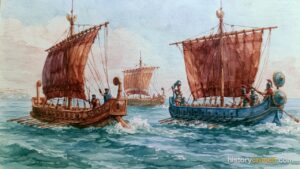
In 57 BCE, Caesar turned against the fierce tribes of the north, in the area of modern Belgium. There he fought the Nervii in a hard-fought battle that nearly ended in Roman defeat before the legions rallied and won. The following year, in 56 BCE, he defeated the Veneti, a seafaring tribe of the northwest, in a naval battle, bringing most of the coast under Roman control.
In 55 BCE, Caesar sought to impress the people back in Rome with bold new adventures. He built a bridge and marched across the Rhine River into Germanic lands, and he also launched the first Roman expedition across the English Channel into Britain. In reality, these expeditions achieved little of lasting military value, but they made Caesar a hero at home. He returned to Britain with a larger army the next year, in 54 BCE, and reached further inland before crossing back to the continent.
During these years Caesar wrote his own account of the war, a book known today as the Commentaries on the Gallic War. He wrote it to be read by citizens back in Rome so that he could boast of his successes and defend his actions if he was accused of acting illegally. Modern scholars treat the book with caution, because Caesar exaggerated the size of enemy armies and downplayed his own losses to make himself look like a flawless commander.
Not all of the campaigns went smoothly. Revolts broke out among the tribes, and in the winter of 54 BCE the Romans suffered a humiliating defeat when part of Caesar’s army was ambushed and destroyed. In 53 BCE, Caesar responded with a harsh campaign of punishment meant to crush any spirit of resistance. This brutal treatment, however, only pushed the Gauls toward the very thing the Romans feared most, which was a single united uprising.
That uprising came in 52 BCE under a young and charismatic chieftain of the Arverni tribe named Vercingetorix. He was elected chief of the coalition at Bibracte in 52 BCE, and for the first time many Gallic tribes joined together under one leader. Vercingetorix used clever tactics, avoiding open battle and burning crops and villages so the Romans could not find food.
At first, this strategy worked. The Gauls won a notable victory over Caesar at the Battle of Gergovia, a rare Roman defeat in the war. After that setback, a direct assault on the Gauls was no longer a safe option, so Caesar changed his approach. When Vercingetorix and his army withdrew to the hilltop stronghold of Alesia, Caesar decided to trap them there and starve them out.
The siege of Alesia, fought in September of 52 BCE, became the decisive battle of the entire war. Vercingetorix withdrew to the hilltop of Alesia with an army composed, according to Caesar, of 12,000 horsemen and 80,000 foot soldiers. Caesar’s army, numbering only around 50,000 to 60,000 men, then began one of the most remarkable feats of military engineering in ancient history.
The Romans built two enormous rings of fortifications around the town. The internal line, or contravallation, was intended to prevent the Gauls escaping from the area where they were entrenched, whereas the outer line, or circumvallation, was to prevent them from being relieved from outside by other Gaulish troops. These lines included deep trenches, sharpened stakes, hidden traps, and watchtowers spaced at regular intervals. In total, the works stretched for many miles, and it took the legions about four to five weeks to complete them.
Before the trap fully closed, Vercingetorix sent his cavalry out to call for help from the rest of Gaul. A huge relief army eventually arrived, outnumbering the Romans by more than two to one, so that Caesar’s soldiers were now trapped between the defenders inside Alesia and the relief force outside. The fighting reached its climax as the Gauls attacked the Roman lines from both directions at once, searching for a weak point in the fortifications.
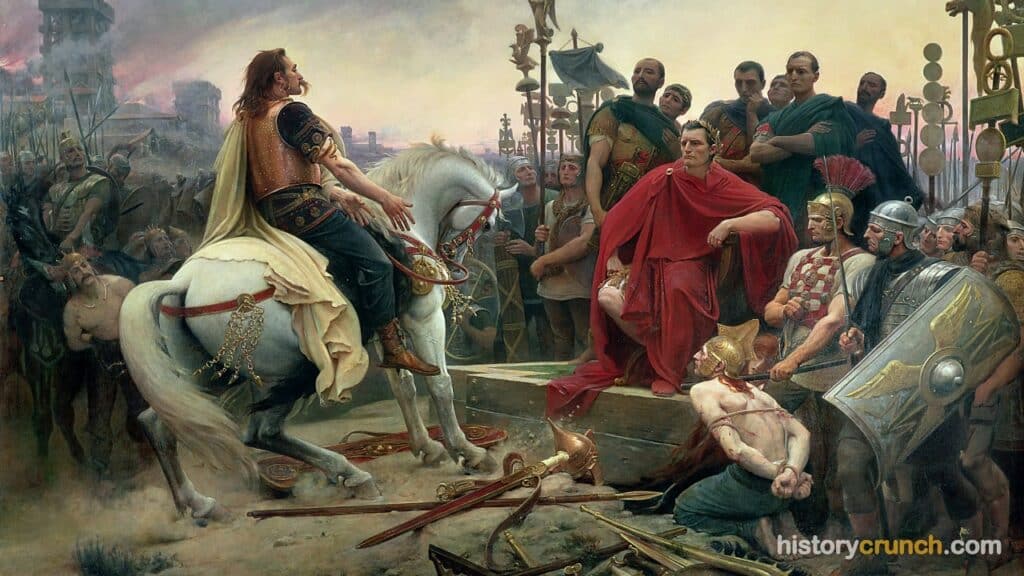
Despite being surrounded and outnumbered, the disciplined Roman defenses held. Caesar personally led reserves to the most threatened parts of the line, and the relief army was finally driven off in confusion. With no hope of rescue and his people starving, Vercingetorix surrendered to Caesar, ending the great revolt.
The captured Gallic leader was taken to Rome as a prisoner. Years later, he was paraded through the streets of Rome as a symbol of Caesar’s victory in 46 BCE, and after the triumph he was executed by strangulation, as was the customary fate of defeated enemy leaders in Rome. After Alesia, only scattered resistance remained. In 51 and 50 BCE, Caesar’s troops spent their time putting down the last small rebellions, and the conquest of Gaul was essentially complete.
Significance of Gallic Wars (Caesar’s Conquests)
The Gallic Wars had enormous consequences for both Gaul and Rome. For Gaul, the war meant the end of independence. The region was brought under Roman control, and over the following centuries its people, language, and customs blended with those of Rome in a process known as Romanization. Untold numbers of Gauls were killed, enslaved, or driven from their homes, making the war one of the most devastating conflicts of the ancient world.
For Julius Caesar personally, the wars were the foundation of his rise to power. The conquest made him one of the richest and most famous men in Rome, and it gave him a large, battle-hardened army fiercely loyal to him rather than to the Senate. In fact, it was this loyal army that would soon allow Caesar to challenge his old ally Pompey and the Senate itself.
The alliance of the First Triumvirate broke apart during these years. Caesar’s daughter Julia, who was married to Pompey, died in 54 BCE, and Crassus was killed in battle in 53 BCE. With both of these bonds gone, Pompey drifted toward Caesar’s enemies in the Senate, setting the stage for a civil war between the two most powerful men in Rome.
In this way, the Gallic Wars were a key step on the road to the end of the Roman Republic. The wealth, fame, and military power that Caesar gained in Gaul made it possible for him to march on Rome, defeat Pompey, and make himself dictator. This chain of events eventually led to the collapse of the Republic and the birth of the Roman Empire, making the Gallic Wars one of the most important turning points in the history of Ancient Rome.
Frequently Asked Questions
When did the Gallic Wars take place?
The Gallic Wars took place between 58 BCE and 50 BCE, lasting about eight years. The heaviest fighting came in the early years and again in 52 BCE, when the great revolt led to the decisive siege of Alesia. Scattered resistance was finally cleared away in the last two years of the war.
Who did Julius Caesar fight in the Gallic Wars?
Caesar fought the many tribes of Gaul, along with some Germanic peoples from across the Rhine River. Among the most important enemies were the Helvetii, the Nervii, and the Arverni. Some tribes, such as the Aedui, were actually allies of Rome during much of the war before turning against Caesar in the final revolt.
Why did Julius Caesar want to conquer Gaul?
Caesar wanted to conquer Gaul mainly to gain wealth, fame, and a loyal army for his political career in Rome. A successful war would also protect him from enemies in the Senate who wanted to prosecute him. Beyond his personal ambitions, Rome had long feared the Gallic tribes and saw value in securing its northern frontier.
What was the most important battle of the Gallic Wars?
The most important battle was the siege of Alesia in 52 BCE, which decided the outcome of the entire war. There Caesar trapped Vercingetorix behind two rings of fortifications and defeated both the town’s defenders and a massive Gallic relief army. Vercingetorix surrendered afterward, effectively ending organized Gallic resistance.
How did the Gallic Wars help end the Roman Republic?
The Gallic Wars gave Caesar the wealth, prestige, and loyal soldiers he needed to seize supreme power. After the war, he used his army to fight and defeat Pompey in a civil war and then made himself dictator. This concentration of power in one man weakened the Republic and paved the way for the rise of the Roman Empire under his heir, Augustus.
Cite This Article
To cite this article as a source, use one of the formats below.
MLA: Millar, B. “Gallic Wars (Caesar's Conquests): A Detailed Summary.” HistoryCrunch, 7 July 2026, https://historycrunch.com/gallic-wars-caesars-conquests/.
APA: Millar, B. (2026). Gallic Wars (Caesar's Conquests): A Detailed Summary. HistoryCrunch. https://historycrunch.com/gallic-wars-caesars-conquests/
Chicago: Millar, B. “Gallic Wars (Caesar's Conquests): A Detailed Summary.” HistoryCrunch. July 7, 2026. https://historycrunch.com/gallic-wars-caesars-conquests/
Sources
- H.H. Scullard, From the Gracchi to Nero.
- Fordham Ancient History Sourcebook
- Adrian Goldsworthy, How Rome Fell / Caesar (military and political).