EspionageSecretly gathering information about a foreign government to give your own country a military or financial advantage. in the Cold War was an important aspect of intelligence gathering and national defence between the United States and the Soviet Union. Both superpowers relied heavily on spies, surveillanceClose and continuous monitoring of a person, place, or country to gather intelligence., code-breaking, and covert operationsSecret activities carried out by a government that are hidden from the public and from enemy nations. to gather information and gain strategic advantage. Furthermore, spy satellites and U-2 spy planes also became vital tools for monitoring enemy activities during the events of the Cold War.
What Is Espionage in the Cold War?
Espionage, or spying, is when one secretly gathers information about a foreign government or a competing business, with the purpose of placing one’s own government or business at some military or financial advantage. Espionage usually involves a government or person getting access to information that is considered secret or confidential. The secret information is taken by the spy without the permission of the holder of the information. Espionage is illegal and against the law. Espionage was common during the Cold War and led to other Cold War events such as: McCarthyism and the Cuban Missile Crisis.
The Cold War was a major world event that took place from approximately 1945 until 1991. In general, the Cold War was a period of increased tensions and hostility between the superpowers of the United States and the Soviet Union (USSR). Espionage played an important role in the Cold War and highlighted the ongoing tensions between the two superpowers.
 FactsthatCrunch
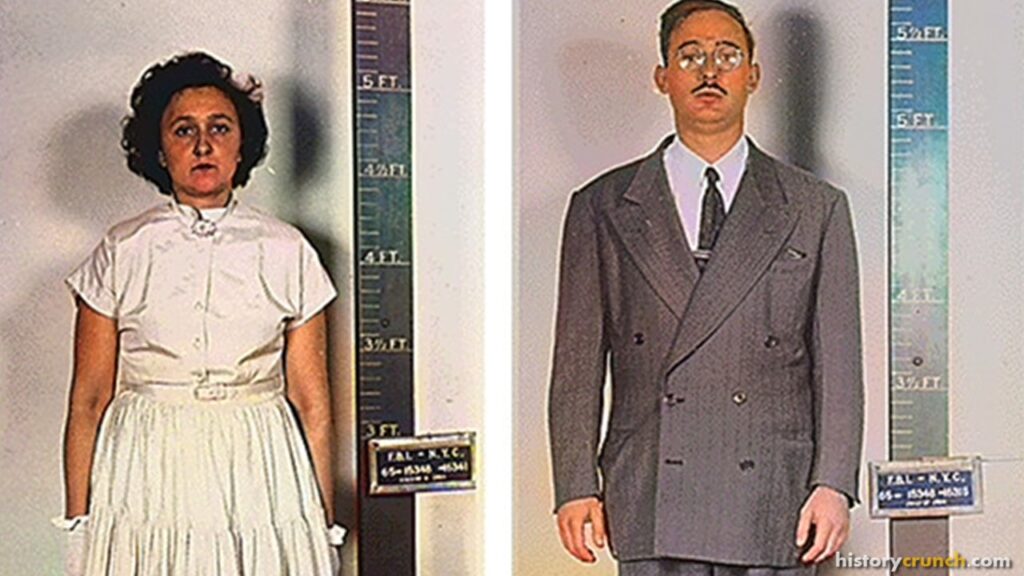 Evidence Photo
Espionage in the Cold War – Why?
Espionage was a key tool of the Cold War and helped both superpowers (the United States and the Soviet Union) in their policies to expand their influence. These countries conducted espionage against each other and other countries to get information on subjects such as military secrets, government secrets; or economic secrets.
Military Secrets – One country’s military secrets may be of interest to another, especially if the two countries have a history of conflict, (not being at peace and they may share a border). The military information may involve secret defense planning by a country’s military, its methods of operations, its personnel, its secret specialized equipment or weapons in use by that military, or the military’s capabilities in any location of the world.
Government Secrets – This may involve information about a government’s secret approach to another country or to specific issues like the environment or foreign spending. This may also involve the spy attempting to learn information about the country’s own intelligence service, its operations and personnel within that intelligence service, an example being the Russian Intelligence Service (SVR) may be interested in the people who are employed in the United States Central Intelligence Agency (CIA).
Economic Secrets – This may involve information within a company that is one of a kind or unique to the world. If that information is obtained by the spying country then the employment jobs and work generated from that information may go to another country. Countries spy on other countries (and the companies in that country) to get an economic advantage. Secondly, the company’s information may be used by the military and is secret due to its final use in the military. An example of this is the companies who produce the material used by the United States Air Force to make certain aircraft “stealth”. (This is a secret process used to make United States military aircraft invisible to radar). Companies in the United States may be providing the United States military with some of the elements that go into making an airplane invisible to radar.
FactsthatCrunchWhat kinds of secrets did Cold War spies try to steal, and why did each type matter?
Espionage in the Cold War – How?
During the Cold War both superpowers (and many other major nations) maintained government agencies related to espionage (spying) and intelligence gathering. For example, in the United States these functions were carried out by the Central Intelligence Agency (CIA). The CIA’s Cold War activities ranged from general surveillance of suspected foreign agents, to the deployment of agents abroad, to illicit operations like assassinations and human experimentation. The CIA also supported US foreign policy by providing support, funding and equipment to anti-communist leaders and groups abroad. The Soviet Union maintained its own agencies, most notably the KGB (Komitet Gosudarstvennoy Bezopasnosti, or ‘Committee for State Security’). The KGB assumed responsibility for both domestic security and foreign intelligence. Decades of experience, along with a greater preparedness to employ devious tactics, gave the Soviet Union a distinct ‘head start’ when it came to espionage. During World War II, Moscow prioritized the infiltrationSecretly entering an enemy organization or government to gather information from the inside. of the Manhattan Project, America’s nuclear weapons research program. Soviet agents were able to obtain and pass on technical information about this program, including blueprints, with remarkable ease.
The most effective way to gather information and intelligence about the enemy, (or potential enemy), is by infiltrating the enemy’s government. This is the job of the spy, (or an espionage agent). Spies can bring back all sorts of information concerning the size and strength of the other country’s military and its capabilities.
A country will attempt to recruit an ‘agent’ or person from another country. This recruited agent is called a ‘human sourceA recruited person from another country who provides secret information to a foreign intelligence service.’. A good human source is of great value to a country as he or she may be deeply involved in the other country’s intelligence service, military or access to secret information of an economic advantage.
Spying is also conducted by the interception of communications. Examples are telephone calls, e-mails, or text messages. Today, some countries now have the ability to conduct cyber espionageIllegally accessing another country’s secret computer databases and transferring that data to the attacking country. against another country. This is when access to restricted or secret computer data banks is illegally made. That information is then illegally transferred to the attacking country. This type of interception may be of a more general nature targeting another country’s specific government department or it may be targeted to a specific person.
Espionage has been going on for a number of years. In the 1960s the intense espionage activity between the United States and the Soviet Union and China involved nuclear weapons secrets. More recently espionage agencies have targeted the illegal drug trade and persons believed to be terrorists. Since 2008 the United States has charged at least 57 people for attempting to spy for China.
FactsthatCrunchWhat made the CIA and KGB such dangerous rivals during the Cold War?
Espionage in the Cold War – Examples
There were several examples of espionage and spying during the years of the Cold War and for the purposes of one superpower trying to gain an advantage over the other.
For example, in 1951, Jewish-Americans Julius and Ethel Rosenberg were tried and convicted of espionage against the government of the United States for stealing and providing secret information to the Soviet Union. The information was about American military secrets and may have included information about American advancements in the development of the atomic bomb. Julius Rosenberg was an electrical engineer who worked for the Army Signal Corps, which allowed him access to technical information and to other people who were working on military related projects. After being discovered, Julius and Ethel underwent a very public trial which ended with their execution for “anti-American” activities. The couple became the only American civilians to be executed for espionage in the United States during the Cold War.
Next, was the U-2 Spy Plane Incident, which occurred in May of 1960, when an American U-2 spy aircraft that was piloted by Francis Gary Powers was shot down by the Soviet Union while flying a high-altitude surveillance mission over Soviet territory. The United States initially claimed it was a weather research plane, but the Soviets revealed they had captured Powers alive and recovered surveillance equipment from the crashed plane. The incident was significant and caused a major international embarrassment for the United States. More specifically, the U-2 Spy Plane Incident intensified Cold War tensions between the two superpowers and exposed the extent of espionage operations conducted by both sides.
Another and very damaging case of espionage in United States history was the John Walker spy ring, which operated from 1967 to 1985. John Walker Jr. and his son, Michael L. Walker, brother, Arthur J. Walker, and friend, Jerry A. Whitworth, supplied the country of the Soviet Union, (now Russia) with secret United States information including codes from the U.S. Navy that allowed the Soviets to learn of over a million Navy messages. The Walker ring also sold the Soviets classified material concerning the Soviet shooting of a Korean Airlines jet in 1983 and U.S. military offensives during the Vietnam War. John Walker pleaded guilty to espionage and was sentenced to a life term in prison. Michael Walker pleaded guilty and was sentenced to twenty-five years in prison. Arthur Walker was convicted and sentenced to a life term in prison. Jerry Whitworth received a sentence of 365 years for stealing and selling Navy coding secrets. The Walker spy ring cost the United States a lot of damage and money. The United States had to spend over a billion dollars to rebuild their entire communications system.
A final example of a very damaging spy to the United States was the case of Mr. Aldrich Ames. He was employed in the United States Central Intelligence Agency but was recruited by the Soviet Union and sold secret information to them from 1985 to 1994. Ames was later determined to have been responsible for the execution of about a dozen (12) agents spying for the United States. These were persons employed with the government of the Soviet Union who were recruited as spies by the United States. Ames had told the Soviets the identities of all these spies. Ames had received over 2 and a half million dollars from the Soviets for his secret information. He was sentenced to life in prison.
FactsthatCrunchWhy did Soviet agents target the Manhattan Project during World War II?
Espionage in the Cold War – Significance
Espionage was significant in the Cold War for several main reasons. First, it allowed both the United States and the Soviet Union to gather critical intelligence without engaging in direct military conflict. This was an important aspect of the Cold War, because both superpowers had access to atomic weaponry and the fear of nuclear warfare was ever present. Second, espionage in the Cold War fueled distrust and paranoia, which helped shape key foreign policy decisions and intensified tensions between the superpowers. For instance, spy operations influenced major events, such as the Cuban Missile Crisis, and contributed to the development of advanced technologies in surveillance and code-breaking. Finally, it also extended into propagandaInformation spread by a government to shape public opinion and influence political outcomes in its favor. and psychological warfare, aiming to manipulate public opinion and political outcomes.
Overall, espionage was an important aspect of the Cold War and influenced many of the most significant events in the Cold War.
FactsthatCrunchFollow the chain from top to bottom. Tap any step to read what happened.
Key Vocabulary
Espionage
Covert operations
Infiltration
Human source
Cyber espionage
Surveillance
Propaganda
Frequently Asked Questions
What was espionage during the Cold War?
Espionage during the Cold War was the secret gathering of information between the United States and the Soviet Union. Both superpowers used spies, surveillance, and code-breaking to gain an advantage. They wanted military, government, and economic secrets without going to war directly. This spying lasted for most of the Cold War, from about 1945 until 1991.
What agencies handled spying for each superpower?
The United States used the Central Intelligence Agency (CIA), while the Soviet Union relied on the KGB. The CIA ran surveillance, placed agents abroad, and supported anti-communist groups and leaders. The KGB handled both domestic security and foreign intelligence for the Soviets. Years of experience gave the Soviet Union an early advantage in spying.
Who were Julius and Ethel Rosenberg?
Julius and Ethel Rosenberg were American citizens convicted of passing secret information to the Soviet Union. The information may have included details about the atomic bomb. Julius was an electrical engineer who worked for the Army Signal Corps. After a very public trial, the couple were executed, becoming the only American civilians executed for espionage during the Cold War.
What happened in the U-2 Spy Plane Incident?
In May of 1960, the Soviet Union shot down an American U-2 spy plane flown by Francis Gary Powers. The United States first claimed it was a weather research plane. The Soviets then revealed they had captured Powers alive and recovered his surveillance equipment. The event caused major embarrassment and raised Cold War tensions.
Who was Aldrich Ames?
Aldrich Ames was a CIA employee who sold secrets to the Soviet Union from 1985 to 1994. He was blamed for the execution of about a dozen agents who were spying for the United States. He exposed their identities to the Soviets for over two and a half million dollars. Ames was later caught and sentenced to life in prison.
Why was espionage so important in the Cold War?
Espionage let both superpowers gather key information without fighting a direct war. This mattered because both sides had nuclear weapons, and the fear of nuclear warfare was constant. Spying also fueled distrust and paranoia, which shaped foreign policy choices. It influenced major events like the Cuban Missile Crisis and advanced surveillance technology.
Cite This Article
To cite this article as a source, use one of the formats below.
MLA: Beck, Elias. “Espionage in the Cold War: A Detailed Summary.” HistoryCrunch, 13 October 2026, https://historycrunch.com/espionage-in-the-cold-war/.
APA: Beck, E. (2026). Espionage in the Cold War: A Detailed Summary. HistoryCrunch. https://historycrunch.com/espionage-in-the-cold-war/
Chicago: Beck, Elias. “Espionage in the Cold War: A Detailed Summary.” HistoryCrunch. October 13, 2026. https://historycrunch.com/espionage-in-the-cold-war/
Sources
- Vladislav Zubok, A Failed Empire.
- Odd Arne Westad, The Global Cold War.
- State Department — Office of the Historian
- John Lewis Gaddis, The Cold War: A New History.