Domino Theory in the Cold War: A Detailed Summary

Domino Theory in the Cold War
The domino theory was a Cold War era belief popular within the United States from the 1950's until the end of the Cold War. It was premised on the concept of containment, which was a popular view of American foreign policy at the time.

Table of Contents

The domino theory was a Cold War belief that if one country fell to communism, neighboring countries would soon follow, like a row of falling dominoes. This article details the history and significance of the domino theory in the Cold War.

The domino theory was a Cold War era belief popular within the United States from the 1950’s until the end of the Cold War. It was premised on the concept of containment, which was a popular view of American foreign policy at the time. Essentially, it promoted the idea that the spread of communism should be stopped at all costs. For instance, the domino theory was the idea that the first domino should be prevented from tumbling in order to save the others.

DOMINO THEORY IN THE COLD WAR – SUMMARY

The Cold War was a major world event that took place from approximately 1945 until 1990.  In general, the Cold War was a period of increased tensions and hostility between the superpowers of the United States and the Soviet Union (USSR). Based on the Truman Doctrine and American containment, the theory held the idea that if Soviet communism was able to spread into a single country, then it had the potential to spread to all of the other surrounding countries.  The basic idea was that the American’s needed to prevent the first domino from falling (country turning to communism) in order to prevent the spread of communism.  American containment was based on stopping communism any place it spread to, and as such, the domino theory helped explain the perceived need for the United States’ involvement in international issues.

​For example, the domino theory was used to justify American involvement in both the Korean War and Vietnam War from the 1950’s to the 1970’s.  Both countries are in the South Pacific and both saw Soviet-style communism spread into their political systems.  The Korean War first occurred in the 1950’s and saw the country divide between a communist north and democratic south.  The United States eventually became involved in the conflict, supporting South Korea on the basis of the domino theory, fearing that Korean communism would spread throughout the rest of the South Pacific.

American involvement in Vietnam in the 1960’s and 1970’s was very similar to the earlier Korean War, as the country divided between a communist north and democratic south.  Again, the United States became involved fearing that a communist Vietnam would help spread communism throughout the rest of the South Pacific.

In the end, the domino theory was important because it explained American foreign policy at the time and saw the United States become involved in two major wars.​  As well, both wars saw the United States struggle and cost the lives of thousands of American soldiers. As such, historians have called into question the validity of the domino theory in the Cold War, in terms of its effectiveness as a foreign policy.
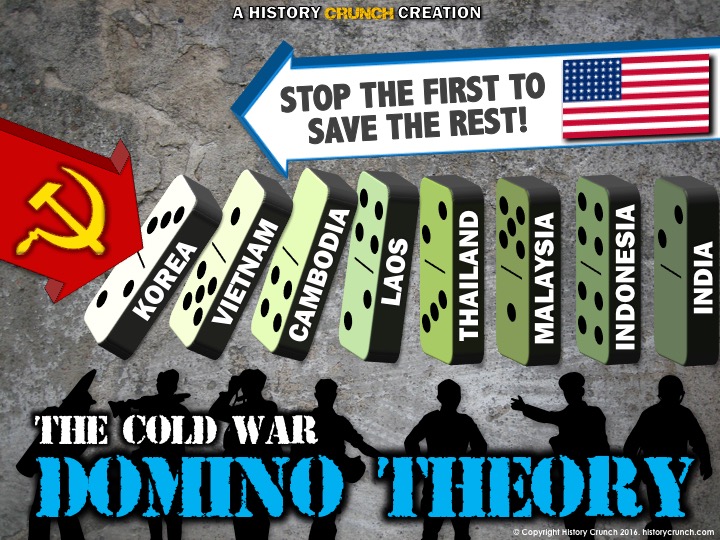

Domino Theory in the Cold War Infographic
Domino Theory in the Cold War Infographic by History Crunch
Facebook
X
Reddit
Pinterest
LinkedIn

We strive to produce educational content that is accurate, engaging and appropriate for all learners. If you notice any issues with our content, please contact us and let us know!

AUTHOR INFORMATION
Picture of Elias Beck

Elias Beck

I'm a passionate history and geography teacher with over 15 years of experience working with students in the middle and high school years. I have an Education Degree with a focus in World History. I have been writing articles for History Crunch since 2015 and love the challenge of creating historical content for young learners!
Impacts of the Cold War
Cold War

Impacts of the Cold War: A Detailed Summary

The impacts of the Cold War included the nuclear arms race, the space race, decolonization, proxy wars, and the eventual collapse of the Soviet Union. This article details the main impacts of the Cold War.

Marxism
Political Systems

Marxism: A Detailed Summary

In the early 20th century, Marxism inspired revolutions, most notably the Russian Revolution of 1917, which established the world’s first communist state under Vladimir Lenin. This article details the history, main principles and significance of Marxism.

Richard Nixon
Cold War

Richard Nixon: A Detailed Biography

Richard Nixon served as the 37th president of the United States from 1969 to 1974. He is remembered for major foreign policy actions, including opening relations with China, but his presidency ended in scandal with the Watergate Crisis. This article details the life and significance of Richard Nixon.

Gerald Ford
Cold War

Gerald Ford: A Detailed Biography

Gerald Ford was significant because he became president during the Watergate crisis and tried to steady the United States after one of the most difficult moments in modern American political history. This article details the life and significance of Gerald Ford.

Lyndon B. Johnson
Vietnam War

Lyndon B. Johnson: A Detailed Biography

Lyndon B. Johnson was the 36th president of the United States, following the assassination of John F. Kennedy. He served as president during the height of the Vietnam War. This article details the life and significance of Lyndon B. Johnson.

Anti-War Protests of the Vietnam War
Vietnam War

Anti-War Protests of the Vietnam War: A Detailed Summary

Anti-war protests of the Vietnam War were important because they exposed deep disagreements in the United States over foreign policy, military service, morality, race, class and the power of government. This article details the history and significant of the anti-war protests of the Vietnam War.