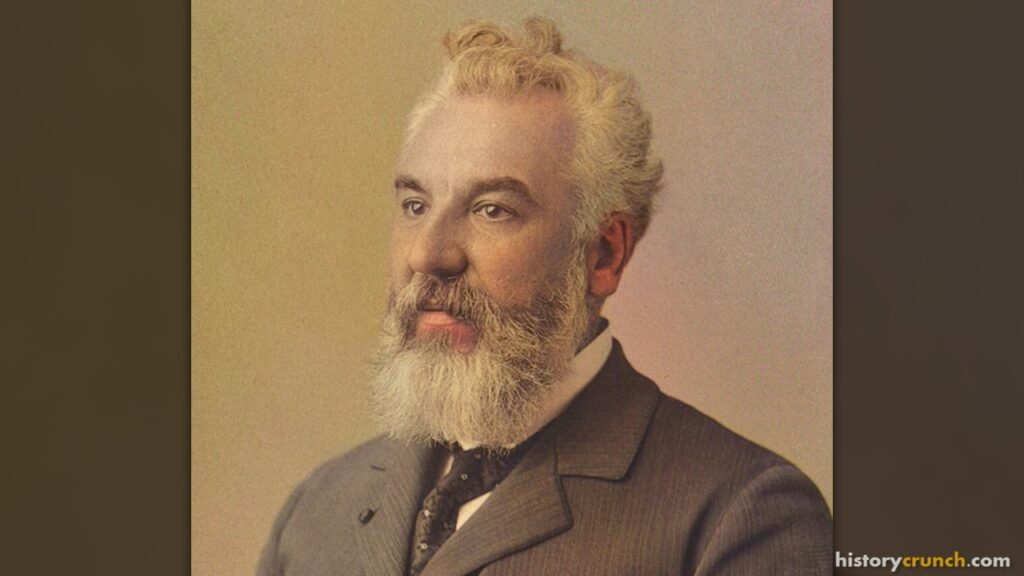
Alexander Graham Bell is one of the most significant figures in history in terms of innovation and invention. More specifically, he played an important role in the development of the late Industrial Revolution in both North America and Europe. For instance, he is best remembered today for the invention of the first telephone. He was also a successful entrepreneur and co-founded the Bell Telephone Company, which set up the American Telephone and Telegraph Company (AT&T) in 1885.
 FactsthatCrunch
Bell secured the first telephone patent in 1876 and founded the Bell Telephone Company in 1877, whose long-distance arm, AT&T, was formed in 1885. Beyond the telephone, he taught deaf children using his Visible Speech system, developed an audiometer to detect hearing problems, and held 18 patents in his own name along with 12 more with collaborators.
Alexander Graham Bell – Early Life
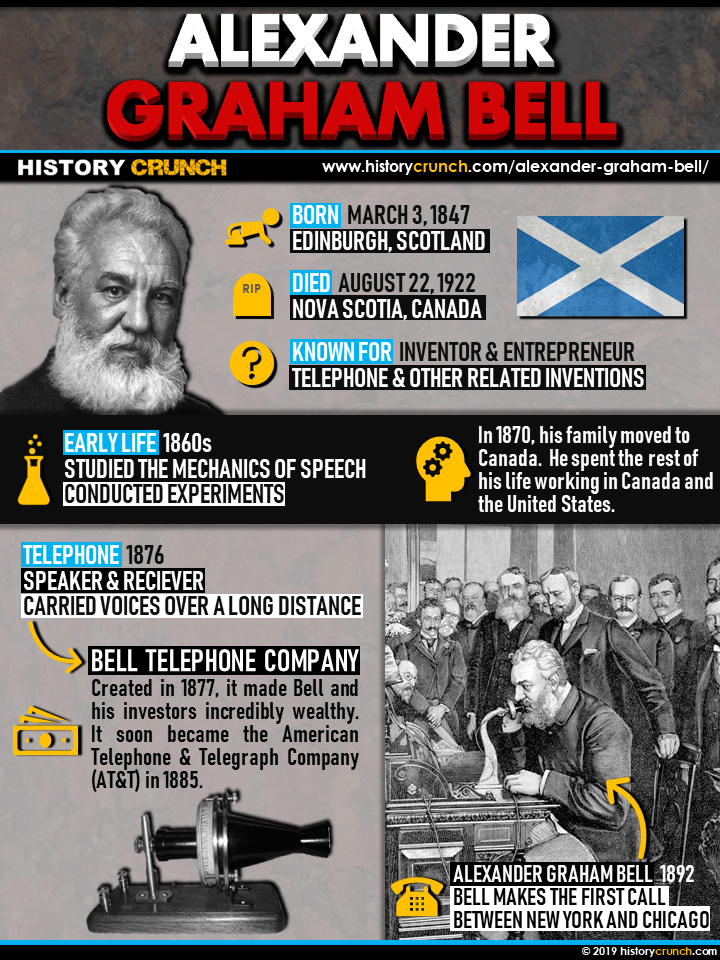
Alexander Graham Bell was born on March 3rd, 1847 in Edinburgh, Scotland. He was curious and inventive even from a young age. For example, he supposedly invented a device when he was just twelve years old, which helped de-husk wheat. The device was built from nail brushes and was used on the farm of a family friend for years after. Bell went to school in Edinburgh and London, England. In his studies he showed an interest in manners of speech. This was similar to his father, Alexander Melville Bell, who worked as a phoneticianA scientist who studies human speech sounds and how language is produced.. A phonetician is someone who studies human speech and linguistics. After finishing school, Alexander Graham Bell also started researching the mechanics of speech. Throughout the 1860s, Bell studied and worked on experiments related to speech patterns and devices related to this topic. Some of his experiments focused on the use of electricity and he studied uses of the automation that were occurring across Europe at the time.
FactsthatCrunchAs teenagers, Bell and his brother Melville built a talking head that could say "Mama."
Their father challenged the boys to build a speaking machine. They modeled a head with a throat, tongue, and lips out of rubber, cotton, and other simple materials, then blew air through it. It made the word "Mama" so clearly that neighbors reportedly thought a baby was crying. The project started Bell's lifelong interest in how speech works.
Alexander Graham Bell – Early Experiments
In 1870, Bell and his family moved to Canada. They purchased a farm in Ontario, Canada. While here, Bell continued studying and carried out more experimentation with sound and electricity. His experiments focused on sending sounds across large distances. However, just the next year, Bell moved to the United States in order to teach. While there, he worked with deaf children and taught using a system called Visible SpeechA set of symbols showing mouth position for different sounds, used to help deaf children learn to speak., created by his father. Simply put, it was a set of symbols that showed the position of the mouth when different sounds were made. It was used mostly to help deaf children learn to speak. He continued to work on his own experiments at this time. For instance, Bell specifically worked on a project related to ‘harmonic telegraphA concept for sending multiple sound messages through one wire, each at a different pitch.’. The concept of this project was that sound messages could be sent through a single wire if each message was transmitted at a different pitch. However, he did not have the system perfected and continued with his experiments.
FactsthatCrunchAlexander Graham Bell – Invention of the Telephone
After a number of years of teaching, Bell was appointed professor of vocal physiology at Boston University in 1873. Throughout these years, he worked in Boston but would often return to the family farm in Canada during the summer months. While at the university he acted on his fascination with transmitting speech, and in 1875 he developed a receiver that could turn electricity into sound. Called ‘acoustic telegraphyAn early device Bell built in 1875 that could turn electricity into voice-like sounds carried over wires.’, the device allowed voice-like sounds to be heard across wires. While, not yet delivering clear voices across the wires, the device proved to Bell that the technology was viable. Bell quickly raced to get the acoustic telegraph patented in 1875. In the meantime, he continued to experiment and quickly worked to develop the first working telephone.
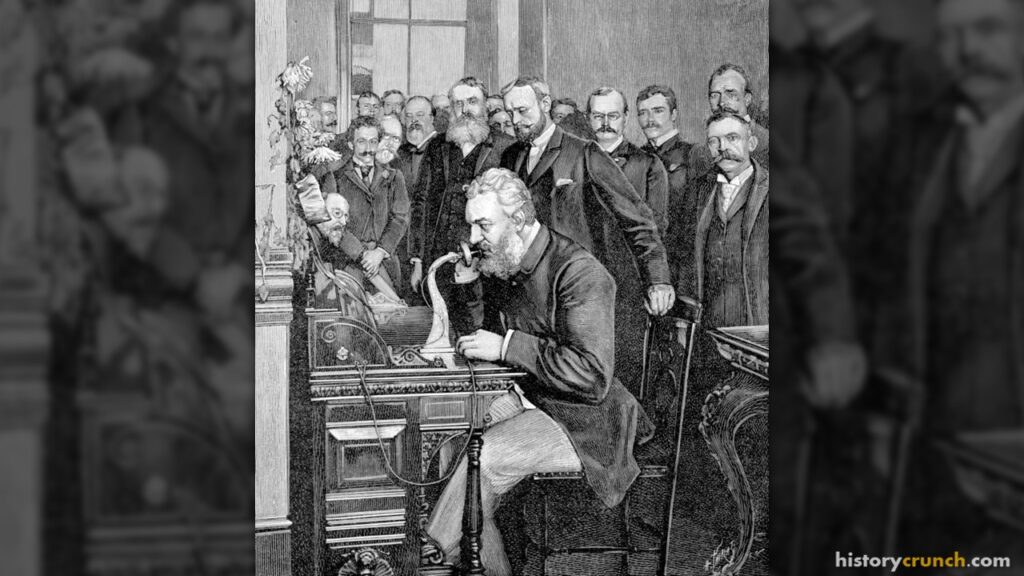
At the time, there was intense competition with other inventors, who were working on similar technology. For example, American engineer Elisha Gray had developed a prototype of a telephone model in 1876. In fact, some historians suggest that Gray should be credited with developing the first telephone. Others even accuse Bell of stealing the basic design elements of his own telephone design from Gray. Regardless, Alexander Graham Bell obtained the credit for the invention because he was the first to secure the patentAn official government right giving an inventor sole legal credit and control over their invention. in 1876. In fact, on March 10th in 1876, three days after his patent was issued, Bell performed a successful test of his then current telephone design. The test involved Bell stating “Mr. Watson—Come here—I want to see you” in reference to Thomas Watson, an assistant to Bell at the time.
Following this initial test of his design, Bell carried out a more extensive test on his family farm near Brantford, Canada on August 3rd, 1876. He had run a wire crudely along fences and telegraph posts over a stretch of about five miles (eight kilometers) from Brantford to his home. When setup, Bell was able to hear people on the other end of the line in Brantford. The test proved the ability of his telephone design to carry voices over long distances.
 FactsthatCrunch
What did Alexander Graham Bell secure in 1876 that gave him credit for the telephone over rival inventors?
Alexander Graham Bell – Bell Telephone Company
Following these tests, Bell worked hard to improve and perfect his telephone and the technology behind it. In fact, the Bell Telephone Company was created in 1877, and it made Bell and his investors incredibly wealthy. The company continued developing the telephone and installed wires all across the United States. In fact, through a series of different mergers the original Bell Telephone Company eventually became the American Telephone and Telegraph Company (AT&T) in 1885. These mergers gave the company access to more lines and allowed people to make long-distance phone calls. For example, Bell made the first transcontinentalCrossing an entire continent from one side to the other. telephone call in January of 1915. He made the call from an AT&T office in New York City and called his assistant, Thomas Watson, in San Francisco, California.
At the time, The New York Times reported the following of the test:
“On October 9, 1876, Alexander Graham Bell and Thomas A. Watson talked by telephone to each other over a two-mile wire stretched between Cambridge and Boston. It was the first wire conversation ever held. Yesterday afternoon [on January 25, 1915], the same two men talked by telephone to each other over a 3,400-mile wire between New York and San Francisco. Dr. Bell, the veteran inventor of the telephone, was in New York, and Mr. Watson, his former associate, was on the other side of the continent.”
FactsthatCrunchAlexander Graham Bell – Later Life
Bell was naturalized as an American citizen in 1882 and soon after, using prize money from France’s Volta Prize, Bell founded the Volta laboratory to enable the experiments in communication, and techniques for teaching speech to the deaf to continue. He worked with Helen Keller and other important teachers at the time. He was also interested in the field of aviation and in 1885 Bell bought land in Nova Scotia to allow him to experiment outside. Following this acquisition, Bell became more and more interested in geography and in 1888 he was one of the founding members of the National Geographic Society.
FactsthatCrunchAlexander Graham Bell – Death and Legacy
Although he is best remembered for the invention and development of the telephone, Bell was interested in many other topics and invented or worked on several other innovations. For instance, he is said to have created a metal device that was worn as a jacket that helped the person wearing it to breathe. As well, he developed an audiometerA device Bell developed to detect minor hearing problems in people. to detect minor hearing problems. As such, Bell is credited with several inventions and held 18 patents in his own name and another 12 with people that he collaborated with.
Alexander Graham Bell died on August 2nd, 1922 in Nova Scotia, Canada. At the time he was 75 years old and suffering from complications related to diabetes. Today, he is best remembered as the inventor of the modern telephone. His invention transformed life for people around the world and led to greater communication over long distances.
FactsthatCrunchAfter Bell's patent was granted in 1876, the Bell Telephone Company had to defend it in court about 600 times over the next two decades.
Western Union, which owned telephone designs by Elisha Gray and Thomas Edison, fought Bell in court before settling in 1879. Many other rivals kept suing. In 1888 the U.S. Supreme Court upheld Bell's patent, and the company used it to become the leading telephone provider in the United States.
Alexander Graham Bell – Infographic
Industrial Revolution timeline · 1760 – 1840
Key Vocabulary
Phonetician
Visible Speech
Harmonic telegraph
Acoustic telegraphy
Patent
Transcontinental
Audiometer
Frequently Asked Questions
Who was Alexander Graham Bell?
Alexander Graham Bell was an inventor best known for creating the first telephone. He was born in Edinburgh, Scotland, on March 3rd, 1847, and later worked in Canada and the United States. He was also an entrepreneur who helped build the company that became AT&T. His work changed how people communicate over long distances.
When did Alexander Graham Bell invent the telephone?
Bell secured the telephone patent in 1876, which earned him credit for the invention. On March 10th, 1876, he made his first successful test by telling his assistant, “Mr. Watson, come here, I want to see you.” A larger test soon followed near Brantford, Canada, over about five miles (8 km) of wire.
Did Alexander Graham Bell really invent the telephone first?
Bell got the credit because he was the first to file a successful patent, in 1876. However, American engineer Elisha Gray was working on very similar technology at the same time. Some historians argue that Gray should share or receive the credit. A few even claim Bell borrowed design ideas from Gray.
What else did Alexander Graham Bell do besides the telephone?
Bell worked on many projects beyond the telephone throughout his life. He taught deaf children using Visible Speech, a system created by his father, to help them learn to speak. He also studied aviation, built an audiometer to detect hearing problems, and helped found the National Geographic Society in 1888. In total, he held 18 patents on his own.
How did the Bell Telephone Company become AT&T?
The Bell Telephone Company was created in 1877 and made Bell and his investors very wealthy. In 1885 the Bell company set up the American Telephone and Telegraph Company, or AT&T, to build long-distance lines, and AT&T later became the parent company of the whole Bell system. Bell made the first transcontinental call in January of 1915.
When and where did Alexander Graham Bell die?
Alexander Graham Bell died on August 2nd, 1922, in Nova Scotia, Canada. He was 75 years old and suffered from complications related to diabetes. He is remembered most for the telephone, which transformed communication worldwide. His many other inventions and interests also left a lasting mark.
Cite This Article
To cite this article as a source, use one of the formats below.
MLA: Beck, Elias. “Alexander Graham Bell: A Detailed Biography.” HistoryCrunch, 26 September 2026, https://historycrunch.com/alexander-graham-bell/.
APA: Beck, E. (2026). Alexander Graham Bell: A Detailed Biography. HistoryCrunch. https://historycrunch.com/alexander-graham-bell/
Chicago: Beck, Elias. “Alexander Graham Bell: A Detailed Biography.” HistoryCrunch. September 26, 2026. https://historycrunch.com/alexander-graham-bell/
Sources
- Fordham Modern History Sourcebook
- Joel Mokyr, The Enlightened Economy.
- Emma Griffin, A Short History of the British Industrial Revolution.
- Robert C. Allen, The Industrial Revolution: A Very Short Introduction.