
The Black Death is the plague pandemic that reached Europe in 1347 and killed about half of everyone in it within four years, the largest share of a population any disaster has ever taken. It came out of Asia along the trade routes, arrived on Genoese ships at Sicily, and went round Europe in a circle to Russia. Then it came back, again and again, for nearly four hundred years. This timeline runs from the first plague pandemic under Justinian in 541 to the discovery of the cause in 1894 and a cure in 1947, and two of its eight chapters have no dates in them at all, because they are about how the plague moved and what living through it was like.
From the Plague of Justinian in 541 to a cure in 1947.
The Black Death is the plague pandemic that reached Europe in 1347 and killed about half of everyone in it within four years, the largest share of a population any disaster has ever taken. It came out of Asia along the trade routes, arrived on Genoese ships at Sicily, and went round Europe in a circle to Russia. Then it came back, again and again, for nearly four hundred years. This timeline runs from the first plague pandemic under Justinian in 541 to the discovery of the cause in 1894 and a cure in 1947, and two of its eight chapters have no dates in them at all, because they are about how the plague moved and what living through it was like.
A bacterium, a flea, a rat and a person. It took until 1894 to work that out.
The biology, in five cards.
Between a third and half of Europe in four years. No war has come close.
Crowding, filth, ignorance and a disease nobody had seen for six hundred years.
Nobody in 1348 called it that. They said the Great Mortality, or just the Pestilence.
Names, swellings and a mistranslation.
Fifteen years across Asia by caravan, then four years across Europe by ship.
Hebei, Issyk-Kul, Caffa, Messina, Marseille, Paris, Melcombe.
Every route that made Europe rich in 1340 carried the plague in 1348.
The Silk Road, the Mongol peace, the crusaders' ships and the ports.
One chronicler says so. He was in Italy at the time.
A famous story, and what the evidence for it actually is.
Historians used to say China. Now some say Central Asia. The gravestones are the clue.
Hebei, Issyk-Kul and the argument.
You would have known someone who died. Probably most of the people you knew.
Symptoms, fear, funerals and the bodies in the street.
Bleeding, incense, crushed emeralds, a dried toad. And a mask with a beak.
Medieval medicine meets a disease it cannot see.
Priests died at the bedsides. The pope hid between two fires. The flagellants marched.
Faith under a disease that killed the faithful.
The Decameron, the Dance of Death, the ghost ship at Bergen, the corpses over the walls of Caffa.
Fact, legend and the space between.
The planets, God, bad air, and the Jews. Only one of those could be burned.
From Strasbourg to the pope's letter.
Five hundred and fifty years after Messina, in a hut in Hong Kong.
From the Paris faculty's planets to Yersin's microscope.
If the plague was God's punishment, then punishing yourself first might turn it away.
The logic of the flagellants, and why the pope banned them.
Half the workers dead. The other half suddenly worth twice as much.
The Ordinance of Labourers to the end of serfdom.
France in 1358, Florence in 1378, England in 1381. Different countries, one cause.
The Jacquerie, the Ciompi and the Peasants' Revolt.
The first great book of the Renaissance is about escaping the plague.
Boccaccio, Petrarch, Florence and the shortage of people.
The Dance of Death was painted on church walls all over Europe.
From Tournai's coffins to Bruegel's army of the dead.
Fewer people, higher wages, cheaper land, angrier peasants, and a Church with less authority.
The world of 1400.
Half the workers dead meant half the men dead. Somebody had to do the work.
Widows, wages and guilds.
1361, 1369, 1374, 1630, 1665, 1720. The Black Death was the first of a series.
From the children's plague to Marseille.
Ragusa worked it out in 1377. It took another 517 years to find out why it worked.
Thirty days, then forty, then a village that shut its own gates.
Eyam shut its own gates in 1666 so the plague would not spread. About a third of it died.
One village, one decision.
Eight hundred years earlier the same disease emptied Constantinople and stopped Rome's comeback.
The Plague of Justinian, 541 to 750.
Sicily in October 1347. Russia in 1351. Everything between them happened in 1348.
Italy, France, England, Spain and the Muslim world in a single year.
A king's daughter died. A pope hid. A parliament passed a law nobody obeyed.
Power against a disease.
They made the roads safe. The plague used them.
The Pax Mongolica and its price.
Nobody was counting. The numbers come from wills, rent rolls, church records and graves.
Evidence for a death toll.
Half the city in 1348. A fifth of it in 1665. Then the fire.
One city, two plagues, three centuries.
Same bacterium, same route, eight hundred years apart.
541 and 1347 side by side.
Eight hundred years before the Black Death, the same disease came up the grain routes from Egypt and emptied Constantinople, the largest city in the world, at a rate one eyewitness put at 10,000 dead a day. The emperor Justinian caught it and lived; his plan to put the Roman Empire back together did not. It came back in waves for two centuries and then vanished from Europe for six hundred years, which was long enough for everyone to forget it had ever existed.
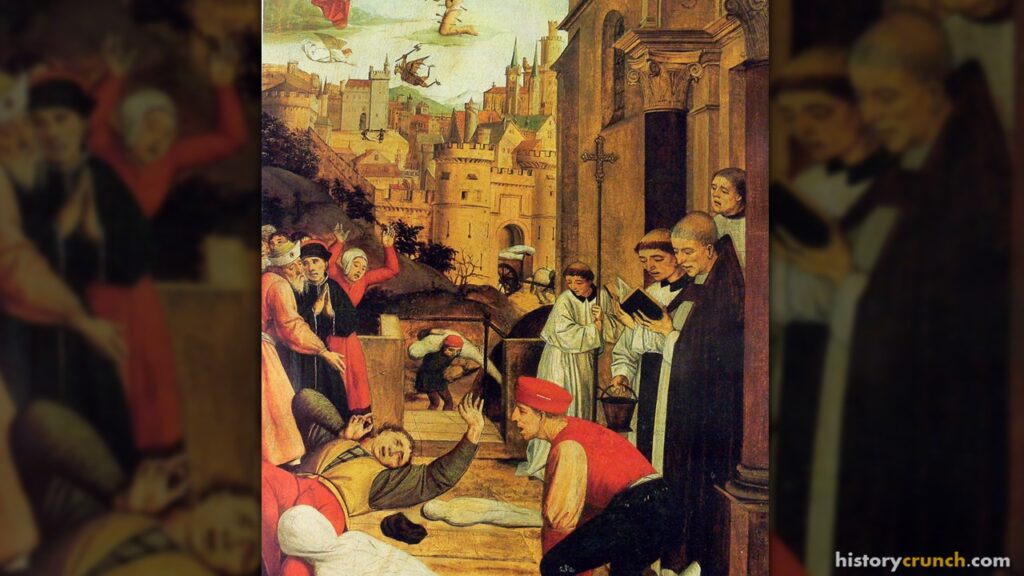
The first recorded outbreak occurred in the port city of Pelusium in 541 CE. It had come up from the Red Sea or the Nile along the grain and spice routes, and it moved with the grain ships.
LEARN MORESHOW LESSwhy it mattersDISEASEThis is the same disease as the Black Death, eight hundred years earlier. Everything that happened in 1348 had already happened once, and nobody remembered.
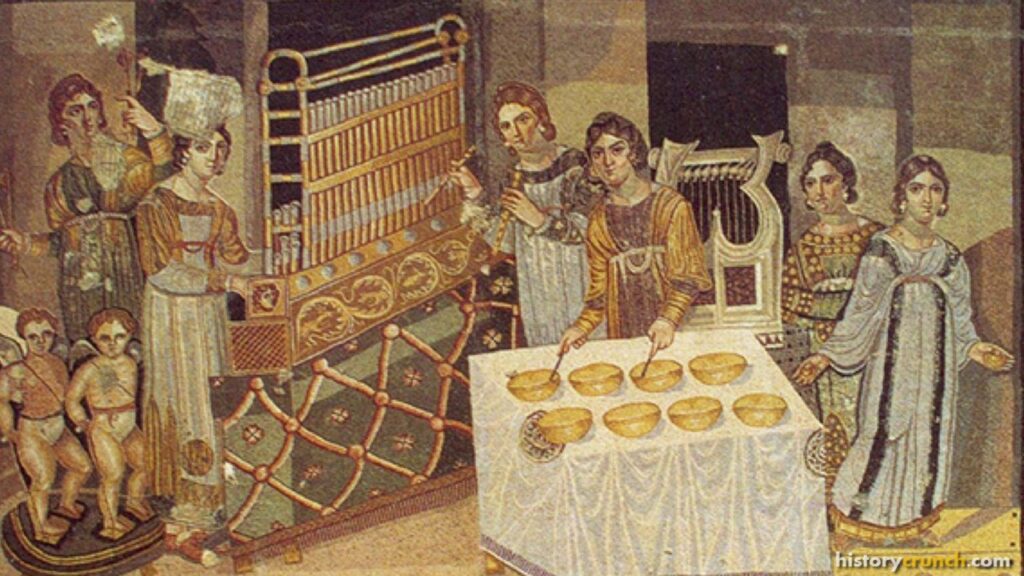
It hit the capital in 542 CE with devastating force. The historian Procopius, who was there, wrote that at its height the dead numbered 10,000 a day and the city ran out of places to bury them; bodies were piled in the towers of the walls.
LEARN MORESHOW LESSwhy it matters · key numbersDISEASEConstantinople was the largest city in the world. A disease that could empty it could empty anywhere, and over the next two centuries it did.
Justinian caught the plague and survived it, one of very few rulers in history to do so. Famine followed the disease in 542 and again in 545 and 546 CE, because the people who farmed were dead.
LEARN MORESHOW LESSwhy it mattersPOLITICSThe pattern the Black Death would repeat: the disease kills, and then the missing harvest kills again.
Justinian I reigned from 527 to 565 CE and had set out to reunite the old Roman Empire under his rule. He retook Italy, North Africa and part of Spain. The plague took the men and the taxes that would have held them.
LEARN MORESHOW LESSwhy it matters · a debatePOLITICSThe west was never Roman again. Historians argue that the map of medieval Europe was drawn by a bacterium as much as by any army.
Did the plague end the Roman Empire's comeback?
Yes. Justinian had retaken Italy and Africa; the plague cut the empire's population and tax income by a third, and there was no longer anything to hold them with.
No. The reconquest was overstretched before the plague came, and the Lombards and Persians would have taken the lands back anyway.
The plague returned in waves for more than two centuries, striking the empire and its neighbors again and again, until it faded around 750 CE. Then it vanished from Europe for six hundred years.
LEARN MORESHOW LESSwhy it mattersDISEASESix hundred years is long enough to forget. When the plague came back in 1347, no doctor, priest or king alive had any idea what it was.
This chapter has no dates in it. It is about the machinery: a bacterium that lives in rats and travels on fleas, three ways it can kill a person, and why the fourteenth century was the moment it could cross a continent. The Silk Road, the Mongol peace that made the roads safe, two centuries of crusading that put Italian ships in every eastern port, towns with no sanitation, and a Europe that had doubled its population and was already going hungry. Nobody understood any of it until 1894.
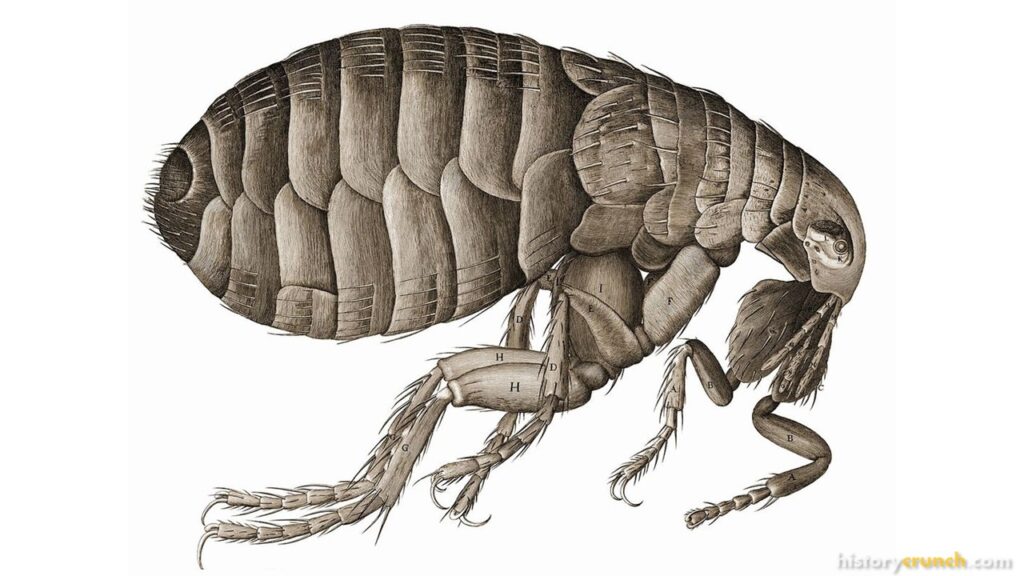
Yersinia pestis lives in the blood of wild rodents and moves between them on fleas. When a colony of rats dies, the hungry fleas bite whatever is nearest, and in a medieval town that was people. Nobody knew any of this until 1894.
LEARN MORESHOW LESSwhy it mattersDISEASEThe whole disaster comes down to a bacterium too small to see, carried by a flea too small to notice, on an animal everybody ignored.
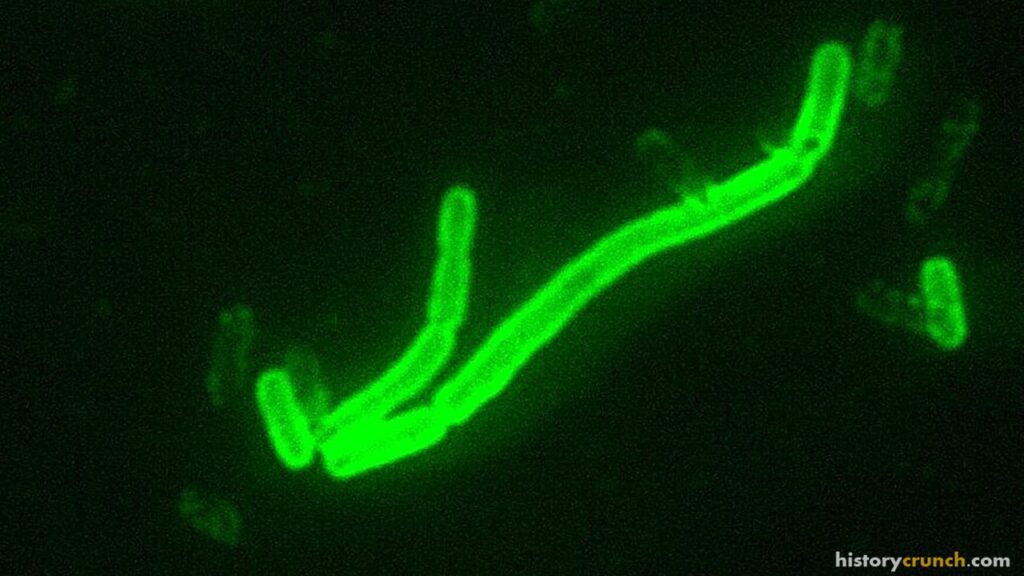
From a flea bite, bubonic plague swells the lymph nodes into buboes and kills about six people in ten within a week. If it reaches the lungs, as pneumonic plague, it spreads by coughing and kills nearly everyone within days. If it reaches the blood first, it can kill in a day, before any bubo appears.
LEARN MORESHOW LESSwhy it mattersDISEASEThe pneumonic form is why the plague spread so fast in winter, when fleas are sluggish. People were infecting each other directly, and nobody understood how.

The plague began in Central Asia and moved west along the caravan routes, in the fur, grain and rats that travelled with the goods. Every caravanserai on the road was a place where rats from one caravan met rats from the next.
LEARN MORESHOW LESSwhy it mattersTRADEThe routes that made the Middle Ages rich are the routes that nearly ended them. Trade and disease travel together, then and now.
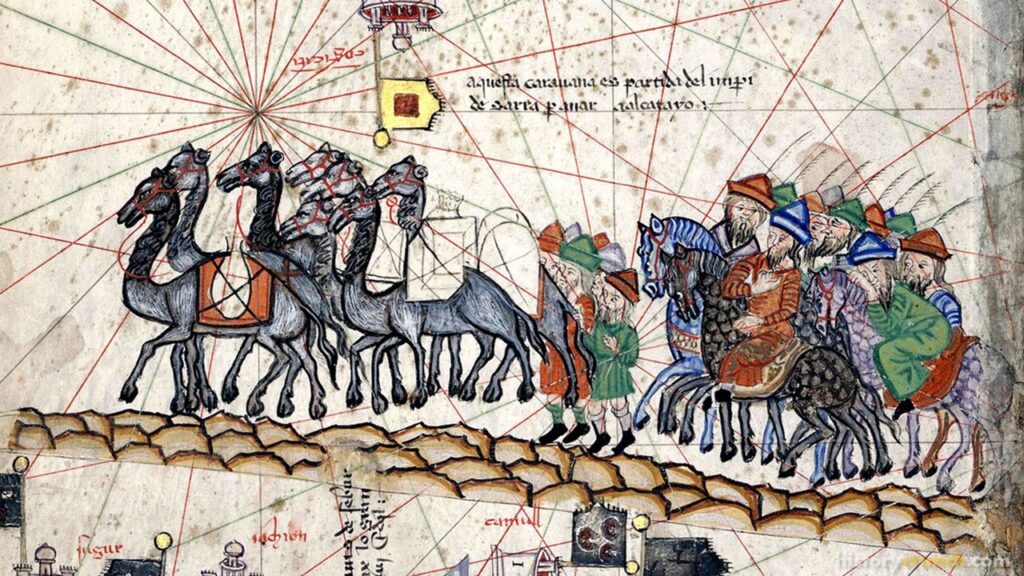
By 1300 one empire ruled from China to the Black Sea and kept the roads safe for merchants for the first time in centuries, the Pax Mongolica, the Mongol peace. Goods, people and the plague moved farther and faster than at any time before.
LEARN MORESHOW LESSwhy it mattersTRADEMarco Polo could walk to China because the Mongols had made the road safe. So could a flea.
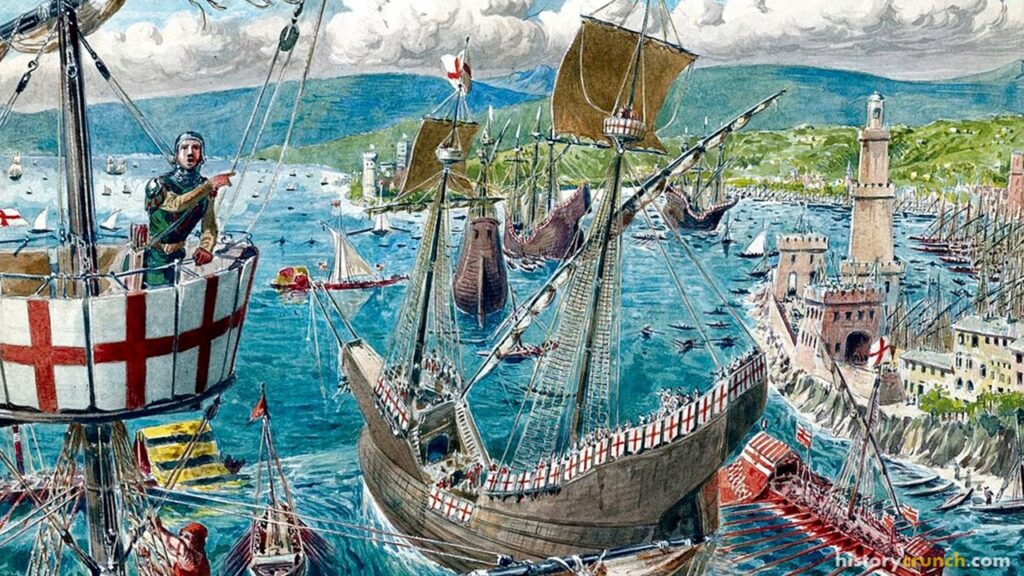
Two centuries of crusades had put Genoese and Venetian ships in every port from the Crimea to Alexandria. A merchant galley could carry rats from the Black Sea to Sicily in a few weeks, faster than any caravan.
LEARN MORESHOW LESSwhy it mattersTRADEThe plague crossed Asia in about fifteen years and Europe in about four. The difference was ships.
Medieval towns had no sanitation or running water. Human waste was dumped in the street, rats flourished on it, and crowded towns and cities were havens for the plague because they attracted the rodents that carried it.
LEARN MORESHOW LESSwhy it mattersLIFETowns were where the plague killed fastest. A village might lose a third; a port could lose two-thirds.
Europe's population had roughly doubled since the year 1000 and was farming poor land at the limit of what it could feed. The Great Famine of 1315 to 1317 had already killed perhaps a tenth of northern Europe.
LEARN MORESHOW LESSwhy it mattersLIFEHistorians argue about whether a hungry, crowded Europe died faster than a well-fed one would have. Either way, the plague found a continent with no margin left.
It was killing in China by 1331 and had left gravestones by a lake in Central Asia by 1338, fifteen years before a single European heard of it. In 1346 it struck a Mongol army besieging the Genoese port of Caffa in the Crimea, and Genoese ships fled west with it. In October 1347 twelve galleys with dying crews reached Messina in Sicily. Genoa drove its own ships off with burning arrows; Marseille let them in. By Christmas the plague was in France.
Chinese records describe an epidemic in Hebei province in 1331 that killed most of the population, and further outbreaks across the 1330s. This is the earliest evidence of the disease that became the Black Death.
LEARN MORESHOW LESSwhy it mattersDISEASEThe Black Death was an Asian disaster before it was a European one. It had been killing for fifteen years before a single European heard of it.
Christian gravestones near Lake Issyk-Kul, in what is now Kyrgyzstan, record an unusual number of deaths in 1338 and 1339, several of them 'of pestilence'. They are the earliest dated evidence of the plague on the road west.
LEARN MORESHOW LESSwhy it mattersDISEASEA few carved stones by a mountain lake are the first footprint of the pandemic. From here the trade routes run west to the Black Sea.
A Mongol army besieging the Genoese trading port of Caffa in the Crimea was struck by plague. The chronicler Gabriele de Mussis wrote that the Mongols catapulted their dead over the walls. Genoese ships fled the port and carried the disease west.
LEARN MORESHOW LESSwhy it matters · a debateWARWhether or not the catapult story is true, this is where the plague met the ships. The traders on the first ship to reach Sicily had come from here.
Was Caffa the first biological weapon?
Yes. De Mussis describes the Mongols deliberately throwing plague corpses into the city to infect it, and the plague reached Europe on ships from Caffa.
No. De Mussis was not there, corpses do not spread bubonic plague, and rats crossing the siege lines would have carried it in regardless. The plague was already in the region.
The plague reached Constantinople from the Black Sea in the spring of 1347. The emperor's thirteen-year-old son died of it; the emperor, John VI, later wrote his own account of the city's suffering.
LEARN MORESHOW LESSwhy it mattersDISEASEThe same city the first pandemic had emptied in 542. This time it was one stop on the road, not the end of it.
In October 1347 Genoese ships arrived in Sicily with dying crews. The merchants were suffering fever, black swellings that oozed blood and pus, and vomiting. Messina drove the ships out of the harbor, but too late: the plague was ashore.
LEARN MORESHOW LESSwhy it mattersDISEASEThis is the moment the Black Death enters Europe, and the moment every later quarantine law was trying to prevent.
Genoa refused its own returning galleys, driving them off with burning arrows. They sailed on to Marseille, which took them in. By Christmas the plague was in southern France and spreading along the trade routes.
LEARN MORESHOW LESSwhy it mattersDISEASETurning a ship away did not work, because the rats had already gone ashore. The cities that survived best were the ones that traded least.
One year. Pisa and Venice in January, Florence in March, where Boccaccio watched citizen avoid citizen and parents abandon their children. The pope at Avignon sat between two fires and lived. Paris in the summer, where half the city died and the doctors blamed the planets. England in June, London by November, half of it dead by spring. A princess died on the way to her wedding. The pope wrote that the Jews were not to blame, and Cairo and Damascus died as hard as anywhere in Europe.
In January 1348 there was a major outbreak in Pisa, which opened the road into northern Italy. Venice, the richest port in Europe, was hit the same month and lost perhaps 60 percent of its people over the next eighteen months.
LEARN MORESHOW LESSwhy it mattersDISEASEItaly was the trading heart of Europe, and the plague went where the trade went. From here every road led north.
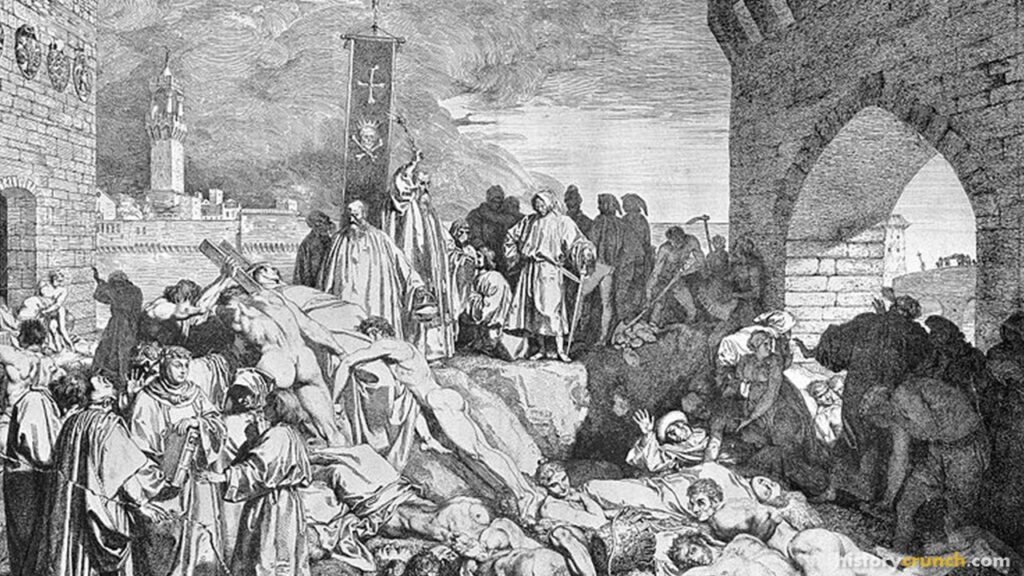
The plague reached Florence in March 1348. Giovanni Boccaccio, who lived through it, wrote that citizen avoided citizen, that kinsfolk never met, and that fathers and mothers abandoned their own children as if they had been strangers. The city lost perhaps half its people by the end of the year.
LEARN MORESHOW LESSwhy it matters · a sourceDISEASEBoccaccio's account is the most famous eyewitness description of the Black Death, and it is about what the fear did to people before the disease did.
IN THEIR OWN WORDS“brother was forsaken by brother, nephew by uncle, brother by sister, and oftentimes husband by wife”
Giovanni Boccaccio, The Decameron
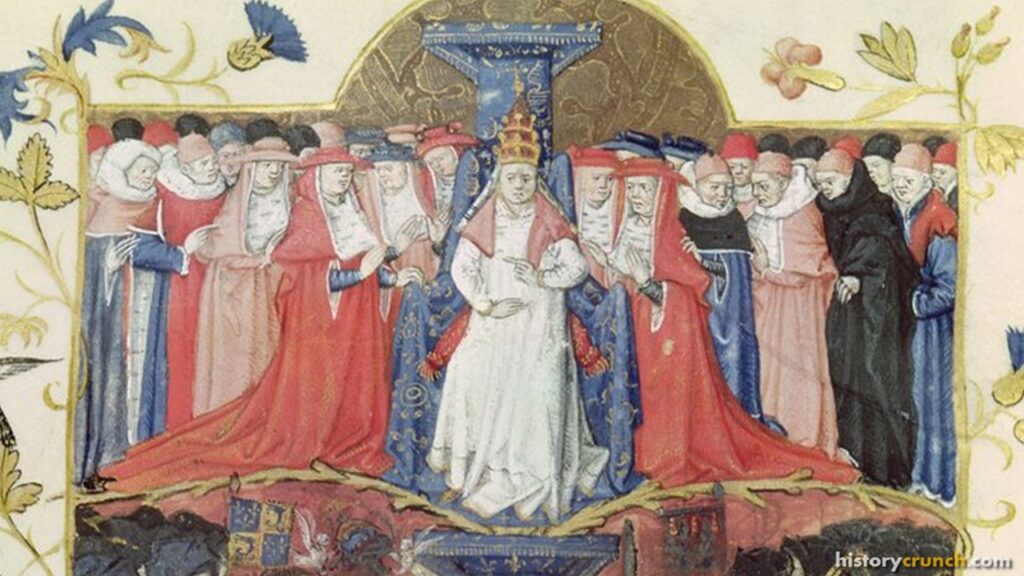
At Avignon, where the popes then lived, the plague killed about a third of the cardinals. Pope Clement VI's doctor kept him in a room between two large fires. He survived, and the heat may have kept the fleas away.
LEARN MORESHOW LESSwhy it mattersRELIGIONThe head of the Church could not stop the plague, could not explain it, and had to hide from it. For many people that was the moment the old certainties cracked.
Agnolo di Tura of Siena wrote that he buried his five children with his own hands, that people died without confession or last rites, and that so many died 'all believed it was the end of the world'. Work on Siena's great new cathedral stopped and never resumed.
LEARN MORESHOW LESSwhy it matters · a sourceLIFEOne family's account of one city. The half-built cathedral wall is still standing in Siena, where the money and the masons ran out in 1348.
IN THEIR OWN WORDS“And I, Agnolo di Tura, called the Fat, buried my five children with my own hands”
Agnolo di Tura, chronicler of Siena
The plague reached Paris, the largest city in northern Europe, in the summer of 1348. About half the city's population died. The medical faculty of the university, asked by the king to explain the disease, blamed a conjunction of the planets.
LEARN MORESHOW LESSwhy it matters · key numbersDISEASEThe best doctors in Europe looked at the sky for the cause. It is the clearest measure of how far medicine was from understanding what was happening.
A ship from Gascony brought the plague to the port of Melcombe Regis, now part of Weymouth in Dorset, around midsummer 1348. It reached Bristol by August and was moving inland along the roads by autumn.
LEARN MORESHOW LESSwhy it mattersDISEASEEngland is an island, and it made no difference. Every port was a door.
Joan, daughter of Edward III of England, died of plague at Bordeaux on September 2nd, 1348, aged fourteen, on her way to marry the heir to the throne of Castile. Her wedding dress was in her luggage.
LEARN MORESHOW LESSwhy it matters · 1 key figurePOLITICSKings had physicians, clean linen and country houses. The plague killed their children anyway. No rank was safe, and everybody noticed.
As rumors spread that Jews had caused the plague by poisoning wells, Pope Clement VI issued two bulls in 1348 forbidding anyone to harm them, pointing out that Jews were dying of the plague like everyone else and that the disease raged in places where no Jews lived.
LEARN MORESHOW LESSwhy it mattersRELIGIONThe pope was right and almost nobody listened. Within six months Jewish communities across Germany had been destroyed.
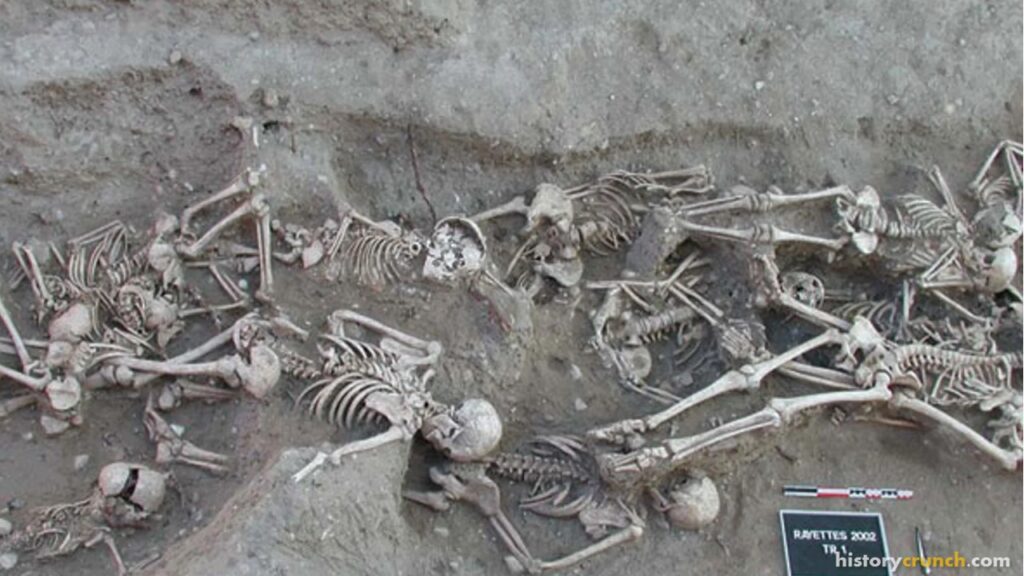
The plague reached London in the autumn of 1348 and raged through the winter and spring. Roughly half the city died. New burial grounds were opened outside the walls; one at East Smithfield has been excavated, and the skeletons in it are how historians finally proved what the disease was.
LEARN MORESHOW LESSwhy it matters · key numbersDISEASEHalf of London. A hole in the ground outside the walls, dug in a hurry in 1349, is the evidence that settled a six-hundred-year argument.
The plague struck the Muslim world as hard as Europe. In Cairo, the largest city west of China, chroniclers counted thousands dead each day at its height. The traveller Ibn Battuta saw it in Damascus and Gaza and recorded prayers, fasts and processions that did nothing.
LEARN MORESHOW LESSwhy it mattersDISEASEThe Black Death is usually told as a European story. It was not. It killed as large a share of the Middle East, and the responses on both sides of the Mediterranean were almost the same.
In February 1349 Strasbourg burned two thousand of its Jews before the plague had even arrived. Bands of flagellants whipped themselves from town to town to turn away God's anger, and carried the disease with them. England froze wages by law with half its workers dead. A ship drifted into Bergen with everyone aboard dead. Scotland gathered an army to invade a dying England and the plague reached the army first. It got to Russia in 1351, four years after leaving the Crimea, having gone round Europe in a circle. By then about half of Europe was dead.
On February 14th, 1349, before the plague had even reached the city, about 2,000 Jews of Strasbourg were burned alive on a wooden platform in their own cemetery, accused of poisoning the wells. Similar massacres destroyed Jewish communities across Germany that year.
LEARN MORESHOW LESSwhy it matters · key numbersPERSECUTIONJewish people were often blamed for the spread of the disease and persecuted as a result. The plague killed by fear as well as by fleas, and the fear had a target.
England's church lost its archbishop in August 1348, his successor in May 1349, and a third took office before the year was out. Nearly half of England's parish priests died, many of them at the bedsides of the sick.
LEARN MORESHOW LESSwhy it mattersRELIGIONThe priests who stayed died; the survivors were often the ones who had run. The Church came out of the plague with fewer priests and less respect.
Many believed the plague was God's punishment and turned to their faith. Bands of penitents, the flagellants, marched from town to town whipping themselves bloody in public to turn away God's anger. In October 1349 the pope condemned them; some had led attacks on Jews.
LEARN MORESHOW LESSwhy it mattersRELIGIONIf the plague was punishment, then suffering might be the cure. It was a logical answer to a question nobody could answer, and it spread the disease from town to town.
With half the workers dead, wages doubled. On June 18th, 1349, Edward III ordered every able-bodied person under sixty to work for the wages paid before the plague. It was made law as the Statute of Labourers in 1351, and was largely ignored.
LEARN MORESHOW LESSwhy it matters · 1 key figurePOLITICSThe first attempt to pretend the plague had not changed anything. Thirty years of resentment at this law ended in the Peasants' Revolt.
A ship from England drifted into Bergen harbor with its whole crew dead of plague. Norway lost perhaps half its people. The plague went on to Sweden and Denmark in 1350.
LEARN MORESHOW LESSwhy it mattersDISEASEA ship with nobody left alive on it, still carrying the disease. It is the image people reached for six centuries later, and it was real.
By the end of 1349 the plague had crossed Germany, the Low Countries and Austria and was moving into Poland and the Baltic. Some places were touched less, Milan and parts of Poland among them, for reasons historians still argue about.
LEARN MORESHOW LESSwhy it mattersDISEASEThe only communities that seemed to withstand the plague were the ones which relied less on trade with their neighbors. Isolation, for once, was an advantage.
The Scots, hearing that the English were dying, gathered an army near the border to invade. The plague reached the army first; it broke up and carried the disease home. Scotland lost perhaps a third of its people.
LEARN MORESHOW LESSwhy it mattersWARThe plague did not care about borders or wars. An army was a crowd, and crowds died.
The plague arrived in Russia in 1351, reaching Novgorod and then Moscow in 1353, four years after leaving the Crimea by ship. It had gone round Europe in a circle and arrived back a few hundred miles from where it started.
LEARN MORESHOW LESSwhy it mattersDISEASEThe end of the first wave. In four years the plague had crossed every country in Europe, and the population of the continent had fallen by about a third.
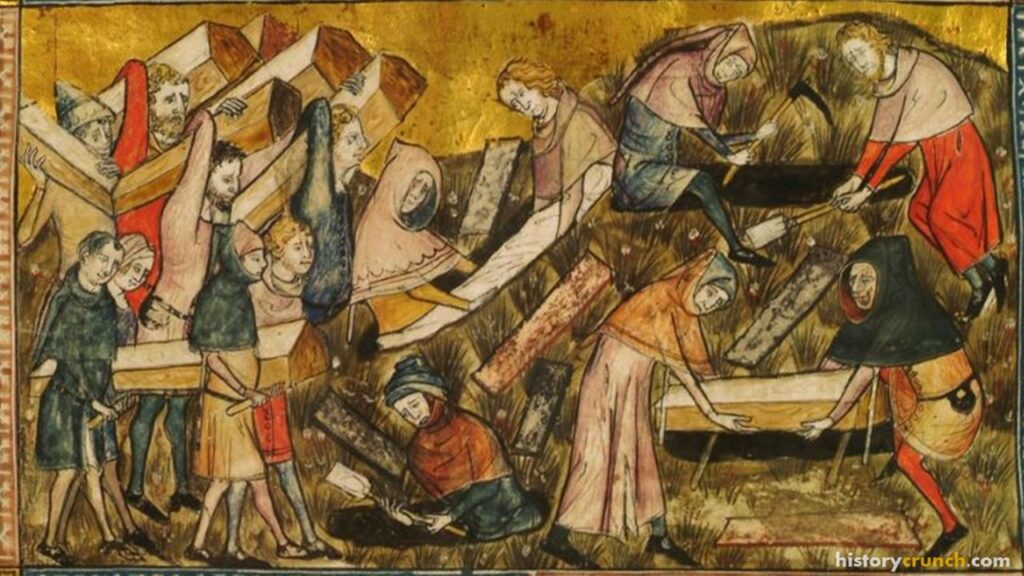
A manuscript of 1353 shows the people of Tournai, in what is now Belgium, burying plague victims in coffins. It is one of the few pictures of the Black Death made by people who saw it; almost every other image was painted centuries later.
LEARN MORESHOW LESSwhy it mattersLIFELook at it: the coffins are still individual, and the diggers are still calm. In most towns, by the end, neither was true.
Between 75 and 200 million people in Europe and Asia by some estimates, between 30 and 60 percent of everyone alive. It is widely accepted that about half of Europeans died in the first wave. Paris and London each lost half their people.
LEARN MORESHOW LESSwhy it matters · key numbers · a debateDISEASENo war, before or since, has killed so large a share of the people it touched. The number is argued about because nobody was counting, and everybody who might have been was dying.
How many people did the Black Death kill?
About a third of Europe. That was the figure historians used for a century, based on the chroniclers' estimates and tax records.
Closer to half, or more. Studies of manor rolls, wills and church records since the 1970s keep pushing the number up, and some towns lost two-thirds.
The second chapter with no dates. What the disease did to a body: fever and chills, then the black swellings in the groin and armpits, then death within days. What people thought was happening: bad air, the planets, God's anger, the Jews. What they did about it: incense, bleeding, crushed emeralds, a dried toad, flight. And what it did to a town: the sick avoided, the dead in the street, the trenches with bodies in layers like lasagne. The bird-masked doctor everyone pictures is from three hundred years later, but the fear is the same.
Sudden fever, chills and headaches, like a bad flu. Then, within a day or two, painful swollen lymph nodes in the groin, armpit or neck.
LEARN MORESHOW LESSwhy it mattersDISEASEFor the first day you could not tell it from a cold. By the time you could, it was usually too late to leave.
A bubo is a swollen lymph node. The buboes, the size of an egg or an apple, grew in the armpits and groin where the lymph nodes had swollen with the bacteria. They turned black, and after a time would often burst and ooze pus and blood.
LEARN MORESHOW LESSwhy it mattersDISEASEThe black swellings are where the name comes from, though 'Black Death' was not used until centuries later. People at the time called it the Great Mortality, or the Pestilence.
Gangrene in the fingers and toes, fever, cramps, seizures, vomiting, extreme pain and difficulty breathing. Most who caught the bubonic form died within three to five days; the pneumonic form could kill in two.
LEARN MORESHOW LESSwhy it mattersDISEASEBoccaccio wrote of people who ate breakfast with their friends and dinner with their ancestors in Paradise. It was not much of an exaggeration.
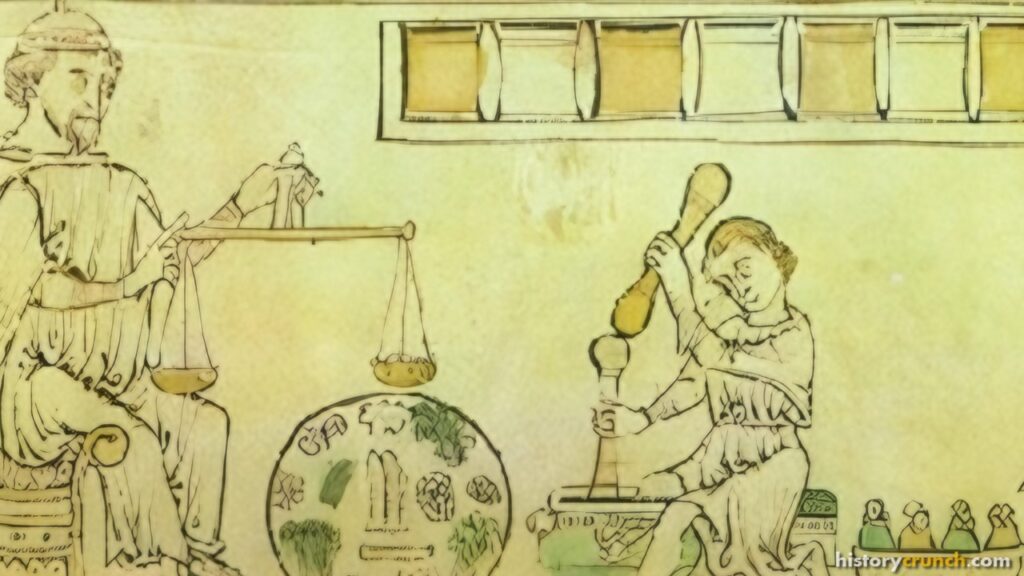
Most doctors believed disease came from miasma, bad air rising from swamps, corpses and rot, and prescribed incense, sweet herbs and closed windows against it. Some believed the plague was spread by bad air and thought they could cleanse the air by burning incense.
LEARN MORESHOW LESSwhy it mattersMEDICINEThe bad-air theory was wrong, but it was not stupid: the plague did smell, and it did cluster in filthy places. Wrong theories that fit the evidence are the hardest to get rid of.
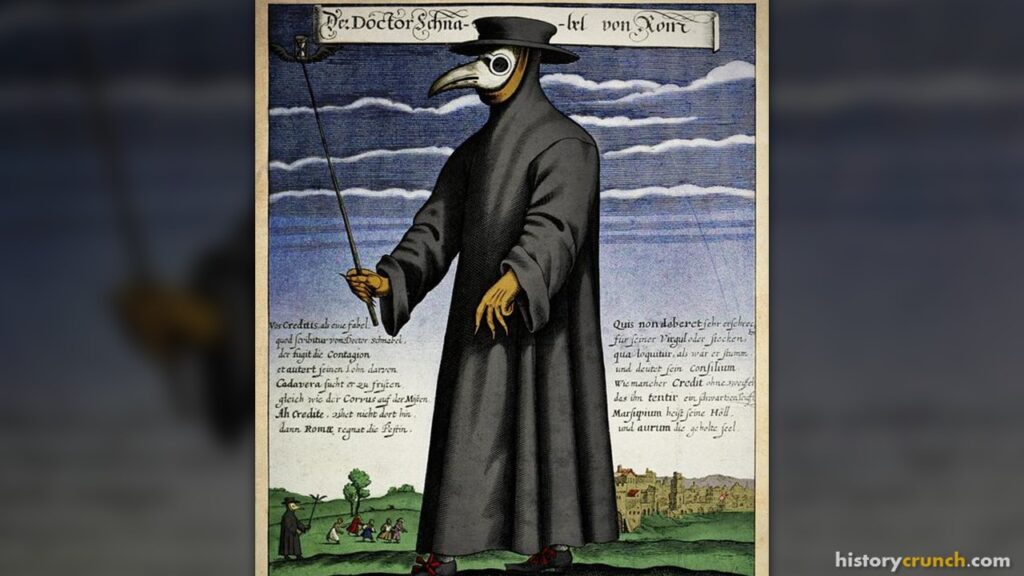
Doctors wore a mask like the beak of a bird, with the beak stuffed with herbs and incense to overpower the bad air, along with a waxed coat, gloves and a cane for examining patients at a distance. It also masked the smell of death.
LEARN MORESHOW LESSwhy it mattersMEDICINEThe costume belongs to the plague doctors of the 1600s, not the 1340s, but it is the picture everyone knows. By accident, the waxed coat and gloves did keep some fleas off.
The medical faculty of Paris, asked by the king to explain the plague, blamed a conjunction of Saturn, Jupiter and Mars in March 1345. Preachers blamed sin. Many people turned to their faith during the crisis.
LEARN MORESHOW LESSwhy it mattersRELIGIONBoth explanations left nothing to be done except pray. Neither the stars nor God could be argued with, which is one reason the explanations lasted.
Bleeding, lancing the buboes, vinegar and rosewater, crushed emeralds for the rich and a dried toad tied to the swelling for the poor. Some people fled to the countryside, which worked better than anything a doctor did.
LEARN MORESHOW LESSwhy it mattersMEDICINEMedieval medicine was not useless in general; it just had nothing for this. The best advice of the age, in Latin, was 'leave at once, go far, come back late'.
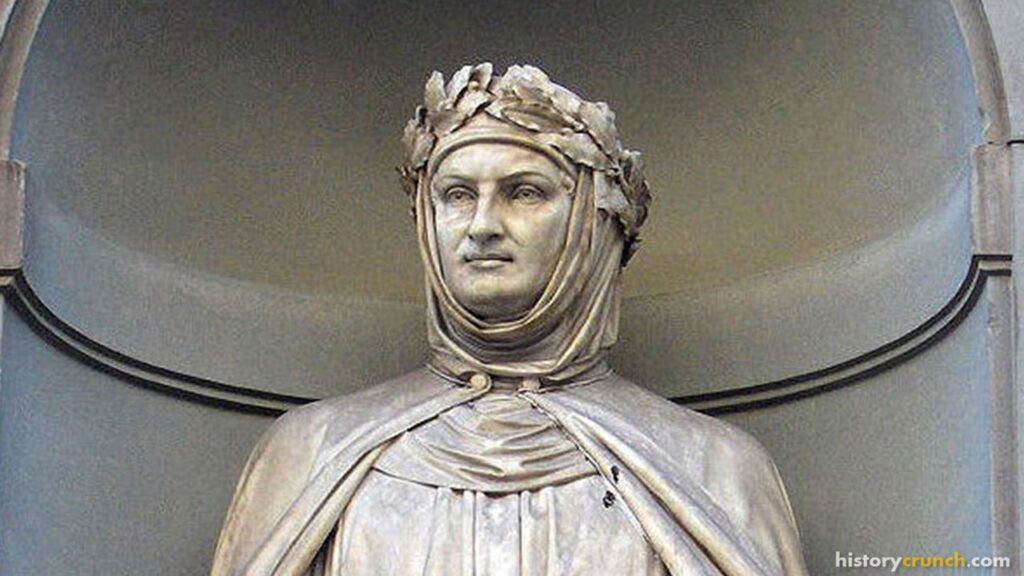
People who nursed their sick relatives were bitten by the same fleas and died too, so people soon learned to avoid anyone showing symptoms. Families and whole communities were ripped apart. The bodies of the dead collected in houses and on streets.
LEARN MORESHOW LESSwhy it mattersLIFEThe plague broke the thing that holds a society together, which is that people look after each other. Boccaccio's account is really about that.
Overwhelmed towns dug long trenches and buried the dead in layers, 'like lasagne', one Florentine wrote, with a little earth between. Some burned the bodies. Priests died faster than they could be replaced, and many of the dead went into the ground without one.
LEARN MORESHOW LESSwhy it mattersLIFEThe mass graves are where the answers finally came from. In 2011, DNA from the skeletons at East Smithfield in London proved the Black Death was Yersinia pestis.
The plague came back in 1361 and killed the children, and again in 1369 and 1374, and Europe's population kept falling for fifty years. The survivors were worth more, and knew it. Wages doubled; kings passed laws to freeze them and laws about who could wear silk; the peasants rose in France in 1358, in Florence in 1378 and in England in 1381, and lost every time, and serfdom in the west died anyway within a generation. Ragusa invented quarantine. Boccaccio wrote the first great book of the Renaissance about ten people hiding from the plague.
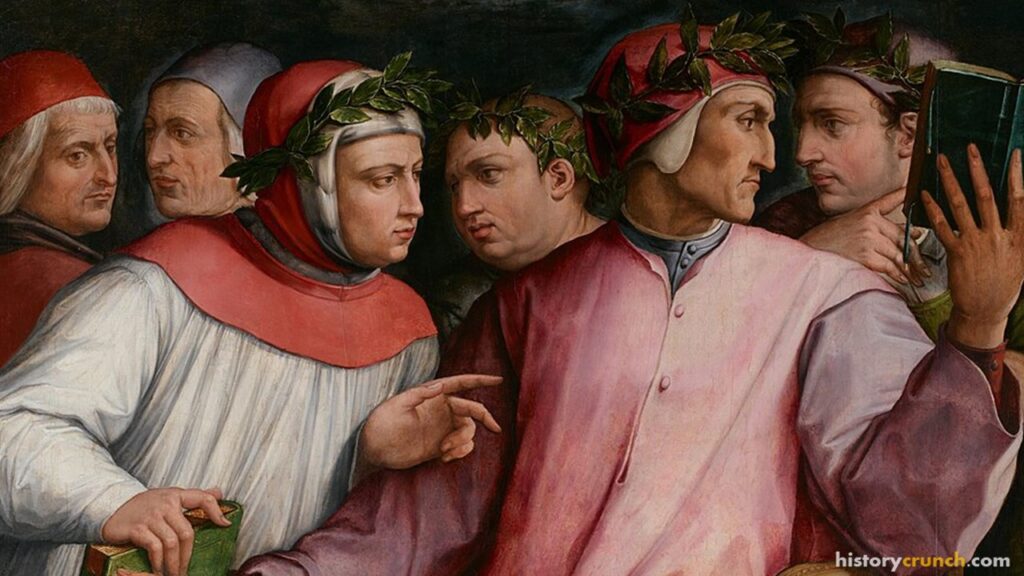
Written between 1349 and 1353 and circulating by the mid-1350s: ten young Florentines flee the plague to a villa in the hills and tell each other a hundred stories over ten days. Its opening pages, describing Florence in 1348, are the most famous eyewitness account of the Black Death.
LEARN MORESHOW LESSwhy it matters · 1 key figureCULTUREThe first great book of the Renaissance is a book about escaping the plague. That is not a coincidence.
Peasants north of Paris rose against their lords in the summer of 1358, burning castles and killing nobles, in a France already beaten at Poitiers and short of everything. The nobility crushed them within a month, killing thousands.
LEARN MORESHOW LESSwhy it mattersREVOLTThe first of the risings the plague set off. The survivors knew they were worth more, and the lords knew it too.
The second great wave struck in 1361 and killed many of the children born since 1348, which is why it was called the children's plague. It returned in 1369, 1374 and at least six times in just over fifty years after first arriving in 1347.
LEARN MORESHOW LESSwhy it mattersDISEASEThis is the part of the story most people do not know. The Black Death was not one disaster but the first of a series, and Europe's population did not recover for 150 years.
A sumptuary law is a law about what people may wear and own. Parliament tried to stop the newly prosperous from dressing above their station: laws laid down which cloth, furs and colors each class could wear. Peasants' wives were not to wear silk. Wages, and clothes, kept rising anyway.
LEARN MORESHOW LESSwhy it mattersPOLITICSWhen laborers could afford what nobles wore, the nobles passed a law about it. It is a good measure of how much the plague had shifted.
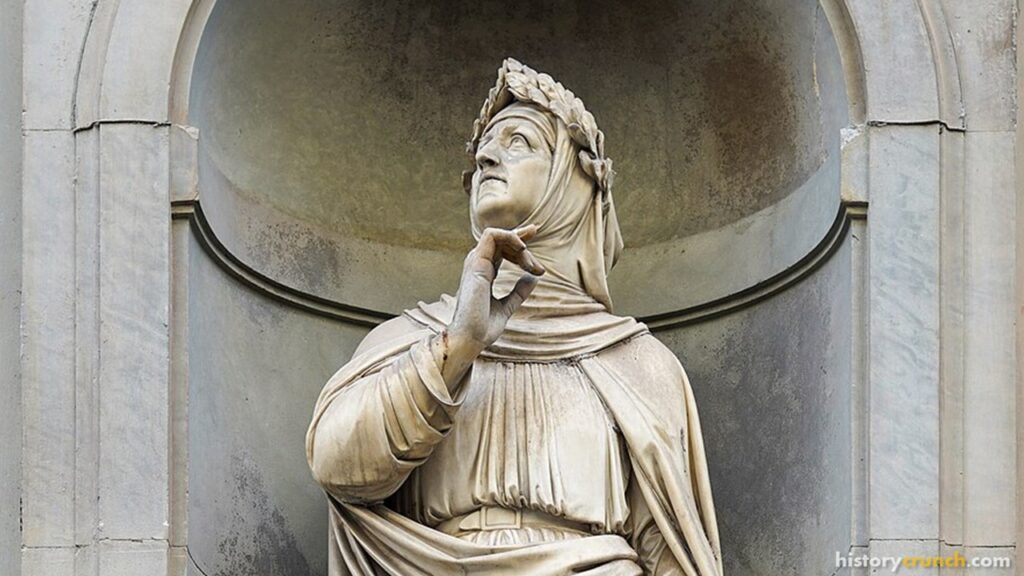
The poet Petrarch had lost Laura, the woman his sonnets were written to, in the plague of 1348, and most of his friends in the waves since. He died in July 1374 with the plague again in Italy, at his desk, over a book.
LEARN MORESHOW LESSwhy it matters · 1 key figureCULTUREPetrarch is called the father of the Renaissance. He spent the whole of it burying people.
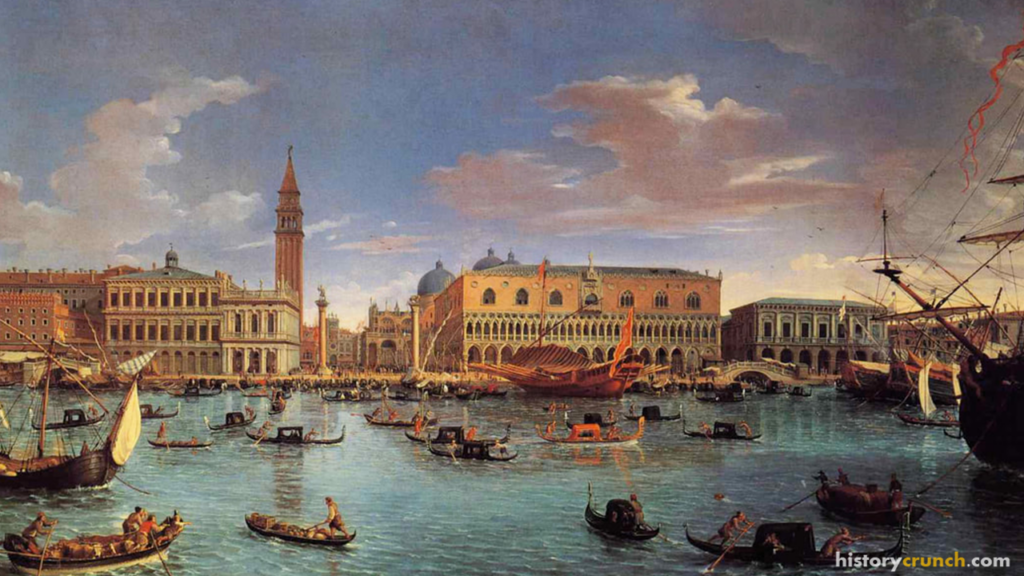
The port of Ragusa, now Dubrovnik, ordered that ships and travellers from plague areas wait thirty days on an island before landing. Venice later made it forty days, quaranta giorni, which gave the practice its name.
LEARN MORESHOW LESSwhy it mattersMEDICINENobody knew what caused the plague, but somebody had noticed that it arrived on ships and took a few weeks to show. That observation is the beginning of public health.
Laborers too poor to belong to a guild took over the government of Florence for six weeks in the summer of 1378 before the guilds took it back. It was the first time the lowest workers of a European city had held power.
LEARN MORESHOW LESSwhy it mattersREVOLTLabor was scarce and knew it. The rising failed, like the Jacquerie, but the people who ran Florence never quite forgot that it could happen.
England, still fighting France, taxed every adult the same flat sum for the third time in four years, three times the rate of the first. When the returns came in short, collectors were sent to find the villages that had not paid.
LEARN MORESHOW LESSwhy it mattersPOLITICSA tax that cost a lord nothing he would notice and a laborer two weeks' wages. The collectors were the spark.
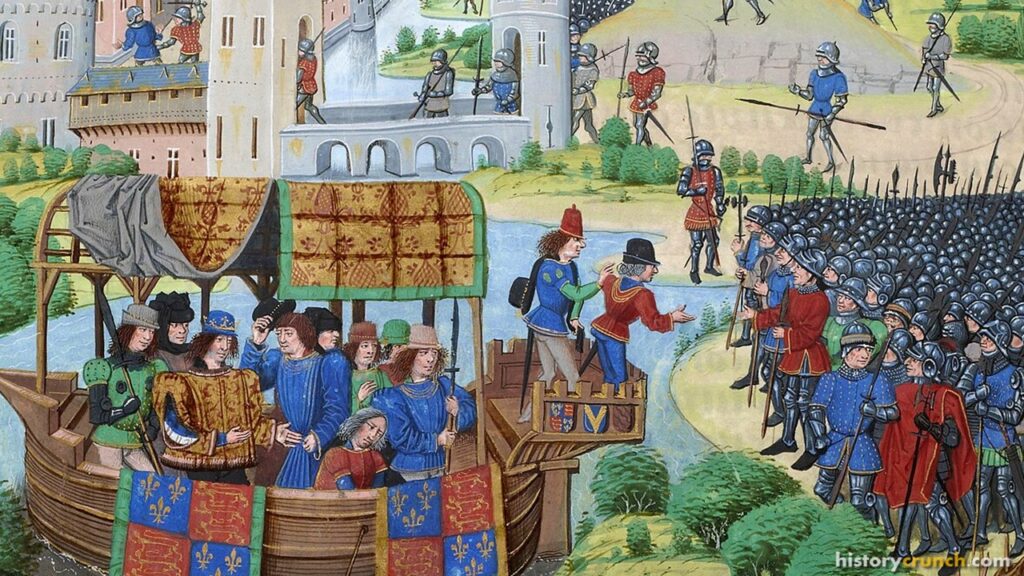
In June 1381 the peasants of Essex and Kent marched on London, burned the Savoy Palace and killed the archbishop. The fourteen-year-old king, Richard II, met them at Mile End and promised to end serfdom; the next day at Smithfield their leader Wat Tyler was killed and the revolt collapsed.
LEARN MORESHOW LESSwhy it mattersREVOLTThirty years of laws holding wages down, a war tax, and a generation that had grown up knowing it was worth more. The plague's politics arrived in London.
The radical preacher who had helped inspire the revolt, and who had asked 'When Adam delved and Eve span, who was then the gentleman?', was captured and hanged, drawn and quartered in July 1381. The king's promises were withdrawn.
LEARN MORESHOW LESSwhy it matters · a sourceREVOLTThe revolt failed and serfdom in England died anyway, within a generation, because no law could make people work for the old wages when there were so few of them.
IN THEIR OWN WORDS“When Adam delved and Eve span, who was then the gentleman?”
John Ball, preaching to the rebels at Blackheath
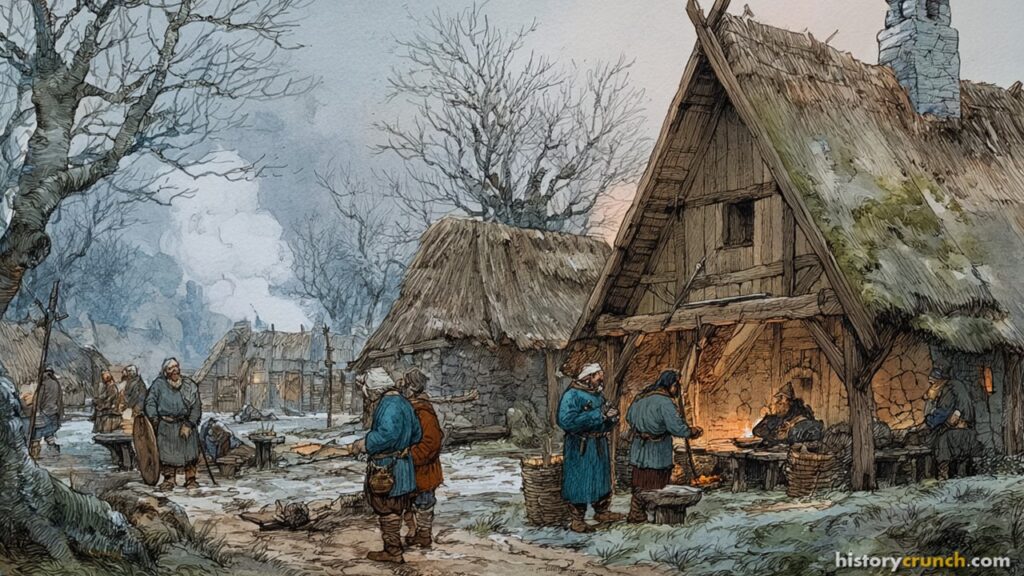
With workers scarce for two generations, lords who tried to hold serfs to the old dues lost them to lords who would pay wages. By 1400 serfdom was dying in England and France. In eastern Europe, where lords had more power, it hardened instead.
LEARN MORESHOW LESSwhy it mattersLIFEThe single biggest change the plague made. Half of Europe's workers died, and the other half were free within fifty years.
The Black Death never really ended. Some part of Europe had plague almost every year until the 1700s: a quarter of northern Italy in 1630, a fifth of London in 1665, a hundred thousand in Marseille in 1720 because the merchants overruled the quarantine for a cargo of silk. The art of the centuries after 1348 filled up with skeletons. A third pandemic broke out of China in 1855 and travelled by steamship. In Hong Kong in 1894 Alexandre Yersin finally found the bacterium, and in 1947 an antibiotic was shown to kill it. The disease is still in the rats. It is just, for the first time, beatable.
The survivors' wealth, the cheapness of land, the questions the plague raised about God and death, and the money that Italian cities had made from the trade that carried the plague all fed the Renaissance. Florence, the city Boccaccio watched empty, led it.
LEARN MORESHOW LESSwhy it matters · a debateCULTUREHistorians count the Black Death among the causes of the Renaissance. It is the strangest kind of cause: a catastrophe that made the survivors richer and less sure of the old answers.
Did the Black Death cause the Renaissance?
Partly. Survivors inherited, labor was worth more, the Church's authority was dented, and the shock made people think differently about life and death.
The Renaissance began in Italian cities that were rich before 1348, from trade and banking; the plague delayed it as much as it helped.
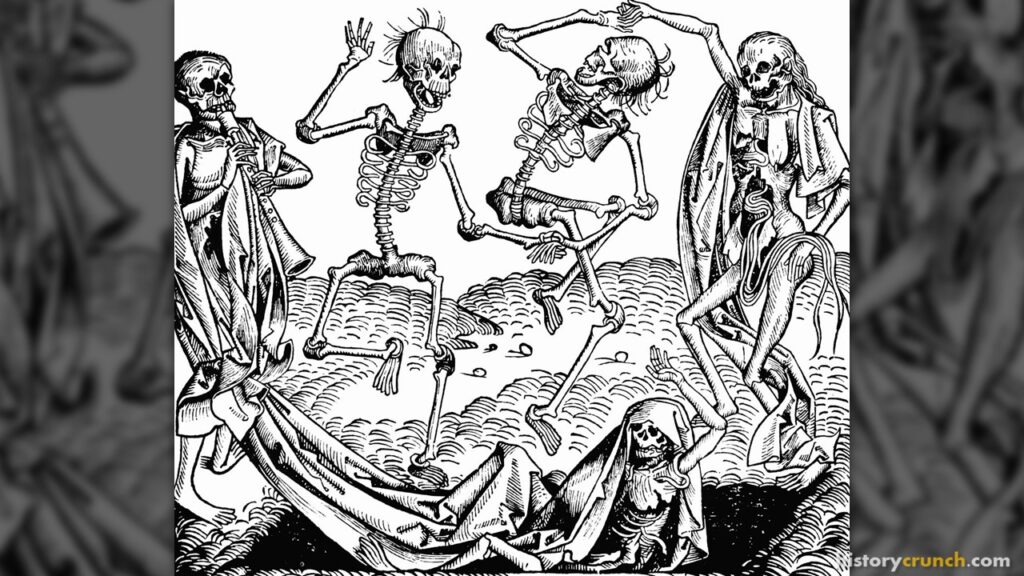
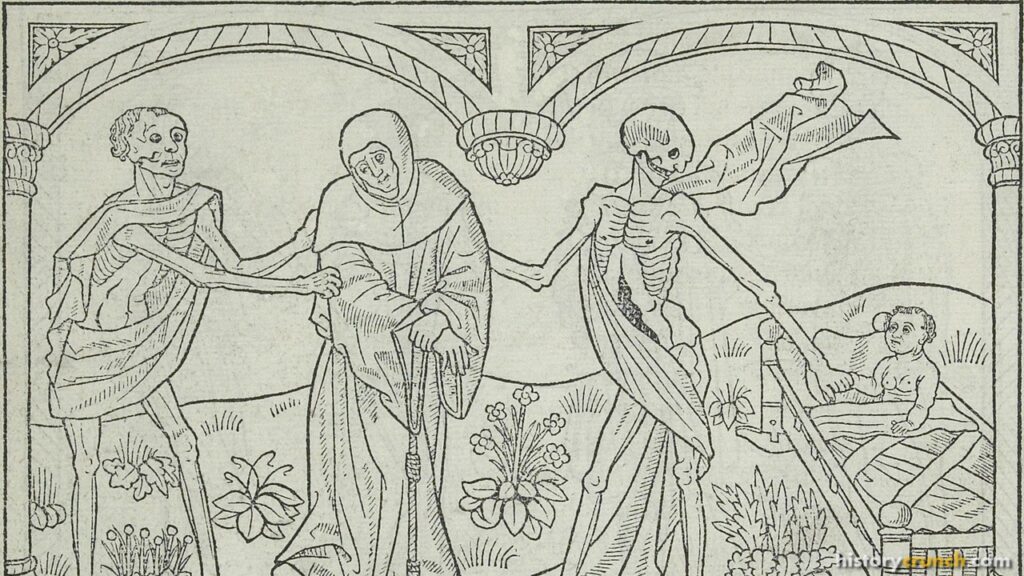
Michael Wolgemut's woodcut 'The Dance of Death' of 1493 shows skeletons leading the living, pope and peasant alike, by the hand. Art of the century and a half after the plague was full of death, because life was.
LEARN MORESHOW LESSwhy it mattersCULTUREThe Dance of Death was painted on church walls all over Europe. Its message was the plague's: it takes everybody, in any order.
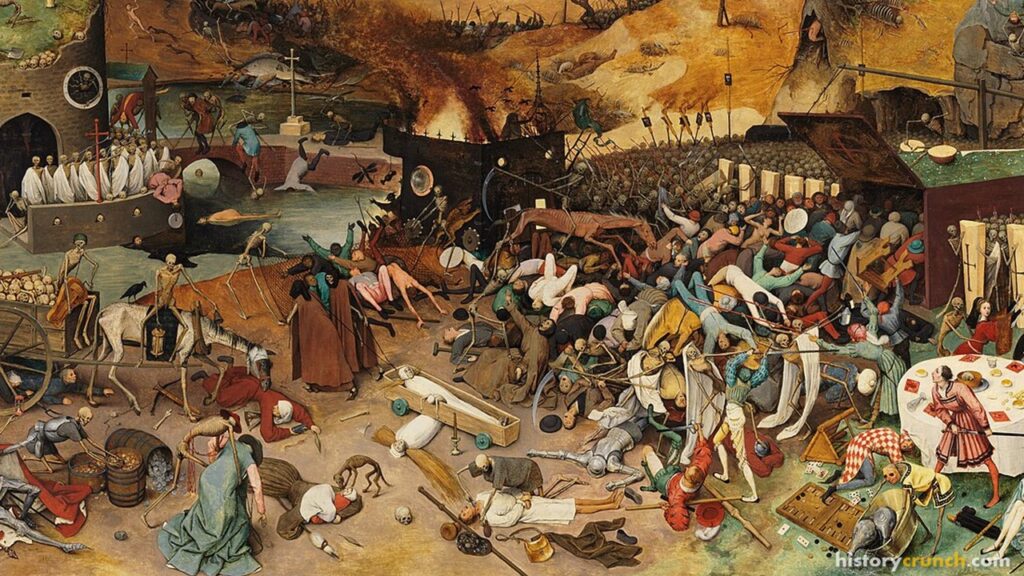
Pieter Bruegel's painting shows an army of skeletons overrunning a landscape, killing kings, soldiers and lovers alike, with a plague cart in the foreground. Two centuries after 1348 the memory had not faded, because the plague had never left.
LEARN MORESHOW LESSwhy it mattersCULTUREBruegel had lived through outbreaks himself. The painting is not history; it is what the plague still looked like to someone in 1562.
The plague of 1629 to 1631 killed about a quarter of northern Italy, 280,000 people. Venice built the church of the Salute in thanks when it ended. Milan tried some of the first organized isolation of the sick, in a hospital outside the walls.
LEARN MORESHOW LESSwhy it mattersDISEASEThree hundred years after 1348 the plague could still take a quarter of a region. The difference was that cities now had boards of health, and they were starting to work.
The plague of 1656 in Rome and Naples is when the beaked mask, waxed coat and cane of the plague doctor were drawn and described. Naples lost about half its people. The costume has stood for the Black Death ever since, three centuries after it.
LEARN MORESHOW LESSwhy it mattersMEDICINEThe most famous image of the Black Death comes from a different plague in a different century. History is full of pictures that have wandered.
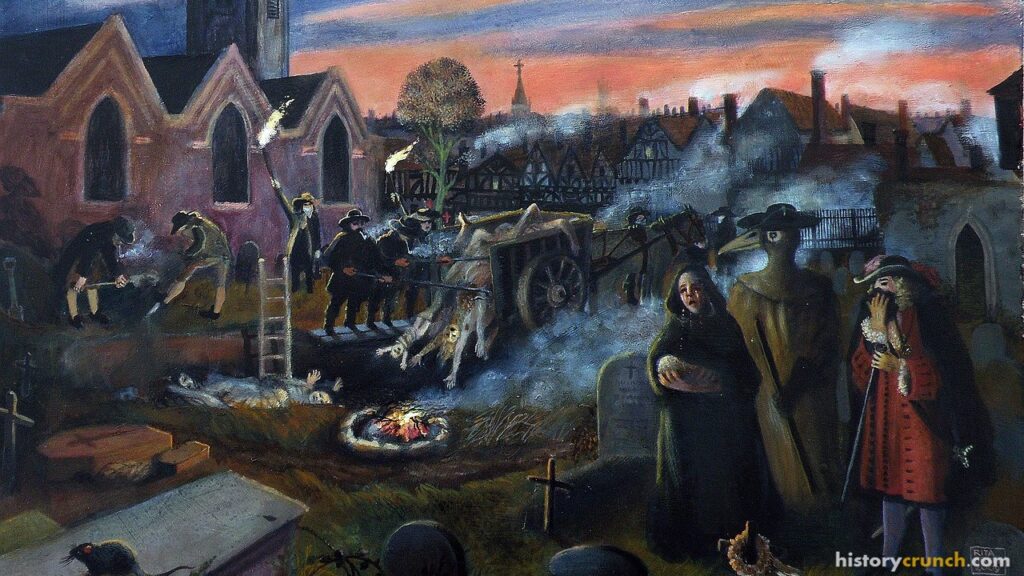
London's last great plague killed about 100,000 people, a fifth of the city, in the summer of 1665. Samuel Pepys kept a diary through it; houses with the sick were sealed with a red cross and 'Lord have mercy upon us' painted on the door. The Great Fire followed the next year.
LEARN MORESHOW LESSwhy it matters · key numbersDISEASEThe plague London had first met in 1348 was still killing a fifth of it in 1665. It was the last time, though nobody knew that.
When the plague reached the Derbyshire village of Eyam in a box of cloth from London, the villagers agreed, at their rector's urging, to quarantine themselves so it would not spread. Food was left at boundary stones. About 260 of 800 died; the villages around were spared.
LEARN MORESHOW LESSwhy it mattersLIFEA whole village choosing to die rather than spread the disease. It is the plague story English schools tell, and it is true.
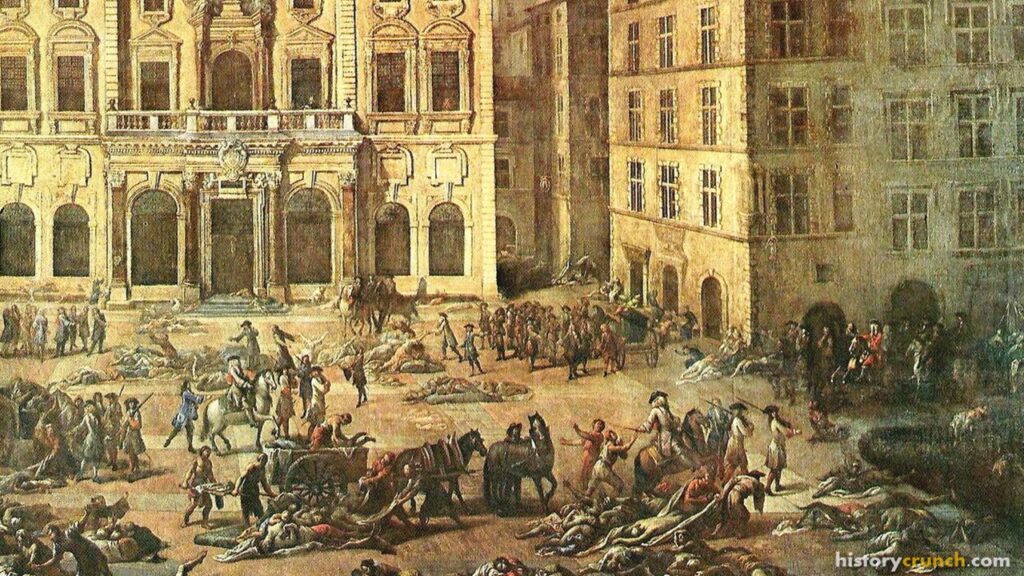
A ship from the Levant brought plague to Marseille in 1720 despite the quarantine, because its cargo was too valuable to wait. About 100,000 died in the city and Provence. A mass grave in southern France from 1720 still shows the bacterium in the bones.
LEARN MORESHOW LESSwhy it mattersDISEASEQuarantine worked when it was obeyed. Marseille's merchants overruled it for a cargo of silk, and it was the last great plague in western Europe.
Plague broke out of Yunnan in southwest China in 1855 and spread by steamship to every inhabited continent over the next fifty years, killing about 12 million people, most of them in India.
LEARN MORESHOW LESSwhy it mattersDISEASEThe disease that had crossed Asia by caravan and Europe by galley now travelled by steamship, and reached San Francisco, Sydney and Cape Town.
In Hong Kong in June 1894, Alexandre Yersin identified the bacterium, later named Yersinia pestis after him. In 1898 Paul-Louis Simond proved, with two rats in a jar, that fleas carried it from rats to people. Five and a half centuries after Messina, the Black Death had an explanation.
LEARN MORESHOW LESSwhy it matters · 1 key figureMEDICINEUnderstanding how the plague spread is what let modern societies stop it, with sanitation, rat control and quarantine that finally knew what it was for.
Streptomycin, an antibiotic discovered in 1943, was shown to cure plague in 1947. The disease still exists in wild rodents on several continents and still kills a few hundred people a year worldwide, but a case treated in time now almost always survives.
LEARN MORESHOW LESSwhy it mattersMEDICINEFrom a bacterium nobody could see to one a pill can kill. The Black Death is not over; it is just, for the first time, beatable.

I'm a passionate history and geography teacher with over 15 years of experience working with students in the middle and high school years. I have an Education Degree with a focus in World History. I have been writing articles for History Crunch since 2015 and love the challenge of creating historical content for young learners!

I'm the founder of History Crunch, which I first began in 2015 with a small team of like-minded professionals. I have an Education Degree with a focus in Social Studies education. I spent nearly 15 years teaching history, geography and economics in secondary classrooms to thousands of students. Now I use my time and passion researching, writing and thinking about history education for today's students and teachers.

K.L. is a content writer for History Crunch. She is a fantastic history and geography teacher that has been helping students learn about the past in new and meaningful ways since the mid-2000s. Her primary interest is Ancient History, but she is also driven by other topics, such as economics and political systems.
To cite this timeline as a source, use one of the formats below.
MLA: Beck, E., et al. “Black Death Timeline.” HistoryCrunch, 14 September 2026, https://historycrunch.com/black-death-timeline/.
APA: Beck, E., Millar, B., & Woida, K.L. (2026). Black Death Timeline. HistoryCrunch. https://historycrunch.com/black-death-timeline/
Chicago: Beck, E., B. Millar, and K.L Woida. “Black Death Timeline.” HistoryCrunch. September 14, 2026. https://historycrunch.com/black-death-timeline/
© History Crunch
A bacterium, a flea, a rat and a person. It took until 1894 to work that out.
Between a third and half of Europe in four years. No war has come close.
Nobody in 1348 called it that. They said the Great Mortality, or just the Pestilence.
Fifteen years across Asia by caravan, then four years across Europe by ship.
Every route that made Europe rich in 1340 carried the plague in 1348.
One chronicler says so. He was in Italy at the time.
Historians used to say China. Now some say Central Asia. The gravestones are the clue.
You would have known someone who died. Probably most of the people you knew.
Bleeding, incense, crushed emeralds, a dried toad. And a mask with a beak.
Priests died at the bedsides. The pope hid between two fires. The flagellants marched.
The Decameron, the Dance of Death, the ghost ship at Bergen, the corpses over the walls of Caffa.
The planets, God, bad air, and the Jews. Only one of those could be burned.
Five hundred and fifty years after Messina, in a hut in Hong Kong.
If the plague was God's punishment, then punishing yourself first might turn it away.
Half the workers dead. The other half suddenly worth twice as much.
France in 1358, Florence in 1378, England in 1381. Different countries, one cause.
The first great book of the Renaissance is about escaping the plague.
The Dance of Death was painted on church walls all over Europe.
Fewer people, higher wages, cheaper land, angrier peasants, and a Church with less authority.
Half the workers dead meant half the men dead. Somebody had to do the work.
1361, 1369, 1374, 1630, 1665, 1720. The Black Death was the first of a series.
Ragusa worked it out in 1377. It took another 517 years to find out why it worked.
Eyam shut its own gates in 1666 so the plague would not spread. About a third of it died.
Eight hundred years earlier the same disease emptied Constantinople and stopped Rome's comeback.
Sicily in October 1347. Russia in 1351. Everything between them happened in 1348.
A king's daughter died. A pope hid. A parliament passed a law nobody obeyed.
They made the roads safe. The plague used them.
Nobody was counting. The numbers come from wills, rent rolls, church records and graves.
Half the city in 1348. A fifth of it in 1665. Then the fire.
Same bacterium, same route, eight hundred years apart.
No question matches that word.
Research question 1A bacterium, a flea, a rat and a person. It took until 1894 to work that out.
Research question 2Between a third and half of Europe in four years. No war has come close.
Research question 3Nobody in 1348 called it that. They said the Great Mortality, or just the Pestilence.
Research question 4Fifteen years across Asia by caravan, then four years across Europe by ship.
Research question 5Every route that made Europe rich in 1340 carried the plague in 1348.
Research question 6One chronicler says so. He was in Italy at the time.
Research question 7Historians used to say China. Now some say Central Asia. The gravestones are the clue.
Research question 8You would have known someone who died. Probably most of the people you knew.
Research question 9Bleeding, incense, crushed emeralds, a dried toad. And a mask with a beak.
Research question 10Priests died at the bedsides. The pope hid between two fires. The flagellants marched.
Research question 11The Decameron, the Dance of Death, the ghost ship at Bergen, the corpses over the walls of Caffa.
Research question 12The planets, God, bad air, and the Jews. Only one of those could be burned.
Research question 13Five hundred and fifty years after Messina, in a hut in Hong Kong.
Research question 14If the plague was God's punishment, then punishing yourself first might turn it away.
Research question 15Half the workers dead. The other half suddenly worth twice as much.
Research question 16France in 1358, Florence in 1378, England in 1381. Different countries, one cause.
Research question 17The first great book of the Renaissance is about escaping the plague.
Research question 18The Dance of Death was painted on church walls all over Europe.
Research question 19Fewer people, higher wages, cheaper land, angrier peasants, and a Church with less authority.
Research question 20Half the workers dead meant half the men dead. Somebody had to do the work.
Research question 211361, 1369, 1374, 1630, 1665, 1720. The Black Death was the first of a series.
Research question 22Ragusa worked it out in 1377. It took another 517 years to find out why it worked.
Research question 23Eyam shut its own gates in 1666 so the plague would not spread. About a third of it died.
Research question 24Eight hundred years earlier the same disease emptied Constantinople and stopped Rome's comeback.
Research question 25Sicily in October 1347. Russia in 1351. Everything between them happened in 1348.
Research question 26A king's daughter died. A pope hid. A parliament passed a law nobody obeyed.
Research question 27They made the roads safe. The plague used them.
Research question 28Nobody was counting. The numbers come from wills, rent rolls, church records and graves.
Research question 29Half the city in 1348. A fifth of it in 1665. Then the fire.
Research question 30Same bacterium, same route, eight hundred years apart.