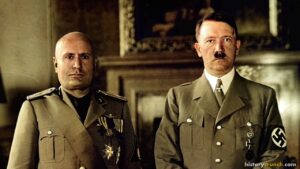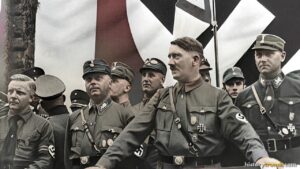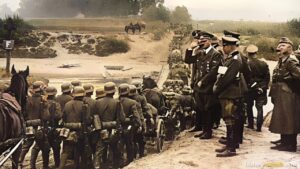
The Final Solution was the Nazi plan to murder all of the Jewish people of Europe, and it stands as the deadliest and most organized stage of the Holocaust. It was the point at which the Nazi Party moved from persecuting and isolating Jewish people to carrying out their systematic mass murder in death camps and killing sites across Nazi-occupied Europe. Under the leadership of Adolf Hitler and the Nazi Party, this plan led to the deaths of approximately 6 million Jewish men, women, and children between 1941 and 1945.
More specifically, the Final Solution was a code name, or hidden name, that Nazi officials used for their plan of genocide. In German it was called the Endlösung der Judenfrage, which means the “Final Solution to the Jewish Question.” A genocide is the mass killing of a group of people for ethnic, religious, or racial reasons. In this case, the Nazis used the innocent-sounding term “Final Solution” to hide the true nature of what they were doing, which was the deliberate and planned destruction of an entire people.
What Was the Holocaust?
The Holocaust is one of the most important events of the 20th century and is perhaps the most significant genocide in human history. The term “holocaust” comes from Greek words meaning burned whole, and originally described a sacrifice burned completely on an altar. It unfolded during the reign of Adolf Hitler in Nazi Germany and alongside the major events of World War II in Europe.
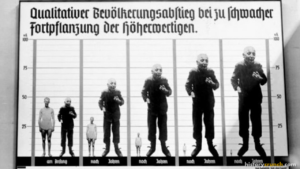
During the Holocaust, which occurred from 1933 to 1945, over 11 million people were executed. In total, 6 million were Jewish people, while the other 5 million included several other groups, such as disabled people, homosexuals, communists, Soviet and Polish prisoners of war, Roma, and other religious and ethnic minorities. The Holocaust was carried out by the Nazi Party and Adolf Hitler and grew out of their anti-Semitic beliefs, which centered on ideas of racial superiority and Social Darwinism.
The Holocaust unfolded in stages over more than a decade. In the 1930s, the Nazis discriminated against Jewish people through laws and policies designed to push them out of German society. The Final Solution was the last and most deadly of these stages, and it is the period in which the vast majority of the victims of the Holocaust were killed.
How Did Nazi Policy Toward Jewish People Change Over Time?
When the Nazis came to power in Germany in 1933, they did not immediately begin the mass murder of Jewish people. However, anti-Semitism, which is a prejudice or hatred of Jewish people, was a central part of Nazi ideology from the very beginning. Once the Nazis controlled the German government, they used their power to persecute Jewish people through a series of steps that grew steadily more severe.
In fact, throughout the 1930s the Nazis excluded Jewish people from German life. They boycotted and seized Jewish-owned businesses, and they passed discriminatory laws such as the Nuremberg Race Laws, which stripped Jewish people of their citizenship and rights. In 1938, Nazis attacked Jewish homes, businesses, and synagogues during a nationwide riot known as Kristallnacht, or the “Night of Broken Glass.” The goal of these early policies was to make life so unbearable that Jewish people would choose to leave Germany.
As stated above, Nazi policy became more extreme once World War II began. When Germany invaded Poland in 1939, millions more Jewish people came under Nazi control. The Nazis forced these people into crowded, sealed-off districts of cities called ghettos, where disease and starvation were common. At this stage, Nazi leaders still spoke of removing Jewish people through forced emigration, and they even considered plans such as deporting all Jewish people to the island of Madagascar. In reality, these plans were never workable, and Nazi policy soon turned toward mass murder.
When Did the Final Solution Begin?
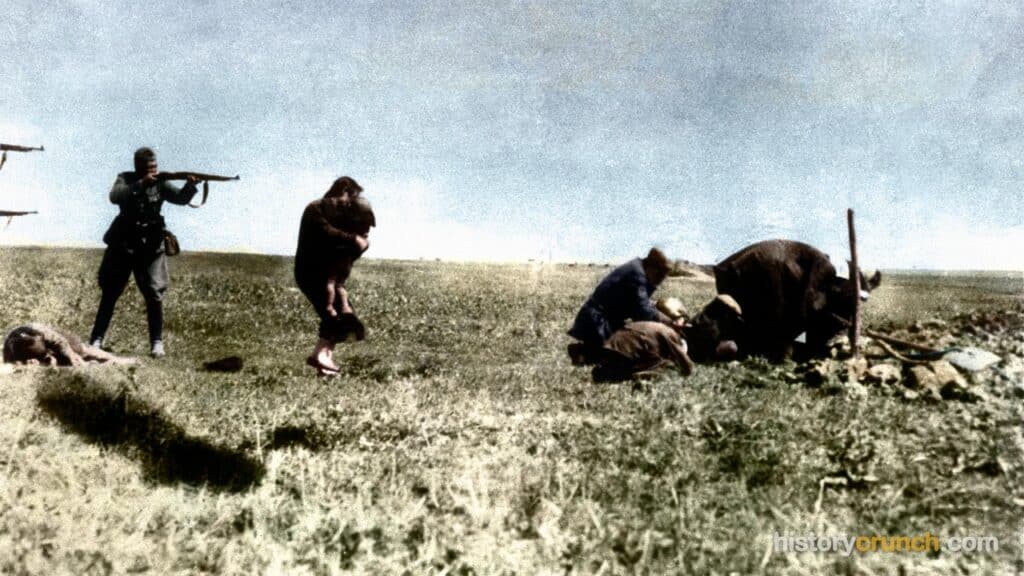
The Final Solution began in 1941, after Germany invaded the Soviet Union. As German armies pushed east, special killing units called the Einsatzgruppen, or “mobile killing squads,” followed behind them. These units rounded up Jewish people in the occupied Soviet territory and shot them in large numbers, often at the edge of pits or trenches. Historians estimate that these squads murdered well over one million people.
Over time, Nazi leaders decided that shooting was too slow and too public for the scale of murder they wanted to carry out. As a result, they began to build fixed killing centers, known as death camps, in occupied Poland. Historians are not able to point to a single day when the decision to murder all of Europe’s Jewish people was made. Instead, most agree that the Final Solution developed step by step over the first years of the war.
An important early moment came on July 31st, 1941, when the Nazi leader Hermann Göring ordered SS official Reinhard Heydrich to prepare a plan for a “Final Solution” of the so-called Jewish question in Europe. This order gave Heydrich the authority to organize the murder of Europe’s Jewish people, and it set in motion the events that followed.
What Was the Wannsee Conference?
The Wannsee Conference was a secret meeting of high-ranking Nazi officials held on January 20th, 1942, at a villa in the Berlin suburb of Wannsee. It was led by Reinhard Heydrich and attended by fifteen senior leaders from the Nazi Party, the SS, and various German government departments. The purpose of the meeting was to coordinate the different parts of the German government so that the Final Solution could be carried out smoothly across Europe.
At the conference, Heydrich informed the officials that the SS would be in charge of the killing program and that Jewish people from across Europe would be deported to occupied Poland and murdered. One of the attendees was Adolf Eichmann, who was placed in charge of organizing the deportations. Before the meeting, Eichmann had prepared a list counting the Jewish population of each country in Europe, which added up to more than 11 million people whom the Nazis planned to murder.
It is important to understand that the Wannsee Conference did not start the killing, since the Einsatzgruppen and the first death camps were already at work. Instead, the conference made the murder more organized and efficient. In fact, none of the officials present objected to the plan, and their agreement helped turn the Final Solution into a coordinated, Europe-wide operation.
How Was the Final Solution Carried Out?
The Final Solution was carried out mainly through a system of death camps built in occupied Poland. Unlike concentration camps, where prisoners were held and forced to work, death camps existed for a single purpose, which was to kill people as quickly as possible. The main death camps included Auschwitz-Birkenau, Treblinka, Sobibor, Belzec, Chelmno, and Majdanek.
More specifically, Jewish people were rounded up from ghettos and towns across Europe and packed into crowded railway cars for long, brutal journeys. When they arrived at a death camp, most were sent almost immediately to gas chambers, which were sealed rooms where victims were killed with poison gas. The Nazis used this method because it allowed them to murder enormous numbers of people in a short amount of time.
The murder continued at a massive scale through 1942 and 1943 and did not stop until Allied armies advanced into Nazi-occupied Europe near the end of World War II. As Allied and Soviet forces liberated the camps in 1944 and 1945, they uncovered the full horror of what the Nazis had done. By the time the war ended, about 6 million Jewish people had been killed, which was roughly two-thirds of all the Jewish people who had lived in Europe before the war.
Significance of Final Solution
The Final Solution is historically significant as the deadliest phase of the Holocaust and one of the clearest examples of government-organized genocide in human history. It showed how a modern state could use its laws, its railways, its factories, and its bureaucracy not to help people but to murder them on an industrial scale. This use of technology and careful planning for the purpose of killing is one of the reasons the event remains so shocking today.
Another important significance of the Final Solution is what it reveals about the dangers of unchecked prejudice and hatred. The murder of millions of Jewish people did not begin with death camps. It began with hateful ideas, discriminatory laws, and the slow removal of a group’s rights. In this way, the Final Solution serves as a powerful warning about where anti-Semitism and other forms of prejudice can lead when they are organized and supported by a government.
Finally, the Final Solution had a lasting effect on the world after 1945. The discovery of the death camps horrified people around the globe and helped shape modern efforts to protect human rights and to prevent future genocides. The word “genocide” itself came into common use in the years just after the Holocaust, and the memory of the Final Solution continues to remind people of the importance of standing against hatred and defending the dignity of all people.
Frequently Asked Questions
What does the term “Final Solution” mean?
The term “Final Solution” was the Nazi code name for their plan to murder all of the Jewish people of Europe. The Nazis chose this vague, official-sounding phrase on purpose so that they could hide the true nature of the genocide from the public and from the outside world. The full German phrase translates as the “Final Solution to the Jewish Question.”
Who was responsible for the Final Solution?
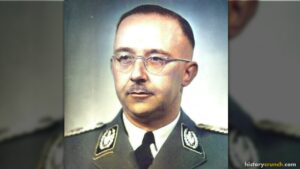
Adolf Hitler and the top leaders of the Nazi Party were responsible for the Final Solution. Key figures included Heinrich Himmler, who led the SS, Reinhard Heydrich, who organized the plan, and Adolf Eichmann, who arranged the deportations of Jewish people to the death camps. Many ordinary officials, soldiers, and workers also took part in carrying it out.
How many people died as a result of the Final Solution?
About 6 million Jewish people were killed as a result of the Final Solution. This was roughly two-thirds of all the Jewish people living in Europe before World War II began. Entire communities in countries such as Poland were almost completely destroyed.
What is the difference between a concentration camp and a death camp?
The main difference is that concentration camps were built to imprison and use people for forced labor, while death camps were built only to kill people. In a concentration camp, prisoners suffered under brutal conditions but were kept alive to work. In a death camp, most victims were killed within hours of arriving, usually in gas chambers.
Did the Final Solution and the Holocaust mean the same thing?
The Final Solution was a specific part of the larger Holocaust, not the same thing as the whole event. The Holocaust lasted from 1933 to 1945 and included many stages, such as discriminatory laws, ghettos, and forced labor. The Final Solution refers to the final and deadliest stage, from 1941 to 1945, when the Nazis carried out the mass murder of Europe’s Jewish people.
Cite This Article
To cite this article as a source, use one of the formats below.
MLA: Millar, B. “Final Solution: A Detailed Summary.” HistoryCrunch, 15 August 2026, https://historycrunch.com/final-solution/.
APA: Millar, B. (2026). Final Solution: A Detailed Summary. HistoryCrunch. https://historycrunch.com/final-solution/
Chicago: Millar, B. “Final Solution: A Detailed Summary.” HistoryCrunch. August 15, 2026. https://historycrunch.com/final-solution/
Sources
- J.M. Roberts & Odd Arne Westad, The Penguin History of the World.
- Jerry Bentley & Herbert Ziegler, Traditions & Encounters: A Global Perspective on the Past.