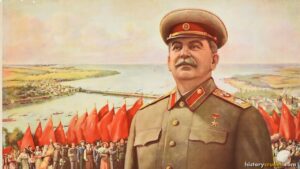
The rise to power of Joseph Stalin was one of the most important political developments of the 20th century, because it placed one of history’s most feared dictators at the head of the Soviet Union, the world’s first communist state. Stalin was not the obvious choice to lead the country after the death of Vladimir Lenin, the founder of the Soviet state. Yet through patience, careful planning, and a talent for turning his rivals against one another, he gradually took total control of the Communist Party and the government. His climb from a poor childhood in the country of Georgia to absolute ruler of a vast empire reshaped Russia and the wider world for decades.
In simple terms, a rise to power is the process by which a person gains control of a government or political system, often by outmaneuvering rivals and building support among key groups. In Stalin’s case, this process took place inside a one-party state, where the Communist Party controlled the government and there were no free elections. Because power was held within the party rather than by the public, Stalin’s rise depended on winning control of the party’s inner machinery rather than on votes.
What Was the Russian Revolution and the Early Soviet Union?
To understand Stalin’s rise, it helps to understand the world he came from. The Russian Revolution of 1917 was one of the most significant events of the early 20th century. It led to the downfall of the Russian monarchy and the creation of the world’s first communist state. Before 1917, Russia was ruled by a tsar, the title given to Russia’s absolute monarchs, and the last tsar was Nicholas II.
By 1917, anger at the tsar had reached a breaking point. The strains of World War I, food shortages, and deep poverty among Russian peasants combined to spark revolt. In February of 1917, Tsar Nicholas II was forced to give up his throne, ending centuries of Romanov rule, and a temporary body called the Provisional Government took charge. However, this new government struggled to fix Russia’s problems and kept the country in the war.
Later that year, a radical group called the Bolsheviks seized the chance to take over. The Bolsheviks were a revolutionary faction of the Russian Social Democratic Labor Party, led by Vladimir Lenin. In October of 1917, they overthrew the Provisional Government and set up communist rule, creating the Soviet Union. A brutal civil war followed, in which the Bolshevik Red forces fought the anti-Bolshevik White forces before finally winning control. It was inside this new state that Stalin would climb to power.
Who Was Joseph Stalin Before He Came to Power?
Joseph Stalin was born on December 18th, 1878, in the town of Gori, in the country of Georgia. At the time, Georgia was located between Eastern Europe and West Asia and was part of the Russian Empire. His birth name was Ioseb Besarionis dze Jughashvili, a Georgian name that was later changed into the Russian form Iosif Vissarionovich Dzhugashvili. He came from a poor family, as his father was a cobbler and his mother took in washing to earn money.
Stalin’s childhood was difficult. As a young boy he caught smallpox, a serious disease that left scars across his face for the rest of his life. His mother hoped he would become a priest, so she sent him to a religious school in Tiflis, the Georgian capital. While studying there, however, the young Stalin discovered the writings of Karl Marx, the founder of communist thought, and turned toward revolutionary politics instead of religion.
Stalin left his studies and became a full-time revolutionary in the underground Marxist movement, which was illegal under the tsar. In 1903 he joined the Bolshevik faction led by Lenin. Over the following years he raised money for the movement through robberies and other illegal activities, and he was arrested and sent into exile several times. In 1912, Lenin appointed him to the first Central Committee of the Bolshevik Party, an important leadership body, which marked his first major step upward.
How Did Stalin Gain Influence in the Communist Party?
After the Bolsheviks took power in 1917, Stalin held a series of government and party posts. During the Russian Civil War he took on difficult tasks and built a reputation as someone who could get hard jobs done. More specifically, he showed that he was tough, loyal, and willing to work behind the scenes, qualities that brought him closer to Lenin.
Even so, Stalin struggled to win the respect of the leading Bolshevik thinkers, who were highly educated and skilled at public speaking. Stalin lacked their formal schooling, so he was given jobs that others saw as dull and administrative. In April of 1922, he was made General Secretary of the Communist Party, a position that seemed to involve mostly paperwork and organization.
In reality, the post of General Secretary was far more powerful than it looked. As General Secretary, Stalin controlled appointments within the party, which meant he decided who got jobs and promotions. He used this power to fill the government with people loyal to him, slowly building a network of supporters while pushing his rivals to the side. This quiet control of the party machine became the key to his rise.
What Happened After Lenin’s Death?
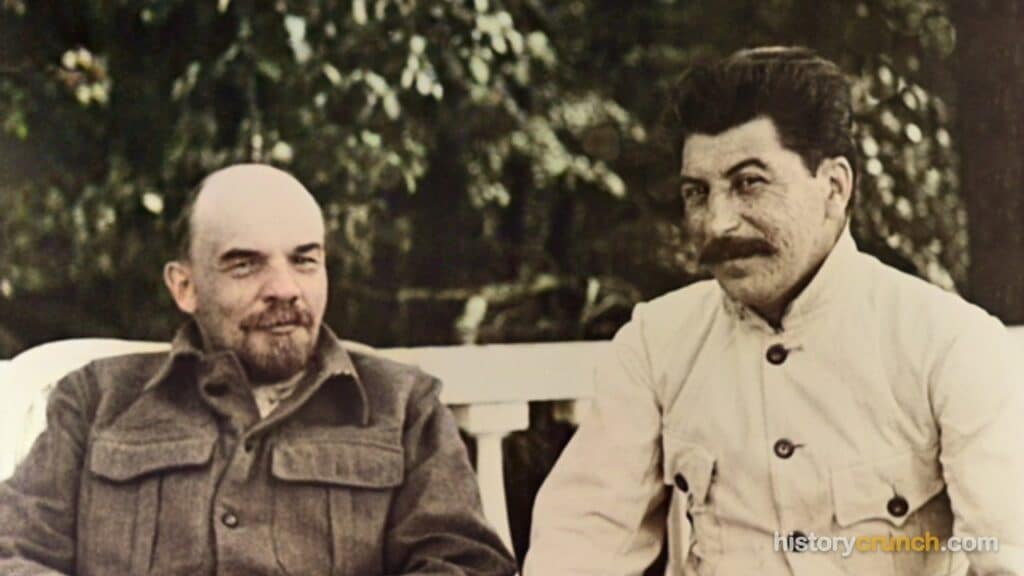
Vladimir Lenin died in January of 1924, and his death set off a struggle over who would lead the Soviet Union. Stalin’s main rival was Leon Trotsky, a brilliant speaker and writer who had been a trusted ally of Lenin and a hero of the civil war. Many people expected Trotsky, not Stalin, to become the next leader.
Before his death, Lenin had written a document, later called his Testament, in which he warned that Stalin had gathered too much power and questioned whether he could be trusted to use it carefully. This warning could have ended Stalin’s career. However, Stalin used his position and his allies to limit the damage, and the document was kept quiet rather than being widely acted upon.
Stalin also worked to present himself as Lenin’s true follower. After Lenin’s death, he traveled the country giving lectures on Lenin’s ideas and framed himself as the natural successor. By tying his own image to the beloved founder of the Soviet state, Stalin gained trust among ordinary party members and made himself appear as the safe, loyal choice to continue Lenin’s work.
How Did Stalin Defeat His Rivals?
Stalin’s greatest political skill was setting his rivals against one another. At first he joined with two other leaders, Grigory Zinoviev and Lev Kamenev, to isolate Trotsky within the party. Working together, this group blocked Trotsky’s influence and slowly stripped him of his power and positions.
Once Trotsky was weakened, Stalin turned against his former partners. He shifted his alliances toward other leaders and used the same methods against Zinoviev and Kamenev that he had used against Trotsky. One by one, the men who had once stood beside him found themselves pushed out of the leadership.
Trotsky suffered the harshest fate. Stalin had him expelled from the Communist Party, then sent into internal exile within the Soviet Union, and finally forced him out of the country entirely in 1929. With Trotsky gone and his other opponents defeated, Stalin next removed the party’s right wing, including Nikolai Bukharin, who had opposed his economic plans. By the end of the 1920s, Stalin had centralized all power in the Soviet Union under himself and ruled as a communist dictator.
Significance of Rise to Power of Joseph Stalin
The significance of Stalin’s rise to power is enormous, because it decided the direction of the Soviet Union for nearly thirty years. Once in control, Stalin transformed the country from a poor farming society into a major industrial and military power. He did this through forced programs of industrialization and the collectivization of farming, in which peasants were made to give up their land and join large state-run farms.
These policies came at a terrible human cost. Millions of people died from famine, forced labor, and political violence during Stalin’s rule. He turned the Soviet Union into a totalitarian state, meaning the government tried to control almost every part of people’s lives, and he created a climate of fear in which citizens were afraid to criticize the government. His name became linked to a whole system of rule known as Stalinism.
Beyond Russia, Stalin’s rise shaped world events for generations. Under his leadership, the Soviet Union helped defeat Nazi Germany in World War II and emerged afterward as one of the two global superpowers, alongside the United States. This set the stage for the Cold War, a long period of tension between the communist and Western worlds. In this way, the once-overlooked General Secretary from Georgia became one of the most powerful and feared figures in modern history.
Frequently Asked Questions
How did Stalin come to power in the Soviet Union?
Stalin came to power by taking control of the Communist Party’s inner machinery rather than by winning an election. As General Secretary, he decided who received party jobs, which allowed him to surround himself with loyal supporters. After Lenin died in 1924, he used this control, along with clever alliances, to defeat his rivals one by one and become the sole leader by the end of the 1920s.
Why did Stalin become leader instead of Trotsky?
Stalin became leader instead of Trotsky mainly because he controlled the party organization while Trotsky did not. Trotsky was a more famous speaker and thinker, but he underestimated Stalin and made political mistakes. Stalin also built temporary alliances with other leaders to isolate Trotsky, and he presented himself as Lenin’s loyal successor, which won him wider support among ordinary party members.
What was the role of General Secretary?
The General Secretary was the head of the Communist Party’s administration, a job that at first looked like simple paperwork. In practice, the role controlled appointments and promotions across the party and government. Stalin took this post in 1922 and turned it into the most powerful position in the country by filling key offices with people who owed their careers to him.
What was Lenin’s Testament and why did it matter?
Lenin’s Testament was a document Lenin wrote near the end of his life that warned about Stalin holding too much power. It mattered because it could have blocked Stalin’s rise if the party had acted on it strongly. Instead, Stalin and his allies managed to limit its impact, and the warning was largely set aside, allowing Stalin to keep his position.
How long did it take Stalin to gain full power?
It took Stalin most of the 1920s to gain full power, roughly from Lenin’s death in 1924 to the end of the decade. He first weakened Trotsky, then turned against his own allies, and finally removed the party’s right wing. By around 1929 he had defeated all serious rivals and ruled the Soviet Union without challenge.
Cite This Article
To cite this article as a source, use one of the formats below.
MLA: Millar, B. “Rise to Power of Joseph Stalin: A Detailed Summary.” HistoryCrunch, 11 August 2026, https://historycrunch.com/rise-to-power-of-joseph-stalin/.
APA: Millar, B. (2026). Rise to Power of Joseph Stalin: A Detailed Summary. HistoryCrunch. https://historycrunch.com/rise-to-power-of-joseph-stalin/
Chicago: Millar, B. “Rise to Power of Joseph Stalin: A Detailed Summary.” HistoryCrunch. August 11, 2026. https://historycrunch.com/rise-to-power-of-joseph-stalin/
Sources
- Jerry Bentley & Herbert Ziegler, Traditions & Encounters: A Global Perspective on the Past.
- J.M. Roberts & Odd Arne Westad, The Penguin History of the World.