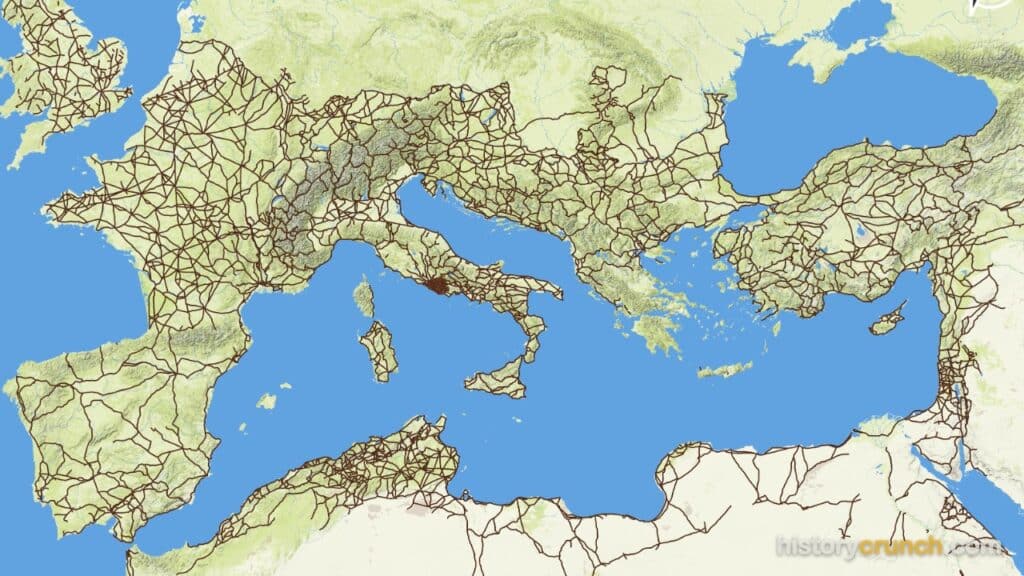
Ancient Roman roads were one of the most important engineering achievements of the ancient world, and they helped hold together an empire that stretched across three continents. These roads formed a vast transportation network that connected the city of Rome to distant provinces, allowing armies, traders, messengers, and ordinary travelers to move across the empire with remarkable speed. Built to be straight, sturdy, and long-lasting, many Roman roads were used for centuries, and some still survive today. The roads were such a defining feature of Roman power that the old saying “all roads lead to Rome” reflected a real truth about how the network was designed.
A Roman road was a carefully engineered route, usually built in layers, that linked cities, military camps, and ports across the territory Rome controlled. The best roads were paved with stone, raised in the center for drainage, and marked with stone milestones that showed distances. Together these roads made up a system that supported the movement of the Roman army, the collection of taxes, and the flow of goods and information throughout the Roman world.
What Was Ancient Rome?
Ancient Rome was one of the most powerful civilizations in world history. It began as a small city-state on the Italian peninsula and grew over many centuries into a vast empire that stretched from Britain in the northwest to Egypt in the southeast. At its height, the Roman Empire controlled much of Europe, North Africa, and parts of the Middle East. Roman civilization is remembered for its contributions to law, government, architecture, language, and culture.
Historians generally divide Roman history into three periods. The Roman Kingdom lasted from the founding of the city in 753 BCE until 509 BCE, when the Romans overthrew their last king. The Roman Republic followed, lasting from 509 BCE to 27 BCE, and it was during this time that Rome conquered most of the Mediterranean world and began building its first great roads. The final period was the Roman Empire, ruled by emperors from 27 BCE onward, during which the road network expanded to its greatest size.
Rome’s growth depended on its ability to control and connect huge amounts of territory. As the Roman army conquered new lands, the government needed a way to move soldiers, supplies, and orders quickly from one place to another. The roads were a direct answer to this need, and they grew alongside the empire itself.
Why Did the Romans Build Roads?
The main reason the Romans built roads was military. Fast, reliable routes allowed Roman legions to march quickly to trouble spots, whether to fight a foreign enemy or to put down a rebellion inside the empire. On a good road, a legion could cover as much as 20 miles (32 km) in a single day. This speed meant that even distant parts of the Roman world could be reinforced quickly, which reduced the need for large and expensive armies stationed everywhere at once.
Roads also grew directly out of conquest. As Roman armies pushed into new regions, engineers built new highways to link captured cities to Rome and to turn them into Roman colonies. In fact, the first great Roman road, the Via Appia, was begun in 312 BCE as a supply route during a war against the Samnites, a people of central Italy. Once a road was in place, it made Roman control of the surrounding land much stronger.
Beyond the military, the roads served government and everyday life. Officials used them to travel and to collect taxes, while merchants used them to carry goods between towns and ports. As stated above, the roads also carried news and ideas, tying together a huge and varied population under a single government.
How Were Roman Roads Built?
Roman engineers were famous for building roads as straight as possible, even when this meant cutting through hills, crossing marshes, or bridging rivers. A fully paved main road, which the Romans called a via munita, was built in several layers stacked on top of one another. Workers first dug a trench, then filled it with layers of stone, gravel, sand, and sometimes concrete, before topping it with tightly fitted paving stones.
These layers gave the road a solid foundation and helped it last for a very long time. The surface was raised slightly in the middle, a shape called a camber, so that rainwater would run off the sides instead of collecting on the road. The Romans often used a special concrete made from volcanic ash and lime, which was extremely durable. More specifically, the polished stones of some roads fit together so tightly that later writers marveled they seemed to have grown together rather than been laid by hand.
Much of this construction was done by the Roman army itself. Engineers were regular members of the legions, and their skill in building roads, forts, and bridges was unmatched by any other culture of the time. When roads crossed rivers or deep valleys, the Romans built strong stone bridges, some of which still stand today. They also dug tunnels through hillsides to keep routes as short and direct as possible.
What Were the Most Famous Roman Roads?
The most famous Roman road was the Via Appia, or Appian Way, which the Romans called the “Queen of Roads.” Begun in 312 BCE, it first linked Rome to the city of Capua in as straight a line as possible, and it was later extended all the way to Brundisium (modern Brindisi) on the Adriatic coast. One stretch of about 90 miles (145 km) was laid out as a single straight line, showing the confidence of Roman engineers.
Italy was crossed by many other named roads as well. The Via Flaminia ran north from Rome toward the Adriatic, the Via Aurelia followed the west coast of Italy, and the Via Salaria, or “salt road,” carried salt into the interior. As the empire spread, the network reached far beyond Italy. For instance, the Via Egnatia crossed the Balkan Peninsula and connected the western and eastern halves of the empire, while the Via Domitia ran through southern Gaul and was vital for moving troops toward Spain.
In all, the Romans built roughly 50,000 miles (80,000 km) of hard-surfaced highway across their empire. Beyond these paved main roads lay a much larger web of smaller, unpaved routes that connected farms, villas, and villages. In reality, most of the roads in the Roman Empire were these smaller local paths rather than the grand paved highways, and together they linked nearly every settlement to the overall network.
What Was Travel Like on Roman Roads?
Traveling on a Roman road was easier and safer than travel almost anywhere else in the ancient world, but it was still slow by modern standards. Ordinary travelers in carts covered about 15 to 20 miles (24 to 32 km) a day. Along the way they passed stone milestones, which were markers that showed the distance to the next town and sometimes named the emperor who had paid to repair the road.
The roads were lined with rest stops built and run by the government. Small stations called mutationes stood every several miles, where official couriers could swap a tired horse for a fresh one. Larger inns called mansiones appeared roughly every 20 miles (32 km) and offered lodging, food, stables, and baths for people and animals. This system, part of the imperial postal service, let messengers on urgent business cover around 50 miles (80 km) in a single day.
Travel still carried risks, and bandits were a real danger in remote areas. To protect travelers, detachments of soldiers patrolled the busier roads, manning watchposts and helping to keep order. These same troops sometimes collected tolls or taxes on goods when a route crossed a bridge, a mountain pass, or the border of a province.
Significance of Ancient Roman Roads
The significance of ancient Roman roads is hard to overstate, because they were one of the main tools that allowed Rome to build and hold its enormous empire. By connecting distant provinces to the capital, the roads let the government move armies, officials, and information across thousands of miles. This made it possible to rule a territory that stretched from Britain to the Middle East from a single center of power.
The roads also helped unify the many peoples and cultures of the empire. Trade goods, languages, customs, and religions all traveled along the same routes that carried the legions. For instance, early Christianity spread across the Roman world in large part by following the network of roads that missionaries used to move from city to city. In this way, the roads shaped not only Roman history but the later history of Europe and the Mediterranean.
Finally, Roman roads left a lasting mark on the world long after the empire fell. Many modern European roads follow the exact routes the Romans laid out, and some ancient roads and bridges are still in use. The engineering ideas behind them, such as layered foundations, drainage, and durable paving, influenced road building for many centuries and remain part of how roads are understood today.
Frequently Asked Questions
How long were Roman roads in total?
The Romans built about 50,000 miles (80,000 km) of paved main roads across their empire. When smaller unpaved routes are included, recent research suggests the true total was far larger, reaching well over 180,000 miles (290,000 km). This enormous web connected nearly every corner of the Roman world.
Why did the Romans build their roads so straight?
The Romans built straight roads to make travel as fast as possible, especially for the army. A straight route was the shortest distance between two points, so it saved time for marching soldiers and traveling officials. Roman engineers were willing to cut through hills and build bridges and tunnels rather than curve a road around an obstacle.
Who built the Roman roads?
Roman roads were mostly built by the soldiers of the Roman army. Engineers were regular members of the legions, and they laid out and constructed roads as the army expanded into new territory. In conquered regions, local populations were often required to provide labor, materials, and money to help build and maintain the roads.
Are any Roman roads still used today?
Yes, parts of many Roman roads still survive and are sometimes still traveled. Numerous modern highways in Europe follow the same routes the Romans first laid out, and stretches of original Roman paving can still be seen in places like Italy. The famous Via Appia is protected as a historic site because of its importance.
What is the meaning of “all roads lead to Rome”?
The saying “all roads lead to Rome” reflects the fact that the Roman road network was designed with the city of Rome at its center. Major highways radiated outward from the capital to reach the provinces, so travelers moving through the empire were often heading toward or away from Rome. Today the phrase is used to mean that different paths can lead to the same goal.
Cite This Article
To cite this article as a source, use one of the formats below.
MLA: Millar, B. “Ancient Roman Roads: A Detailed Summary.” HistoryCrunch, 7 July 2026, https://historycrunch.com/ancient-roman-roads/.
APA: Millar, B. (2026). Ancient Roman Roads: A Detailed Summary. HistoryCrunch. https://historycrunch.com/ancient-roman-roads/
Chicago: Millar, B. “Ancient Roman Roads: A Detailed Summary.” HistoryCrunch. July 7, 2026. https://historycrunch.com/ancient-roman-roads/
Sources
- The Met (Heilbrunn Timeline) — Roman art
- Fordham Ancient History Sourcebook
- Mary Beard, SPQR: A History of Ancient Rome.