Ancient Roman weapons and armor were among the most important reasons that Rome grew from a small city in central Italy into the largest empire of the ancient world. The equipment carried by Roman soldiers, combined with strict training and discipline, gave Rome a major advantage over its many enemies. From the short sword and the throwing spear to the layered shield and iron body armor, Roman military gear was designed with a clear purpose, which was to close with an enemy and defeat it quickly. This equipment belonged to the story of the Roman army, the fighting force that carried Rome through the Roman Kingdom, the Roman Republic, and the Roman Empire.
Weapons and armor in ancient Rome were the tools of war carried by soldiers of the Roman military. The word “weapon” refers to an object used to attack an enemy, such as a sword, spear, or dagger, while “armor” refers to protective gear worn on the body or carried in the hand, such as a helmet, breastplate, or shield. Together, these items made up the standard kit of a Roman soldier, and they changed slowly over the many centuries that Rome remained a great power.
What Was Ancient Rome?
Ancient Rome was one of the most important civilizations in world history. Over the course of more than a thousand years, it grew from a small monarchy into a vast empire that ruled over much of Europe, North Africa, and the Middle East. The history of ancient Rome is generally divided into three periods, which were the Roman Kingdom, the Roman Republic, and the Roman Empire.
The Roman Kingdom was the earliest period, when Rome was ruled by kings and was heavily influenced by its neighbors, especially the Etruscans to the north and the Greeks to the south. The Roman Republic followed, and during these centuries Rome expanded across Italy and around the Mediterranean Sea through repeated warfare. The Roman Empire began in 27 BCE with the rule of the emperor Augustus, and it was during this time that the Roman army reached the height of its size and organization. In fact, much of Rome’s success in all three periods depended on the strength, discipline, and equipment of its military.
How Did Roman Weapons and Armor Change Over Time?
Roman weapons and armor did not stay the same across the centuries. In the earliest days, Roman soldiers fought in a large block formation called a phalanx, which the Romans borrowed from the Greeks. In this style of fighting, soldiers carried long spears and pressed forward together as a single mass.
Over time, the Romans found that the phalanx was too stiff for the hills and valleys of central Italy. As a result, they developed a more flexible system based on smaller units called maniples, arranged in three lines like a checkerboard. During this Republican period, soldiers usually supplied their own equipment, which meant that the quality of arms and armor could vary a great deal from man to man. Wealthier citizens could afford better gear, while poorer soldiers often carried very little protection.
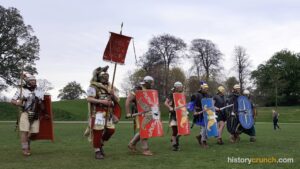
A major change came in 107 BCE with the reforms of the Roman general and consul Gaius Marius. More specifically, Marius opened the army to poorer citizens and had the state provide standard weapons and armor to every legionary. After these reforms, all soldiers were armed and protected in the same way, which made the army far more uniform and easier to command. This standardized equipment continued through much of the Roman Empire and became the classic image of the Roman soldier that people picture today.
What Weapons Did Roman Soldiers Use?
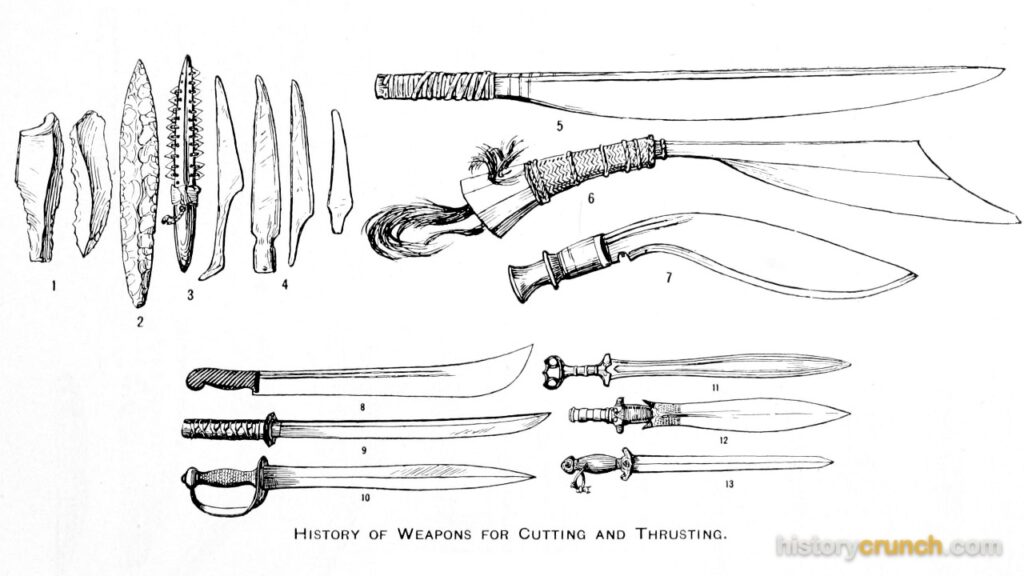
The most famous Roman weapon was the gladius, a short sword used mainly for stabbing in close combat. The gladius had a short, double-edged blade, usually around 18 to 24 inches (45 to 60 cm) long, that was ideal for thrusting into an enemy’s chest or stomach. Roman training taught soldiers to stab rather than slash, because a thrust could be deadly even when it went in only a couple of inches, while a slash was more likely to be stopped by bone or armor. The handle was made of wood or bone and fit snugly in the hand, giving the soldier excellent control.
Another key weapon was the pilum, a heavy throwing spear. The pilum had a long wooden shaft attached to a thin iron shank with a sharp point, and it was around 6 feet (1.8 m) long. Roman soldiers threw their pila at the enemy just before charging, aiming to punch through shields and armor. In fact, the iron point was designed to bend after it struck, so that an enemy could not easily pull it free or throw it back, and a pilum stuck in a shield often forced the enemy to drop that shield entirely.
Roman soldiers also carried a dagger called the pugio as a backup weapon for very close fighting. In later centuries, a longer sword known as the spatha became common, especially among cavalry and among foot soldiers in the later Empire. The spatha had a longer, wider blade than the gladius, which made it better for slashing and cutting in open formations. Some soldiers also used lead-weighted darts called plumbatae, which they clipped to the back of their shields and threw to wound the enemy at a distance.
What Armor and Shields Did Roman Soldiers Wear?
Roman soldiers used several kinds of body armor over the centuries. One well-known type was the lorica segmentata, a suit of overlapping iron plates joined by leather straps and hinges. This armor protected the torso and shoulders very well while still allowing the soldier to move freely, and it is the type most often shown on Roman monuments. It was mainly used from the 1st to the 3rd century CE.
Another common type was the lorica hamata, or chain mail, which was made of thousands of small iron rings linked together. Chain mail was very durable and could last for decades, which made it popular for a long stretch of Roman history. Some soldiers wore hardened leather reinforced with metal, while poorer soldiers in the early Republic sometimes wore only a small plate strapped across the chest.
To protect the head, Roman soldiers wore a helmet, which they called a galea. Helmet styles changed over time, but later models added neck guards and cheek pieces to protect the face and back of the neck. The most important piece of protective gear, however, was the scutum, the large curved shield carried by legionaries. The scutum was made of layers of wood glued together and covered with leather or canvas, with metal edges and a metal boss in the center, and it weighed around 22 pounds (10 kg). As stated above, its curved shape let a soldier hold it close to his body, and when many soldiers locked their shields together, they formed a wall that was very hard for an enemy to break.
What Siege Weapons Did the Romans Use?
Beyond the gear carried by individual soldiers, the Romans also built large machines for attacking enemy walls and formations. These siege engines could do great damage from a distance, especially when supported by infantry and cavalry. Many of these designs were first developed by the ancient Greeks and then improved by Roman engineers.
One such machine was the ballista, a giant device that worked much like an enormous crossbow. It could hurl heavy balls or large bolts that pierced shields and armor with tremendous force. A smaller version called the scorpio fired lighter bolts, and each legion was equipped with dozens of them for use in both attack and defense. Another machine, the onager, was a type of catapult that flung heavy stones and boulders to smash through walls. In reality, the Romans named the onager after the wild ass because of the powerful kick it produced when it was fired.
Significance of Ancient Roman Weapons and Armor
Ancient Roman weapons and armor were a central reason for Rome’s long military success. Roman equipment was generally of better quality and more widely available than the gear of most of Rome’s enemies, many of whom fought with little more than a shield for protection. Soldiers equipped with shields, helmets, and strong body armor held a major advantage in long battles, especially when they fought in tight, disciplined formations.
Just as important was the way the equipment was designed to work together. The pilum weakened the enemy line, the scutum protected the soldier as he advanced, and the gladius finished the fight up close. This careful, purpose-built system, combined with heavy training and iron discipline, allowed the Roman army to defeat larger and often braver foes. For this reason, Roman weapons and armor helped Rome conquer and hold territory stretching from Britain to the Middle East for many centuries.
Finally, the study of Roman arms and armor still shapes how people understand the ancient world today. Surviving pieces found by archaeologists, along with carvings on Roman monuments, reveal how Roman soldiers lived and fought. As a result, the sword, shield, and spear of the Roman legionary remain some of the most recognizable symbols of ancient Rome and its power.
Frequently Asked Questions
What was the main weapon of a Roman soldier?
The main weapon of a Roman legionary was the gladius, a short sword used for stabbing at close range. Each legionary usually carried this sword along with one or two pila, which were heavy throwing spears, plus a pugio dagger as a backup. This combination let a soldier attack from a distance and then finish the fight face to face.
What was Roman armor made of?
Roman armor was made mostly of iron, bronze, and leather, depending on the type and the time period. The lorica segmentata used overlapping iron plates, while the lorica hamata was built from thousands of linked iron rings. Blacksmiths and armorers across the Empire produced this gear once the state began supplying soldiers with standard equipment.
Why did the Roman pilum bend when thrown?
The pilum was designed to bend on impact so that enemies could not throw it back or easily remove it from a shield. When the soft iron shank bent after striking a shield, the heavy, dangling spear made that shield awkward to hold, often forcing the enemy to drop it. This left the opponent exposed just as the Romans charged in with their swords.
How heavy was a Roman shield?
A Roman scutum weighed roughly 22 pounds (10 kg) and was built from layers of wood covered in leather. Soldiers trained for hours to carry and fight with this heavy shield, which also protected them during long marches and camp building. Its weight and curved shape made it strong enough to stop arrows, spears, and sword blows.
Did Roman soldiers use bows and arrows?
Roman legionaries relied mainly on swords and spears rather than bows, but archers still played a role in the army. These archers, known as sagittarii, were often recruited from allied peoples such as the Cretans and served as specialist support troops. Their long-range arrows helped weaken and scatter enemy formations before the heavy infantry moved in to attack.
Cite This Article
To cite this article as a source, use one of the formats below.
MLA: Millar, B. “Ancient Roman Weapons and Armor: A Detailed Summary.” HistoryCrunch, 7 July 2026, https://historycrunch.com/ancient-roman-weapons-and-armor/.
APA: Millar, B. (2026). Ancient Roman Weapons and Armor: A Detailed Summary. HistoryCrunch. https://historycrunch.com/ancient-roman-weapons-and-armor/
Chicago: Millar, B. “Ancient Roman Weapons and Armor: A Detailed Summary.” HistoryCrunch. July 7, 2026. https://historycrunch.com/ancient-roman-weapons-and-armor/
Sources
- Adrian Goldsworthy, How Rome Fell / Caesar (military and political).
- Fordham Ancient History Sourcebook
- Mary Beard, SPQR: A History of Ancient Rome.