The Roman Army was one of the most powerful and effective military forces in the ancient world. It was the instrument through which Rome conquered and held an empire stretching from Britain to Egypt, and it played a central role in Roman society, politics, and daily life for over a thousand years. The army was not just a fighting force. It was also an engineering corps, a road-building crew, and a vehicle for social mobility that allowed men from humble backgrounds to earn citizenship, land, and a respected place in Roman society. Understanding the Roman Army is essential to understanding how Rome became as powerful as it did and how it maintained that power for so long.
WHAT WAS ANCIENT ROME?
Ancient Rome was one of the most powerful civilizations in world history. It began as a small city-state on the Italian peninsula and grew over many centuries into a vast empire that stretched from Britain in the northwest to Egypt in the southeast. At its height, the Roman Empire controlled much of Europe, North Africa, and parts of the Middle East. Roman civilization is remembered for its contributions to law, government, architecture, language, and culture. The Roman Army was the foundation on which all of this was built, and without it, the empire could not have been created or maintained.
ROMAN ARMY – ORIGINS AND EARLY DEVELOPMENT
In the earliest days of Rome, the army was not a professional standing force. It was made up of citizen soldiers, men who owned property and were expected to serve when called upon during the campaign season. Soldiers provided their own weapons and armor, meaning the quality of equipment depended largely on a man’s wealth. The earliest Roman army fought using a formation borrowed from the Greeks called the phalanx, in which soldiers stood shoulder to shoulder in tight rows with overlapping shields. Over time the Romans developed a more flexible formation called the maniple system, which divided the army into smaller units that could respond more quickly to different kinds of terrain and opponents.
The most important reform of the Roman Army came under the general and consul Gaius Marius around 107 BCE. Marius opened the legions to all Roman citizens regardless of property ownership, dramatically expanding the pool of available soldiers. He standardized equipment for the first time, with the state providing weapons and armor rather than requiring each man to supply his own. He reorganized the legion around a larger unit called the cohort, introduced a heavier javelin called the pilum designed to bend on impact and prevent the enemy from throwing it back, and required soldiers to carry most of their own equipment on the march. After the Marian Reforms, soldiers served standard terms of around 20 years, making the Roman Army a professional standing force for the first time.
ROMAN ARMY – ORGANIZATION
The basic unit of the Roman Army was the legion. In the imperial period, a standard legion consisted of approximately 5,000 to 5,500 soldiers organized into ten cohorts. Each cohort was divided into six centuries of around 80 men. The officer in charge of each century was called a centurion, who was responsible for the training, discipline, and battlefield leadership of his men. Centurions were the backbone of the Roman Army: experienced, tough, and closely connected to the daily life of their soldiers. The first cohort of each legion was double strength, around 800 men, and contained the most experienced soldiers in the formation.
Each legion also carried a sacred standard called the aquila, or eagle, which was the symbol of the legion’s honor. Losing the aquila in battle was considered a catastrophic disgrace. Legions were led by senior officers called legates, typically experienced senators appointed by the emperor.
In addition to the legions of Roman citizens, the army also included auxiliary units recruited from non-citizen peoples across the empire. Auxiliaries served for 25 years and received Roman citizenship at the end of their service. They included specialist fighters such as archers from Syria, slingers from the Balearic Islands, and cavalry from North Africa. At the height of the empire, legions and auxiliaries together gave Rome an estimated total force of over 400,000 soldiers protecting roughly 4,350 miles (7,000 km) of frontier.
ROMAN ARMY – WEAPONS AND ARMOR
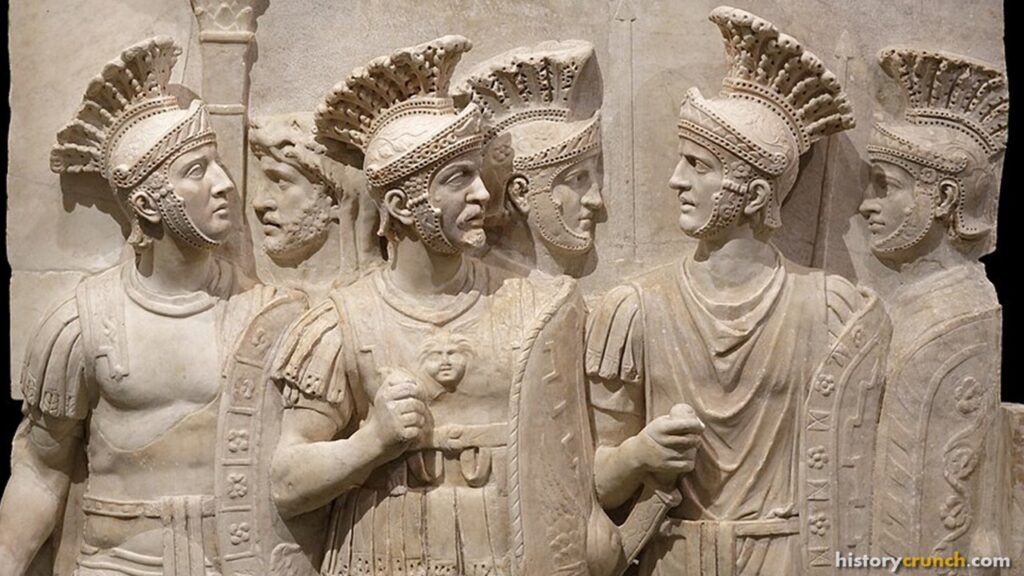
A standard Roman legionary in the imperial period was equipped for maximum effectiveness in close-quarters battle. His armor typically consisted of the lorica segmentata, a suit of overlapping iron strips that protected the torso while allowing good freedom of movement. He wore an iron helmet that protected the head and neck. Officers and centurions wore distinctive crests on their helmets to help soldiers identify them in battle.
Every legionary carried a large curved rectangular shield called a scutum, made from layered wood and covered in leather, with an iron boss at the center. The standard weapons were the pilum and the gladius. The pilum was a heavy javelin roughly 6 to 7 feet (about 2 meters) long, thrown at the enemy just before hand-to-hand fighting began. It was designed so its iron tip bent on impact, making it impossible to pull from a shield and throw back. The gladius was a short double-edged sword around 24 to 31 inches (60 to 80 cm) long, designed for thrusting and stabbing in the tight press of close combat.
ROMAN ARMY – TRAINING AND DISCIPLINE
The effectiveness of the Roman Army rested above all on training and discipline. New recruits underwent months of intensive training before being considered ready for active service. They learned to march in step, form up in battle order, handle weapons correctly, and build the fortified camp that the army erected at the end of every day’s march. Roman soldiers were expected to march up to 18 miles (30 km) a day in full armor, carrying equipment that could weigh up to 88 pounds (40 kg).
Discipline in the legions was strict. Minor infractions were punished with extra duties or flogging. The most extreme collective punishment was decimation, in which one soldier in every ten was selected by lot and beaten to death by his fellow soldiers. Though rarely used, its existence reinforced the culture of absolute obedience that made Roman formations so reliable in battle. In return for their service, soldiers received a regular wage, food, equipment, and the promise of a land grant or cash payment at the end of their service.
ROMAN ARMY – TACTICS AND BATTLEFIELD PERFORMANCE
Roman battle tactics were built around the flexibility and discipline of the cohort system. Unlike the Greek phalanx, which relied on a single rigid line that could collapse under pressure, the Roman formation could maneuver, reinforce weak points, and respond to changing conditions on the battlefield. When the front rank of soldiers tired, they withdrew and fresh soldiers moved up to replace them, keeping the fighting line at full strength throughout an engagement.
One of the most famous Roman formations was the testudo, or tortoise, in which soldiers locked their shields together above and around them to form a protective shell against missiles, particularly useful during siege operations. Roman commanders also used artillery, including catapults and bolt-throwing machines called scorpiones, both on the battlefield and during sieges. The engineering skill of the army made it exceptional at siege warfare, able to build elaborate walls, ramps, and fortifications with remarkable speed.
ROMAN ARMY – LIFE AS A SOLDIER
Life in the Roman Army was demanding but offered real rewards for those who completed their service. Soldiers were not permitted to marry legally during their term of service, though many formed unofficial families near their posts. They received a regular wage with deductions for food, equipment, and clothing. In their spare time, soldiers trained, maintained equipment, and performed the many logistical tasks that kept the army functioning.
Soldiers also spent considerable time building. Roman legionaries constructed the roads, bridges, forts, and aqueducts of the empire, carrying shovels as standard equipment alongside their weapons. At the end of their service, veterans were rewarded with either a grant of land or a cash payment worth several years of wages. Many veterans settled in colonies near their former postings, spreading Roman culture and citizenship across the provinces.
SIGNIFICANCE OF THE ROMAN ARMY
The Roman Army was the engine of the Roman Empire. Without it, there would have been no conquest, no Pax Romana, no roads, no aqueducts, and no spread of Roman law and culture across the known world. Its combination of superior organization, standardized equipment, rigorous training, and engineering skill made it the most effective military force in the ancient world for centuries.
The army also shaped Roman society in deep ways. The Marian Reforms tied soldiers’ loyalty to their generals rather than the state, contributing directly to the political instability of the late Republic and the rise of emperors like Julius Caesar and Augustus. In the provinces, veterans and their families were among the most important agents of Romanization, spreading the Latin language, Roman customs, and Roman law far beyond Italy. The legacy of the Roman Army can still be seen today in the road networks, city layouts, and legal traditions of much of Europe.