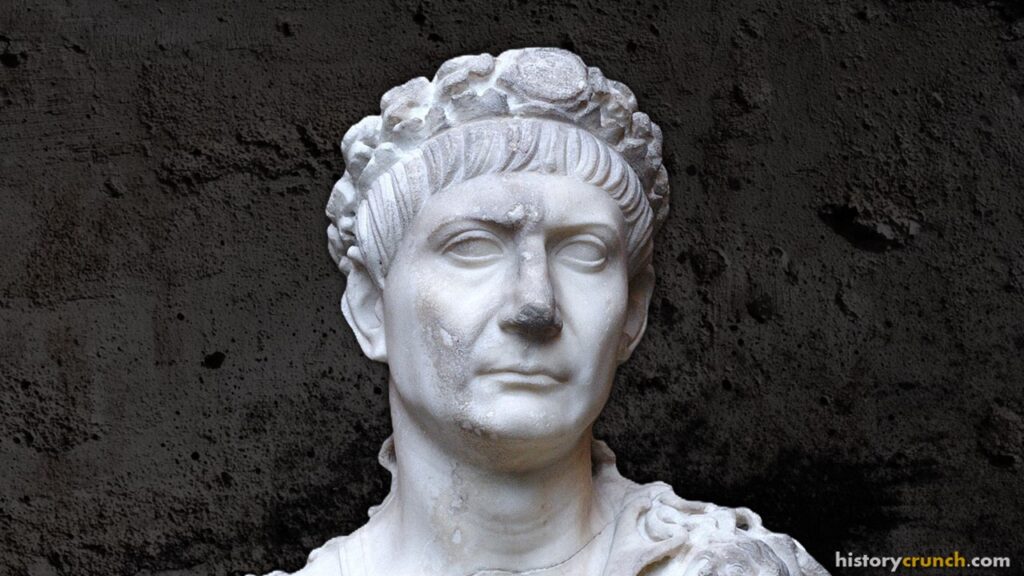
Emperor Trajan, who ruled the Roman Empire from 98 CE to 117 CE, is remembered as one of Ancient Rome’s most significant emperors. For example, his reign marked the height of the empire’s power, wealth and territorial expansion.
EMPEROR TRAJAN – EARLY LIFE
Trajan was born on September 18th, 53 CE, in Italica, an ancient Roman colony in what is now southern Spain. His full name at birth was Marcus Ulpius Traianus. Trajan’s father, who was also called Marcus Ulpius Trajanus, was high up in the military, and was in charge of the Tenth Legion. Regardless, Trajan’s father helped him advance his own military career. For instance, Trajan rose through the ranks by gaining the support of many. During the reign of Emperor Domitian, Trajan held several important military commands, proving himself a capable general on the frontiers of the empire.
Unlike most earlier emperors, Trajan was not born in Italy, making him the first Roman emperor from the provinces. Historians consider this important because it showed how Rome’s power and influence had spread far beyond the Italian peninsula.
EMPEROR TRAJAN – RISE TO POWER
As stated above, Trajan served in the military as a young man. In fact, Trajan was successful while in the military and quickly moved up the ranks. More specifically, Trajan took command of the seventh legion based in Leon, northern Spain in 85 CE, and he was praised by Domitian, the Roman Emperor at the time, for his quick thinking, and swift actions. As a result, Trajan was elected as consul by Domitian in 91 CE.
After the assassination of Emperor Domitian in 96 CE, the Senate chose Nerva as the new ruler. However, Nerva faced opposition from the army, which distrusted him due to his lack of military background. To strengthen his position, Nerva adopted Trajan as his heir in 97 CE, recognizing his popularity among the troops and his strong leadership qualities. When Nerva died the following year, Trajan peacefully succeeded him as emperor in 98 CE, beginning one of the most prosperous and stable periods in ancient Roman history.
EMPEROR TRAJAN – EMPEROR OF ROME
Trajan was a very popular emperor, and unlike any before him, when he entered Rome to take the throne he walked amongst ordinary people. This was considered to be a very modest and open act, that helped him gain much support among the ancient Roman people.
With that said, Trajan is best known for its military conquests, which expanded the Roman Empire to its greatest territorial size. His most famous campaigns were the Dacian Wars (101–102 CE and 105–106 CE), fought against the Dacians, a powerful kingdom located in what is now Romania. The Dacians, under their king Decebalus, had long been a threat to Rome’s borders along the Danube River.
Trajan led two major campaigns into Dacia, demonstrating brilliant strategy and determination. After years of fighting, Rome defeated the Dacians, and Dacia was annexed as a new province of the empire. The conquest brought incredible wealth to Rome, as Dacia’s gold mines greatly increased imperial revenue. Noteable, to celebrate his victory, Trajan built the famous ‘Trajan’s Column’ in Rome. It was a giant marble monument that still stands today, and was decorated with detailed carvings depicting scenes from the Dacian Wars.
After securing Dacia, Trajan turned his attention eastward. Around 113 CE, he launched a campaign against the Parthian Empire, Rome’s powerful rival in the East. Trajan’s armies captured key cities, including Armenia, Babylon, and even Ctesiphon, the Parthian capital. By 116 CE, the Roman Empire had reached its largest size in history, stretching from Britain in the west to the Persian Gulf in the east. Although some of these eastern territories were later lost, Trajan’s conquests demonstrated the unmatched power and reach of ancient Roman military might.
Trajan’s time as emperor was not limited to war. In fact, he was also one of Rome’s most capable leaders. He used the wealth gained from his conquests to improve the lives of Roman citizens and to expand the capital. Trajan was a strong believer in public service and infrastructure, and under his rule, Rome underwent a massive wave of construction. For example, he ordered the building of the Forum of Trajan, which was a grand public space featuring the Basilica Ulpia, libraries, marketplaces and his famous column. This complex symbolized the glory and efficiency of Roman engineering and urban planning. Trajan also ordered the construction of roads, aqueducts and bridges throughout the empire to improve communication, trade and military movement.
EMPEROR TRAJAN – DEATH AND SIGNIFICANCE
In 117 CE, while returning from his eastern campaigns, Trajan fell ill and died in the city of Selinus in modern-day Turkey. Before his death, he adopted Hadrian, his relative and trusted general, as his successor. Trajan was buried in Rome beneath his famous column. In all, Trajan was one of the most significant emperors of Ancient Rome and played an important role in developing the Roman Empire.