Che Guevara, born Ernesto Guevara, was an Argentine doctor who became a Marxist revolutionary and one of the most important military leaders of the Cuban Revolution. He was born on June 14th, 1928, and died on October 9th, 1967, at the age of 39, executed by Bolivian army soldiers with the assistance of the American CIA. Guevara played a central role in overthrowing Cuban dictator Fulgencio Batista in 1959 alongside Fidel Castro and went on to hold senior positions in the Cuban government before leaving Cuba to spread revolutionary ideas across Africa and Latin America. His death in the Bolivian jungle transformed him into a martyrSomeone whose death for a cause makes them a lasting symbol that inspires others to continue that cause. for leftist movements around the world, and his image became one of the most widely recognized icons of the 20th century. He remains a deeply controversial figure, celebrated by some as a heroic champion of the poor and condemned by others for his willingness to use violence and his role in political executions.
 FactsthatCrunch
Che Guevara was an Argentine doctor who became one of the key military commanders of the Cuban Revolution, leading the assault on Santa Clara that delivered a decisive blow to the Batista government in December 1958. He later held senior positions in Cuba's government and wrote influential works on guerrilla warfare before leaving to spread revolution in Africa and Latin America, where he was captured and executed at age 39.
Early Life of Che Guevara
Ernesto Guevara de la Serna was born on June 14th, 1928, in Rosario, in the Argentine province of Santa Fe. He was the eldest of five children in a middle-class family of Spanish and Irish descent. Both of his parents held left-wing political views, and the family home was filled with books and intellectual discussion. As a toddler, Guevara developed severe asthma, a condition that would plague him for the rest of his life. Despite this, he was determined not to let it limit him and threw himself into physical activities. He became an excellent athlete, particularly in swimming and rugby, as if driven to prove that his body could not defeat him.
Guevara entered the University of Buenos Aires in 1948 to study medicine. During his studies, he undertook two long journeys through Latin America that profoundly changed his view of the world. The first, in 1950, was a solo bicycle trip through northern Argentina. The second and more famous was a motorcycle journey taken in 1951 and 1952 with his friend Alberto Granado, later immortalized in his memoir The Motorcycle Diaries. The two young men traveled approximately 4,500 miles through Argentina, Chile, Peru, Colombia, and Venezuela, encountering extreme poverty, disease, and inequality everywhere they went. In fact, the conditions Guevara witnessed during these journeys convinced him that the social and economic problems of Latin America were too deep to be solved by medicine alone. He began to conclude that only political revolution could bring meaningful change.
Guevara completed his medical degree in June of 1953 and immediately set off traveling again, this time through Central America. He witnessed the CIA-backed military coup that overthrew the reformist Guatemalan government of Jacobo Arbenz in 1954, an event that permanently fixed his hatred of the United States and its foreign policy. He became convinced that American imperialismWhen a powerful country uses political, economic, or military force to control weaker countries for its own benefit. was one of the primary causes of poverty and suffering in Latin America. By the time he arrived in Mexico in 1954, he was a committed MarxistSomeone who follows the political ideas of Karl Marx, believing society should be reorganized so workers control wealth and production. who believed that armed revolution was the only answer.
FactsthatCrunchBefore he became a revolutionary, Che Guevara trained as a medical doctor at the University of Buenos Aires.
Che Guevara – Meeting Castro and the Cuban Revolution
In the summer of 1955, in Mexico City, Guevara was introduced to a young Cuban exile named Fidel Castro, who was planning an armed revolution to overthrow the Batista dictatorship in Cuba. The two men met and talked through the night, and by the morning Guevara had agreed to join Castro’s movement as its doctor. It was one of the most consequential conversations in the history of Latin America.
Guevara trained with Castro’s force of Cuban exiles in Mexico and proved himself one of the most dedicated and capable trainees despite his asthma. In November of 1956, he sailed from Mexico to Cuba aboard a small yacht called the Granma along with Castro and approximately 80 other men. The landing was a disaster. Batista’s forces were waiting and ambushed the group shortly after they came ashore. Most of the men were killed. Only around 20 survivors, including Guevara, made it into the Sierra Maestra mountains of eastern Cuba.
During the landing, Guevara was forced to make a choice that he later described as the moment he transformed from doctor to soldier. When he had to choose between carrying his medical equipment or carrying ammunition, he chose the ammunition. It was a symbolic moment that defined the direction of the rest of his life.
In the Sierra Maestra, Guevara proved himself an exceptionally capable guerrillaA fighter who uses small-scale, surprise tactics like ambushes rather than fighting in large organized armies. commander. He earned the trust and admiration of Castro and was promoted to the rank of ComandanteThe highest rank in Castro’s rebel army, given to a commander of exceptional ability and trust., the highest rank in the rebel army, the first person outside the Castro brothers to receive it. He was known for his physical toughness, his strict discipline, and his genuine commitment to the ideological principles of the revolution. He was also known for his ruthlessness toward those he considered traitors or deserters, whom he sometimes ordered executed.
The decisive moment of Guevara’s military contribution came in December of 1958, when he led his column in the assault on the city of Santa Clara in central Cuba. His forces ambushed and derailed an armored train carrying Batista’s troops and weapons, captured the city, and delivered the final decisive blow to the Batista government. Batista fled Cuba on January 1st, 1959, and the revolution was victorious.
FactsthatCrunchWhat was the correct order of Che Guevara's military steps from the Granma landing to the capture of Santa Clara?
Che Guevara – Role in the Cuban Government
After the revolution’s success, Guevara became one of the three most powerful figures in Cuba, alongside Fidel Castro and his brother Raúl Castro. He was granted Cuban citizenship by the new government in February of 1959, declared a Cuban citizen by birth in recognition of his role in the revolution. He married his second wife, fellow revolutionary Aleida March, in June of 1959, and they would have four children together.
Guevara took on a series of important government positions. He served as commandant of La Cabaña fortress prison, where he oversaw the trial and execution of individuals deemed enemies of the revolution by revolutionary courts. He then served as head of the National Bank of Cuba, famously demonstrating his disdain for capitalism by signing the currency simply Che. He subsequently became Minister of Industries, overseeing the nationalizationThe process of a government taking control of privately owned businesses and making them publicly owned. of Cuban businesses and the reorganization of the economy along socialist lines.
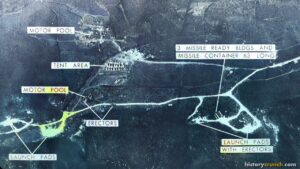
Guevara also traveled widely as an ambassador for the Cuban revolution, visiting the Soviet Union, China, and dozens of other countries to build political and economic relationships. He played a role in guiding Cuba toward closer alignment with the Soviet Union, which proved a critical relationship during the Cold War as Cuba faced increasing American hostility. He was present during the Bay of Pigs invasion of 1961, when a CIA-backed force of Cuban exiles attempted to overthrow Castro, and he played a role in the events surrounding the Cuban Missile Crisis of 1962.
However, Guevara grew increasingly disillusioned with the direction of the Cuban revolution during the early 1960s. He was critical of the Soviet Union’s economic model and believed Cuba was becoming too dependent on Soviet support. He also felt a powerful urge to take the revolution beyond Cuba and spread it across the developing world. By 1965 he had made up his mind to leave.
FactsthatCrunchHow did Che Guevara sign Cuban money when he ran the National Bank of Cuba?
As head of the National Bank of Cuba after the revolution, Guevara signed Cuban banknotes with only his nickname, Che. Many people saw it as a sign of his disdain for money and capitalism. He later became Minister of Industries, where he oversaw the nationalization of Cuban businesses and the reorganization of the economy along socialist lines.
Che Guevara – The Congo and Bolivia
In April of 1965, Guevara left Cuba secretly to try to spread revolution in other countries. Castro revealed a farewell letter Guevara had written, in which he renounced all his official positions and Cuban citizenship to devote himself to revolution around the world. He traveled in disguise to the Congo, now the Democratic Republic of the Congo, where he attempted to help a revolutionary movement against the country’s government. The effort was a failure. After seven months of frustration, Guevara withdrew, concluding that the local fighters lacked the commitment and preparation needed for a successful guerrilla campaign.
After a period of recovery and planning, Guevara turned his attention to Bolivia. He believed that Bolivia, with its central location bordering most of South America’s major countries, could serve as a base for a continent-wide revolution. In the autumn of 1966, he traveled to Bolivia in disguise, bald and clean-shaven so as not to be recognized, and established a small guerrilla force in the remote jungle region of southeastern Bolivia.
The Bolivian campaign was a disaster from the beginning. Guevara was unable to win the support of the local peasant population, who were suspicious of outsiders and did not join the guerrilla movement. The Bolivian Communist Party refused to cooperate with him. His force remained small and isolated, unable to expand its base of support or operations. The Bolivian army, equipped and advised by the American CIA and trained by United States Special Forces, pursued the guerrillas relentlessly through the jungle.
On October 8th, 1967, Guevara’s camp was betrayed and his small force was surrounded by Bolivian army troops in the Quebrada del Yuro ravine. Guevara was captured, wounded and unarmed. He reportedly told his captors that he was more valuable to them alive. The Bolivian government, under President René Barrientos, decided otherwise. On October 9th, 1967, Guevara was executed by a Bolivian army sergeant in the village of La Higuera. He was 39 years old.
FactsthatCrunchThe Bolivian Communist Party refused to support Guevara's campaign, and the local peasant population was suspicious of outsiders and would not join his guerrilla force.
Guevara chose Bolivia in 1966 because its central location bordered most of South America's major countries, making it what he believed would be an ideal base for a continent-wide revolution. The campaign collapsed because his foco theory, that a small guerrilla group could spark popular support, failed when neither the local population nor the Bolivian Communist Party joined him.
Later Years and Death of Che Guevara
There were no later years for Guevara. His death in Bolivia on October 9th, 1967, marked the end of his life and the beginning of his legend. His body was displayed to journalists and officials to prove he was dead, then buried secretly in a mass grave near the town of Vallegrande. In 1997, on the 30th anniversary of his death, his remains were found and returned to Cuba, where they were reburied in a large memorial in Santa Clara, the city he had captured in the decisive battle of the Cuban Revolution.
Significance of Che Guevara
The significance of Che Guevara in the history of the Cold War and of Latin America is considerable and deeply contested. He was one of the most important military commanders of the Cuban Revolution, and his leadership at the Battle of Santa Clara played a decisive role in Batista’s defeat. His writings on guerrilla warfare, particularly the manual Guerrilla Warfare published in 1960, became highly influential texts for revolutionary movements around the world, and his ideas about the foco theoryThe belief that a small, dedicated guerrilla group could spark the conditions needed for a wider popular revolution., the belief that a small dedicated guerrilla force could create the conditions for popular revolution, shaped the strategies of many leftist movements in the 1960s and beyond.
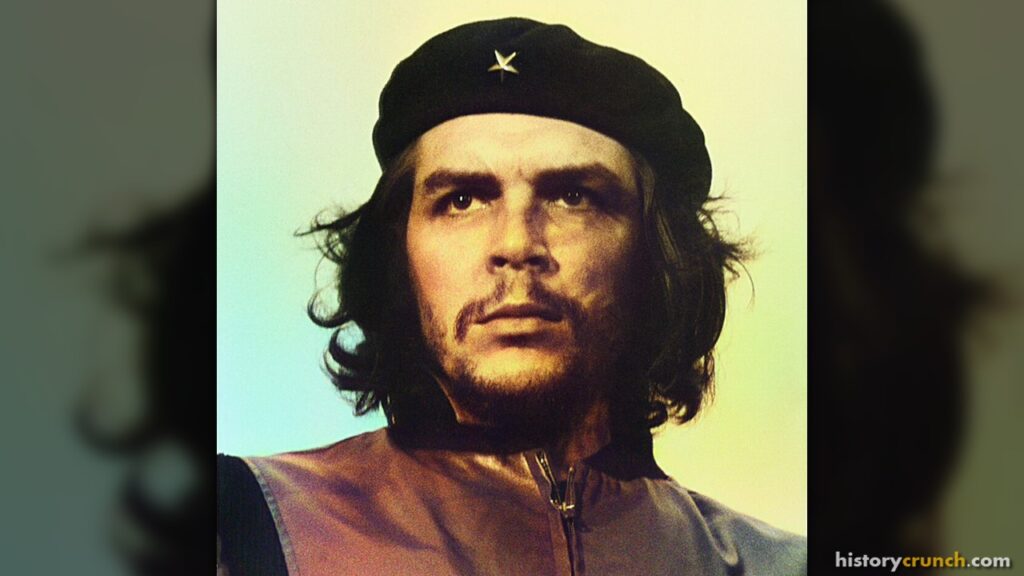
Guevara’s death in Bolivia transformed him into a martyr whose image became one of the most widely reproduced icons in history. The famous photograph taken by Cuban photographer Alberto Korda in 1960, showing Guevara in a beret with a resolute expression, has appeared on T-shirts, posters, and murals in virtually every country in the world. For generations of leftist and anti-imperialist activists, Guevara represents the ideal of selfless revolutionary commitment, a man who gave up comfort, power, and ultimately his life for his beliefs.
At the same time, Guevara’s legacy is deeply complicated. He was involved in the execution of political prisoners, both during and after the Cuban Revolution, and he showed little mercy toward those he considered enemies of the revolution. His guerrilla campaigns outside Cuba, in the Congo and Bolivia, were failures that cost lives and achieved nothing. His vision of spreading revolution across the developing world by force proved unrealistic.
As such, Che Guevara stands as one of the most complex and polarizing figures of the Cold War era, a man who inspired millions with his idealism and his willingness to sacrifice himself for his beliefs, while also demonstrating the destructive consequences of a political vision that placed revolutionary ideology above the lives of ordinary people.
FactsthatCrunchChe Guevara's foco theory argued that a small guerrilla group could spark a wider popular revolution without waiting for broad political conditions to develop first, but its record in practice was deeply mixed.
Explore Cold War · 1947 – 1991
Keep exploring Cold War with these History Crunch resources.
Key Vocabulary
Marxist
Guerrilla
Imperialism
Comandante
Nationalization
Foco theory
Martyr
Frequently Asked Questions
Who was Che Guevara?
Che Guevara was an Argentine doctor who became a Marxist revolutionary and a key military leader of the Cuban Revolution. Born Ernesto Guevara on June 14th, 1928, he helped Fidel Castro overthrow Cuban dictator Fulgencio Batista in 1959. He later held top posts in the Cuban government before trying to spread revolution abroad.
How did Che Guevara die?
Che Guevara was executed by a Bolivian army sergeant on October 9th, 1967, in the village of La Higuera. He was captured a day earlier, wounded and unarmed, after his small guerrilla force was surrounded. The Bolivian army was equipped and advised by the American CIA, and Guevara was 39 years old.
Why is Che Guevara so famous?
Che Guevara is famous as both a revolutionary leader and a worldwide symbol of rebellion. His death turned him into a martyr for leftist movements across the globe. A 1960 photograph of him in a beret became one of the most reproduced images in history, appearing on T-shirts, posters, and murals.
What did Che Guevara do in the Cuban government?
After the revolution, Guevara became one of Cuba’s three most powerful figures, alongside Fidel and Raúl Castro. He ran La Cabaña prison, led the National Bank of Cuba, and served as Minister of Industries. In these roles he oversaw executions of accused enemies and the shift to a socialist economy.
Why is Che Guevara a controversial figure?
Che Guevara is controversial because supporters and critics see him very differently. Some praise him as a selfless champion of the poor who died for his beliefs. Others condemn him for ordering political executions and for failed campaigns in the Congo and Bolivia that cost lives and achieved nothing.
What was The Motorcycle Diaries about?
The Motorcycle Diaries is Guevara’s memoir about a journey he took across Latin America in 1951 and 1952. He and his friend Alberto Granado traveled about 4,500 miles (7,242 km) through five countries. The poverty and inequality he saw convinced him that only political revolution could bring real change.
Cite This Article
To cite this article as a source, use one of the formats below.
MLA: Millar, B. “Che Guevara: A Detailed Biography.” HistoryCrunch, 12 October 2026, https://historycrunch.com/che-guevara/.
APA: Millar, B. (2026). Che Guevara: A Detailed Biography. HistoryCrunch. https://historycrunch.com/che-guevara/
Chicago: Millar, B. “Che Guevara: A Detailed Biography.” HistoryCrunch. October 12, 2026. https://historycrunch.com/che-guevara/
Sources
- Vladislav Zubok, A Failed Empire.
- John Lewis Gaddis, The Cold War: A New History.
- State Department — Office of the Historian