The Roman legion was the backbone of one of the most powerful militaries in world history, and its organization helped Ancient Rome grow from a small city-state on the Italian peninsula into a vast empire. For centuries, the disciplined and well-organized soldiers of the legions conquered new territory and defended the borders of an empire that stretched from Britain in the northwest to Egypt in the southeast. The strength of the Roman army came not from its size alone, but from the careful way it was structured, trained, and led. Understanding the legion and Roman military organization helps explain how Rome was able to build and hold together such an enormous empire for so long.
A legion was the largest unit of the Roman army and was made up of Roman citizens who served as soldiers, known as legionaries. The word legion comes from the Latin word legio, which is related to the idea of gathering or choosing men for war. Each legion was divided into smaller groups that could work together as one force or fight on their own, which made the Roman army both powerful and flexible on the battlefield.
What Was Ancient Rome?
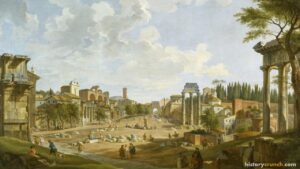
Ancient Rome was one of the most powerful civilizations in world history. It began as a small settlement on the Italian peninsula in the 8th century BCE and grew over many centuries into a vast empire that controlled much of Europe, North Africa, and parts of the Middle East. Roman civilization is remembered today for its lasting contributions to law, government, architecture, language, and culture.
Historians usually divide the history of Ancient Rome into three main periods. The first was the Roman Kingdom, which lasted from 753 BCE to 509 BCE and was ruled by kings. The second was the Roman Republic, which lasted from 509 BCE to 27 BCE and was governed by elected officials and a powerful Senate. The third was the Roman Empire, which lasted from 27 BCE until the fall of the western half in 476 CE and was ruled by emperors. In every one of these periods, the army was essential to Rome’s survival and success, and the way it was organized changed over time to meet new challenges.
How Did the Early Roman Army Begin?
In its earliest days, Rome did not have a permanent, full-time army. Instead, the army was made up of citizens who were called up to fight only when a war broke out and who returned to their farms and jobs once the fighting ended. These early soldiers had to provide and pay for their own weapons and armor, which meant that a man’s role in the army depended heavily on how wealthy he was. Only citizens who owned property were expected to serve, since they were seen as having the most to lose if Rome were defeated.
The early Romans borrowed ideas from the peoples around them, especially the Etruscans to the north and the Greeks to the south. For instance, the earliest Roman soldiers fought in a tight block formation called a phalanx, which the Romans copied from the Greeks. In this formation, heavily armed spearmen stood shoulder to shoulder and pushed forward as a single wall. Over time, however, the Romans found that this rigid formation was difficult to use in the hills and valleys of central Italy, and they began to develop a more flexible system of their own.
What Was the Manipular Legion?
To solve the problems of the phalanx, the Romans created a new system based on smaller units called maniples. A maniple was a group of about 120 soldiers, and the maniples were arranged on the battlefield in three lines set up like a checkerboard, with gaps between the units. This layout allowed the Roman army to move more easily, to fill gaps in the fighting, and to hold its formation even when under heavy attack. In fact, this flexibility gave Rome a major advantage over enemies who fought in a single unbroken line.
During the time of the Roman Republic, a manipular legion contained roughly 4,200 foot soldiers and about 300 cavalry. The three lines of soldiers were organized partly by age and experience, with younger men in the front and the most experienced veterans held in reserve at the back. As stated above, soldiers still supplied their own equipment during this period, which meant that the quality of a man’s weapons and armor could vary a great deal. Wealthier citizens served in the cavalry, where the horses and gear were more expensive but also carried greater prestige.
How Did the Marian Reforms Change the Legions?
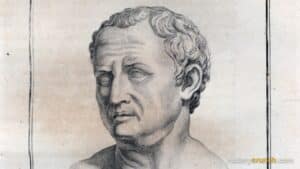
A major turning point came in 107 BCE, when a Roman general and politician named Gaius Marius introduced a series of changes that transformed the army. Before this time, only property-owning citizens could serve as soldiers. Marius removed this requirement and opened the army to poorer citizens who did not own property, which greatly increased the number of men available to fight. In return, the state now provided each soldier with standard weapons, armor, and training.
These changes, known as the Marian reforms, turned the Roman army into a full-time, professional force. Soldiers now signed up for long terms of service, often lasting many years, and were paid a regular wage. When they retired, they were often given money and a plot of land as a reward for their service. Marius also made the eagle standard, called the aquila in Latin, the single most important symbol of each legion, and losing it in battle was considered a terrible disgrace. Because soldiers now carried much of their own gear and equipment on long marches, they earned the nickname “Marius’ mules.”
How Was the Imperial Legion Organized?
By the time of the Roman Empire, the legion had settled into a clear and standard structure that was used across the entire Roman world. On paper, a full legion was made up of about 6,000 men, though in practice most legions operated with somewhat fewer soldiers, often around 5,000 to 5,500 fighting men. Each legion was divided into ten smaller units called cohorts. The soldiers of a legion were heavy infantry, meaning they fought on foot with strong armor and close-combat weapons.
Each cohort was further divided into smaller groups called centuries. A century was originally meant to contain 100 men, which is where its name comes from, but by the imperial period it usually held around 80 soldiers. More specifically, each cohort contained six centuries, so a legion was built up from many small, well-organized groups that could act together or separately. This modular design meant that a legion could be split apart, reinforced, or moved around quickly, which made the Roman army remarkably adaptable in many different situations.
Who Led the Roman Legion?
The Roman legion had a clear chain of command that ran from top to bottom. At the head of a legion during the imperial period was a senior officer called the legatus legionis, who was usually appointed by the emperor. Below him were officers known as tribunes and a camp prefect, who helped manage the legion and its supplies. These senior officers came from the wealthy upper classes of Roman society.
The most important officers on the battlefield were the centurions, each of whom commanded a century. Centurions were experienced soldiers who handled much of the day-to-day training, discipline, and leadership of the men, and they were greatly respected within the army. Below the centurions came junior officers and specialists, such as the standard-bearers who carried the legion’s symbols into battle. This organized system of ranks meant that orders could move quickly from the top commanders down to the ordinary soldiers, even in the chaos of a battle.
What Weapons and Equipment Did Legionaries Use?
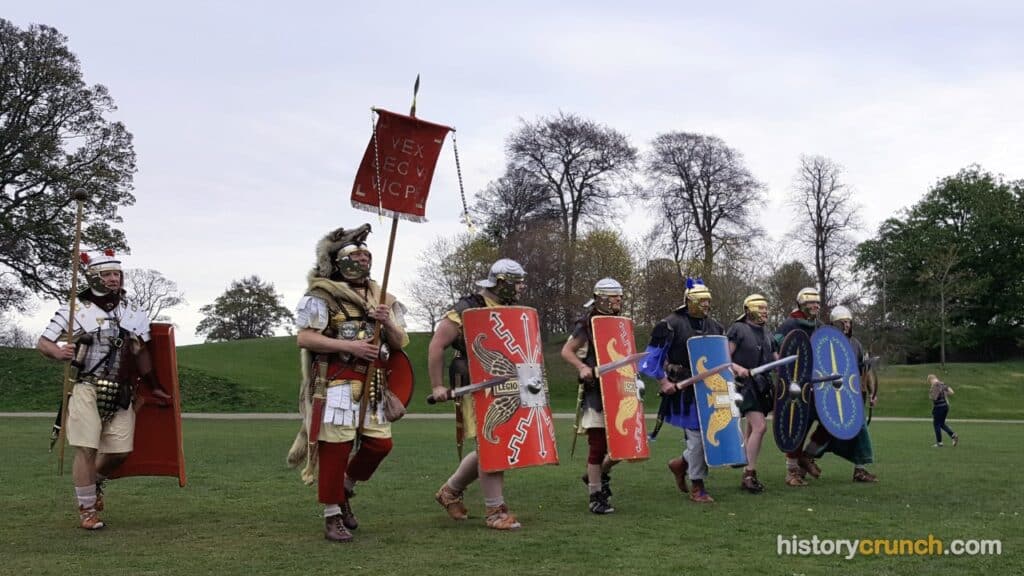
A Roman legionary carried a standard set of weapons and armor that was designed for close combat. His main weapons were the gladius, a short stabbing sword, and the pilum, a heavy javelin. In battle, soldiers would throw their javelins at the enemy just before making contact and then draw their swords for hand-to-hand fighting. Roman training focused on thrusting with the sword rather than slashing, since a stab was more likely to be deadly.
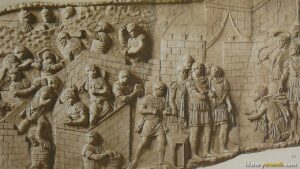
For protection, a legionary wore body armor and a helmet and carried a large curved shield called a scutum. On the march, a soldier had to carry far more than just his weapons and armor. In fact, he also carried tools for building camps, cooking equipment, food, and personal items, often bundled on a forked pole over his shoulder. This ability to build and equipment allowed the Roman army to construct fortified camps, roads, and bridges wherever it traveled, which made the legions useful for far more than just fighting.
What Were the Auxiliary Troops?
The legions were made up of Roman citizens, but they were supported by soldiers called auxiliaries, who came from the peoples that Rome had conquered or allied with. These troops were not citizens, but they could earn Roman citizenship after completing their years of service, which encouraged many men from across the empire to join. An auxiliary force was often about the same size as the legion it supported, so together they roughly doubled the strength of a Roman army.
Auxiliary troops provided skills that the legions themselves often lacked. For instance, the Roman legions were frequently short of cavalry, so many auxiliaries served as horsemen. Others fought as archers, slingers, or light infantry, using weapons and fighting styles from their home regions. In reality, this combination of citizen legionaries and specialized auxiliaries created a balanced fighting force that could handle almost any type of enemy or battlefield.
Significance of Roman Legion and Military Organization
The Roman legion and its careful organization were among the most important reasons for Rome’s rise and long survival. The overall power of Rome depended heavily on its army, and it was through the strength of the legions that Rome conquered new lands and defended its borders for centuries. From Britain and Gaul to Syria and Egypt, the expansion of the Roman Empire was built on the discipline and organization of these soldiers.
The legions did far more than fight. Because they built roads, camps, and other structures wherever they went, they helped connect the empire and made trade, communication, and administration easier across a huge territory. The army also helped spread Roman culture and citizenship, since soldiers who served in the legions and auxiliaries carried Roman ways of life into distant provinces. In this way, the military helped hold the empire together and supported the long period of relative peace known as the Pax Romana.
The influence of the Roman legion also lasted long after Rome itself declined. Its emphasis on discipline, training, and clear organization became a model that later armies studied and copied. Even today, many ideas about how to structure and command a military can be traced back to the way the Roman legions were organized, showing just how advanced the Roman system was for its time.
Frequently Asked Questions
How many soldiers were in a Roman legion?
A Roman legion at full strength was meant to have about 6,000 men, though most legions actually operated with around 5,000 to 5,500 fighting soldiers. The number changed over the course of Roman history, and during the Republic a legion held closer to 4,200 foot soldiers plus cavalry. Casualties, illness, and men being sent on other duties often kept legions below their official size.
What is the difference between a legion and a cohort?
A legion was the whole large army unit, while a cohort was one of its main subdivisions. During the imperial period, each legion was made up of ten cohorts, and each cohort was made up of six even smaller units called centuries. This layered structure allowed the Roman army to be broken into flexible pieces that could be commanded and moved with ease.
What did a centurion do in the Roman army?
A centurion was an officer who commanded a century, which was a unit of about 80 soldiers. Centurions were experienced fighters who were responsible for training their men, keeping discipline, and leading their unit in battle. They were among the most respected soldiers in the Roman army, and a skilled centurion could serve as an example of courage for the men under his command.
Who could join a Roman legion?
Only Roman citizens could serve as legionaries in the legions. In the early Republic, a man also had to own property to serve, but after the Marian reforms of 107 BCE, even poor citizens without property were allowed to join. People who were not citizens could still serve in the army as auxiliaries, and they could earn citizenship through their service.
How long did a Roman soldier serve in the army?
During the imperial period, a Roman soldier usually signed up for a long term of service that lasted many years, commonly around 20 to 25 years. Being a soldier became a full-time career rather than a temporary duty. When soldiers finally retired, they were often rewarded with a sum of money or a plot of land, which made military service an attractive path for many men.
Cite This Article
To cite this article as a source, use one of the formats below.
MLA: Millar, B. “Roman Legion and Military Organization: A Detailed Summary.” HistoryCrunch, 7 July 2026, https://historycrunch.com/roman-legion-and-military-organization/.
APA: Millar, B. (2026). Roman Legion and Military Organization: A Detailed Summary. HistoryCrunch. https://historycrunch.com/roman-legion-and-military-organization/
Chicago: Millar, B. “Roman Legion and Military Organization: A Detailed Summary.” HistoryCrunch. July 7, 2026. https://historycrunch.com/roman-legion-and-military-organization/
Sources
- Mary Beard, SPQR: A History of Ancient Rome.
- H.H. Scullard, From the Gracchi to Nero.
- Adrian Goldsworthy, How Rome Fell / Caesar (military and political).
- Fordham Ancient History Sourcebook