Ancient Roman naval warfare was one of the most important reasons that Rome rose from a regional Italian power into the master of the entire Mediterranean world. Although Rome is best remembered for its legions, control of the sea allowed the Romans to move armies quickly, protect trade, and defeat rival powers that could never be beaten on land alone. Roman naval warfare refers to the ships, weapons, tactics, and fleets that Rome used to fight at sea from the time of its early wars with Carthage through the height of the Roman Empire. It was closely tied to the story of Ancient Rome itself, and its greatest triumphs shaped the borders and history of the ancient world.
Naval warfare is combat that takes place on the water, usually involving fleets of warships that fight one another, transport soldiers, blockade enemy ports, and guard trade routes. In the ancient Mediterranean, this kind of fighting depended on wooden ships powered by rowers and sails, and it required skilled sailors, strong crews, and clever tactics. For the Romans, naval power meant the ability to project their strength across the sea to distant lands.
What Was Ancient Rome?
Ancient Rome was one of the most powerful civilizations in world history. It began as a small city-state on the Italian peninsula and grew over many centuries into a vast empire that stretched from Britain in the northwest to Egypt in the southeast. Its history is usually divided into three main periods, which included the Roman Kingdom, the Roman Republic, and the Roman Empire. Roman civilization is remembered for its contributions to law, government, architecture, language, and culture.
During the period of the Roman Republic, Rome conquered most of the Mediterranean world and built the political institutions that later shaped the empire. In fact, it was during the Republic that Rome first developed a real navy, driven by the need to fight powerful enemies across the sea. As the Republic gave way to the Roman Empire under Augustus in 27 BCE, the Mediterranean became a Roman sea, and the fleet shifted from fighting great battles to keeping the peace.
Why Did Rome Build a Navy?
For most of its early history, Rome was a land power that relied on its legions and had little interest in the sea. In its first centuries, the Roman Republic was largely preoccupied with gaining dominance of the Italian peninsula, and thus concerned itself with the development of its legendary legions, having little experience with seaborne combat. This changed dramatically in the 200s BCE, when Rome came into conflict with Carthage, a wealthy and powerful city-state on the coast of North Africa.
At the time, Carthage was the leading sea power of the western Mediterranean. At the start of the war Carthage was the dominant power in the western Mediterranean, with an extensive maritime empire, while Rome was a rapidly expanding power in Italy, with a strong army but no navy. When the two powers clashed over the island of Sicily, the First Punic War began in 264 BCE. Rome quickly discovered that it could not win a war against Carthage without being able to fight and supply its armies by sea.
As a result, the Roman Senate made the bold decision to build a fleet from scratch. In 261 BCE, the Roman Senate set out to construct a fleet of 100 quinqueremes and 20 triremes. According to ancient accounts, the Romans even used a captured enemy ship as a model. The Romans seized a shipwrecked Carthaginian quinquereme and used it as a blueprint for their own ships. In this way, a land power transformed itself into a naval power in a remarkably short time.
What Kinds of Ships Did the Romans Use?
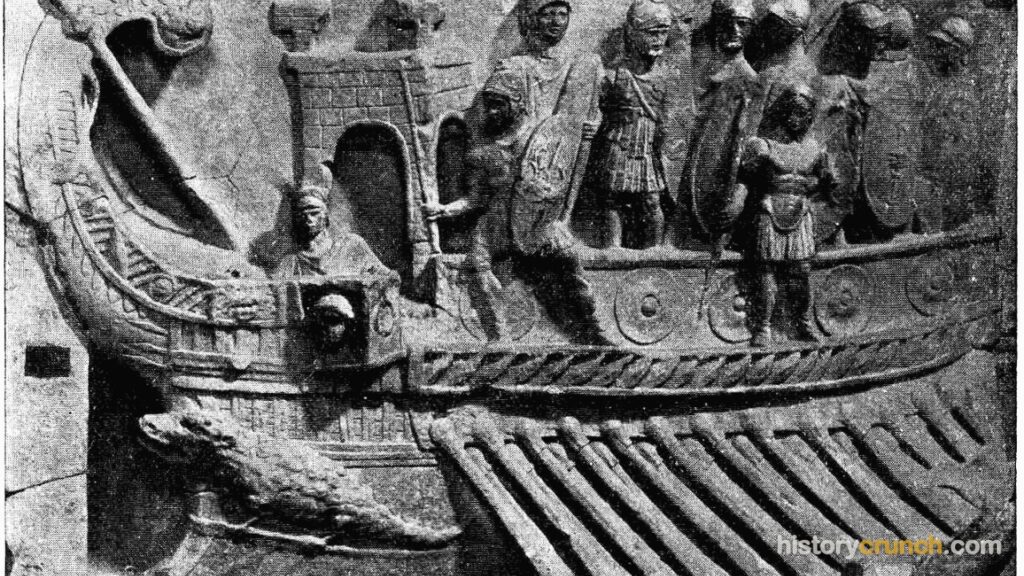
Roman warships were long, narrow galleys powered mainly by rows of oarsmen, though they also carried sails for traveling longer distances. Warships of the day were galleys with long, narrow hulls powered principally by oars, although all were equipped with sails. The most important warship of the early Roman navy was the quinquereme, a large galley rowed by many men arranged in files along each side. A related ship, the trireme, was a lighter and faster galley used by earlier Greek navies.
These names could be confusing, since they did not describe the number of decks. Modern scholarship believes that the maximum practical deck structure is three, and thus the quinquereme was named for the number of files of oarsman on each side, not for five decks. More specifically, a quinquereme most likely had groups of five rowers working the oars on each side, which made it powerful but also heavy and harder to maneuver.
Over time, Rome also developed smaller and faster ships for different tasks. To escort merchant ships and combat pirates, Rome found need for a lighter type, the liburnian, a light, fast vessel to which the Romans added a second bank of oars. The liburnian became especially useful for patrol duties, and it later became the standard Roman warship during the age of the empire.
How Did the Romans Fight at Sea?
Ancient naval battles were fought in ways that were very different from later gunpowder warfare. Because Roman crews were less experienced than the Carthaginians, they turned battles into something closer to land combat, which was where the legions excelled. Naval combat of the era was essentially land combat transferred to the sea, as contesting fleets sailed to the battle site and attacked under oars, with ramming the preferred method of combat, and the ships often were equipped with bronze rams affixed to their stems that could provide fatal blows if accurately delivered.
One common tactic was to smash a hole in the side of an enemy ship using a bronze-covered ram at the front of the galley. The objective was to position the ram to punch a hole in the enemy vessel and then withdraw to allow water into the stricken ship, or alternatively a well-aimed swipe could break one bank of the enemy’s oars and thus disable it. As stated above, this required great skill from the rowers and helmsman, which the early Roman crews often lacked.
To make up for their lack of experience, Roman engineers invented a clever device called the corvus. The corvus was a boarding bridge that allowed Roman soldiers to turn sea battles into hand-to-hand combat, which was important because the Roman army of the time was excellent at hand-to-hand combat. The corvus was a long plank with a heavy spike on the end that dropped onto an enemy deck and locked the two ships together, so Roman marines could storm across and fight as if on land. However, the device had a serious drawback. It is believed that the corvus weight made the ships unstable and could capsize a ship in rough seas.
Major Naval Battles of Ancient Rome
The corvus proved its worth in Rome’s first great sea victory. The first engagement where the corvi were employed with great effect was the Battle of Mylae off the coast of northern Sicily in 260 BCE, and the corvus proved a devastatingly successful attack weapon against the disorganized Carthaginians, resulting in a Roman victory. This early triumph showed that a determined land power really could master the sea.
An even larger clash came a few years later. The Battle of Ecnomus, in 256 BCE off the southern coast of Sicily, was one of, if not the, largest sea battles in ancient times, and it would show that Mylae had been no fluke. These victories helped Rome win the First Punic War, but they came at a terrible cost, since the inexperienced Roman fleets were repeatedly wrecked by storms with enormous loss of life.
The most famous Roman naval battle of all came centuries later during the civil wars that ended the Republic. In the Battle of Actium in 31 BCE, Octavian’s skilled fleet commander, Agrippa, used his liburnians to good effect. The victory over Mark Antony and the Egyptian queen Cleopatra left Octavian as the sole ruler of Rome. In fact, Actium was so decisive that it marked the end of large-scale naval warfare in the Mediterranean for a very long time.
Rome’s Navy During the Empire
Once Rome had defeated Carthage and its other rivals, there were no longer any great naval powers left to challenge it. As a result, the navy shifted from fighting battles to protecting trade and hunting pirates, who threatened the vital grain shipments that fed the city of Rome. In reality, the sea became so safe that the Romans came to think of the Mediterranean as their own private lake, which they called Mare Nostrum, meaning “our sea.”
To keep this peace, the first emperor organized permanent fleets based at key harbors. Following the Battle of Actium, the new Roman emperor Octavian, now calling himself Augustus, established two 50-ship fleets, one based at Ravenna and one based at Misenum near Naples, which were in operation until the 4th century CE. Smaller squadrons patrolled the rivers and coasts on the frontiers of the empire. There were also later fleets based at Alexandria, Antioch, Rhodes, Sicily, Libya, Pontus, and Britain, as well as one operating on the Rhine and another two on the Danube.
Interestingly, the men who served in these fleets did not always think of themselves as sailors. Naval personnel did not think of themselves as sailors but as soldiers, and while sailors came from the lower class of society, drawn mainly from the seafaring peoples of the Eastern Mediterranean, members of the Roman elites filled the high-ranking posts. This reflected the Roman belief that the army was always the most important branch of the military, with the navy serving as its support.
Significance of Ancient Roman Naval Warfare
Ancient Roman naval warfare was hugely important because it made Rome’s rise to power possible in the first place. Without a navy, Rome could never have defeated Carthage, and it could never have controlled the islands, coastlines, and trade routes that held its growing empire together. During the course of the First Punic War, the Roman navy was massively expanded and played a vital role in the Roman victory and the Roman Republic’s eventual ascension to hegemony in the Mediterranean Sea.
The navy’s success also transformed the ancient world by removing every rival sea power. In the course of the first half of the 2nd century BCE, Rome went on to destroy Carthage and subdue the Hellenistic kingdoms of the eastern Mediterranean, achieving complete mastery of the inland sea. This mastery brought a long period of safe travel and trade that helped Roman culture, goods, and ideas spread across three continents.
Finally, the story of the navy mirrors the story of Rome itself. As long as Rome was strong, its fleets kept the seas safe, but as the empire weakened, enemies once again attacked from the water. The decline of the empire in the 3rd century took a heavy toll on the navy, which was reduced to a shadow of its former self, both in size and in combat ability. In this way, Roman naval power remained tied to the fate of the empire from its first battles until its final years.
Frequently Asked Questions
Why did Rome build a navy in the first place?
Rome built a navy because it could not defeat Carthage without controlling the sea. When the First Punic War broke out over the island of Sicily in 264 BCE, Rome had a strong army but almost no ships, while Carthage had a huge and experienced fleet. To compete, the Roman Senate ordered the rapid construction of warships, quickly turning a land power into a naval power.
What was the corvus and how did it work?
The corvus was a boarding bridge that let Roman soldiers cross onto enemy ships during battle. It was a long wooden plank with a heavy spike at the end that dropped down and hooked into an enemy deck, locking the two ships together. This allowed Roman marines to fight hand-to-hand at sea, which played to the strength of Rome’s soldiers, though its heavy weight also made ships unstable in storms.
What was a quinquereme?
A quinquereme was the main heavy warship of the early Roman navy. It was a large galley powered by many rowers arranged in groups along each side of the ship, most likely in files of five men. Because of its size, it was powerful in battle but heavier and harder to steer than lighter ships like the trireme or the liburnian.
What was the most important Roman naval battle?
The Battle of Actium in 31 BCE is often seen as the most important Roman naval battle. In this battle, the fleet of Octavian, commanded by his admiral Agrippa, defeated the combined forces of Mark Antony and Cleopatra. The victory left Octavian as the sole ruler of Rome and led directly to the creation of the Roman Empire the following years.
What happened to the Roman navy after Rome conquered the Mediterranean?
After Rome defeated its rivals, the navy shifted from fighting great battles to patrolling and protecting trade. With no rival sea powers left, the fleet spent most of its time guarding grain shipments, hunting pirates, and patrolling rivers and coasts along the frontier. As the empire declined in later centuries, the navy shrank and grew weaker, until it could no longer defend Rome’s shores from raiders.
Cite This Article
To cite this article as a source, use one of the formats below.
MLA: Millar, B. “Ancient Roman Naval Warfare: A Detailed Summary.” HistoryCrunch, 7 July 2026, https://historycrunch.com/ancient-roman-naval-warfare/.
APA: Millar, B. (2026). Ancient Roman Naval Warfare: A Detailed Summary. HistoryCrunch. https://historycrunch.com/ancient-roman-naval-warfare/
Chicago: Millar, B. “Ancient Roman Naval Warfare: A Detailed Summary.” HistoryCrunch. July 7, 2026. https://historycrunch.com/ancient-roman-naval-warfare/
Sources
- Mary Beard, SPQR: A History of Ancient Rome.
- The Met (Heilbrunn Timeline) — Roman art
- Adrian Goldsworthy, How Rome Fell / Caesar (military and political).