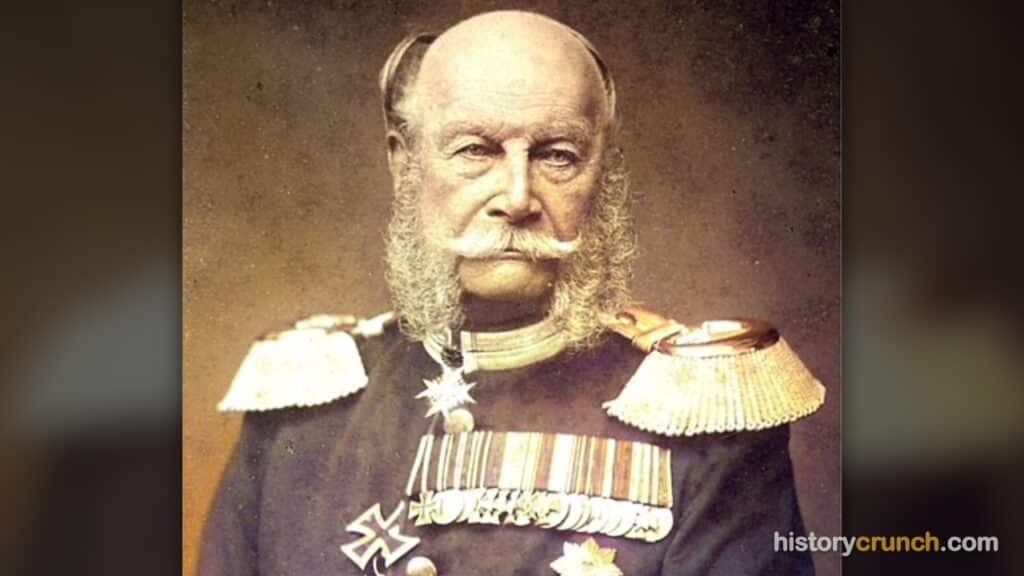
Kaiser Wilhelm I was one of the most important rulers in modern European history, and he holds the distinction of being the first emperor of a united Germany. As King of Prussia and then German Emperor, he sat at the center of the dramatic events that brought dozens of separate German states together into a single powerful nation in 1871. His long reign marked the birth of the German Empire and the rise of Germany as a leading power in Europe.
Wilhelm I was a member of the House of Hohenzollern, the royal family that had ruled the Kingdom of Prussia for generations. He is often remembered alongside his famous chancellor, Otto von Bismarck, who guided much of the day to day governing of the new empire. Together, the two men oversaw the wars of German unification, which reshaped the map of central Europe.
Early Life and Background
Wilhelm was born on March 22nd, 1797, in Berlin, the capital of the Kingdom of Prussia. His full name was Wilhelm Friedrich Ludwig, and he was the second son of Prince Frederick William, who later became King Frederick William III, and his wife Louise of Mecklenburg-Strelitz. As a younger son, Wilhelm was not expected to inherit the throne, since that role was reserved for his older brother. For this reason, he planned a career as a professional soldier rather than as a king.
Wilhelm grew up during a difficult and dangerous time for Prussia. When he was a boy, the French emperor Napoleon Bonaparte crushed the Prussian army and occupied much of the country. This national humiliation left a deep mark on Wilhelm and his family. In fact, his mother, Queen Louise, urged her sons to work hard to restore the honor and strength of Prussia, a lesson the young prince never forgot.
Wilhelm entered the Prussian army at a young age and took part in the wars against Napoleon. He fought in the campaigns of 1814 and 1815, gaining valuable military experience as a teenager. More specifically, he took part in the fighting that finally defeated Napoleon and freed the German states from French control. These experiences shaped Wilhelm into a lifelong soldier who deeply valued a strong and disciplined army.
Rise to Power
After the wars against Napoleon ended, Wilhelm continued to serve in the Prussian army and rose steadily through its ranks. In 1840, his father died and his older brother became King Frederick William IV. Because the new king had no children, Wilhelm became the heir to the Prussian throne, a role known as heir presumptive. This meant that the man who had once expected only a soldier’s life was now next in line to rule.
In 1848, a wave of revolutions swept across Europe, and Prussia was no exception. Crowds of people demanded reforms, greater freedom, and constitutional government. Wilhelm played a leading role in putting down these uprisings, and his harsh reputation forced him to flee briefly to England for safety. As stated above, Wilhelm was a firm conservative who believed strongly in royal authority and a powerful military.
In 1857, King Frederick William IV suffered a serious stroke that left him unable to govern. As a result, Wilhelm took over the running of the kingdom, first temporarily and then, in 1858, as the official regent. When the king died on January 2nd, 1861, Wilhelm finally became King Wilhelm I of Prussia at the age of 63. He was already an older man when he took the throne, but the most important years of his life still lay ahead.
Partnership With Otto von Bismarck
Soon after becoming king, Wilhelm ran into a serious conflict with the Prussian parliament, known as the Landtag. Wilhelm wanted to expand and strengthen the army, but many of the liberal members of parliament opposed the cost and refused to approve his budget. This struggle over the army created a political crisis that threatened Wilhelm’s ability to govern.
To break the deadlock, Wilhelm appointed Otto von Bismarck as Minister President of Prussia in 1862. Bismarck was a conservative statesman who was determined to increase the power of the Prussian state. He is often remembered by his nickname, the Iron Chancellor, because of his tough and practical approach to politics. Bismarck famously argued that the great questions of the day would be decided not by speeches and votes but by iron and blood, meaning military strength.
The partnership between Wilhelm and Bismarck became one of the most important working relationships in European history. Wilhelm provided the royal authority and command of the army, while Bismarck supplied the political strategy and diplomacy. Together, they set out to make Prussia the leader of all the German states. In reality, Bismarck handled much of the actual governing, while Wilhelm remained the respected head of state and commander of the military.
Wars of German Unification
Under Wilhelm and Bismarck, Prussia fought a series of three wars that gradually united the German states under Prussian leadership. The first was a short war in 1864 against Denmark over the border regions of Schleswig and Holstein. Prussia, joined by Austria, defeated Denmark and took control of these disputed territories.
The second war came in 1866, when Prussia turned against its former ally, Austria, in the Austro-Prussian War. This conflict is sometimes called the Seven Weeks’ War because of how quickly Prussia won. The victory proved that the reformed Prussian army was the strongest in Europe. More importantly, it ended Austrian influence over the German states and allowed Prussia to organize the northern German states into a new grouping called the North German Confederation, with Wilhelm at its head.
The third and final war was the Franco-Prussian War, which lasted from 1870 to 1871. Bismarck deliberately manipulated a diplomatic dispute with France over a candidate for the Spanish throne in order to provoke France into declaring war. Once the fighting began, the southern German states joined Prussia, and the combined German armies won a series of crushing victories. The most famous of these was the Battle of Sedan, where the French emperor Napoleon III was captured.
Proclamation as German Emperor
The victory over France completed the process of German unification. With the southern states now willing to join Prussia, the German states declared their union as a single German Empire. On January 18th, 1871, Wilhelm I was proclaimed German Emperor in the Hall of Mirrors at the Palace of Versailles, just outside Paris. The choice of this location, deep inside defeated France, sent a powerful message about German strength.
Interestingly, Wilhelm was actually reluctant to accept the new imperial title. He had spent his whole life proud of being the King of Prussia, and he worried that the title of German Emperor would overshadow his Prussian crown. He agreed to accept the title only after being assured that it was offered to him by the other German princes. In this way, the new empire was created as a federation in which the emperor was seen as a first among equals rather than an all powerful ruler over every state.
Later Life
As emperor, Wilhelm I largely allowed Bismarck to direct the affairs of the new German Empire. Bismarck acted as the empire’s first chancellor and controlled both domestic and foreign policy. During these years, Germany grew into an industrial and military powerhouse, and Bismarck worked carefully to keep the peace in Europe through a system of alliances and balanced diplomacy.
Wilhelm’s later years were not entirely peaceful, however. In 1878, he survived two separate assassination attempts, one of which left him seriously wounded. These attacks shocked the nation and were used by Bismarck as a reason to pass harsh laws against socialists and other political opponents. Despite these dangers, Wilhelm remained a widely respected figure among the German people, who admired his sense of duty and his modest, soldierly manner.
Wilhelm I lived to a remarkable old age for his time. He died on March 9th, 1888, in Berlin at the age of 90. His death led to a period known as the Year of the Three Emperors, since his son Frederick III ruled for only 99 days before dying of cancer, after which Wilhelm’s grandson became Kaiser Wilhelm II.
Significance of Kaiser Wilhelm I
The significance of Kaiser Wilhelm I lies above all in his role as the first ruler of a united Germany. Before his reign, Germany existed only as a collection of separate kingdoms and states. By the end of his life, it had become a single, powerful empire that would dominate the center of Europe. This transformation was one of the most important developments of the entire 19th century.
Wilhelm’s reign also permanently shifted the balance of power in Europe. The new German Empire replaced France as the strongest land power on the continent, and its rapid industrial growth made it an economic giant. This new position of strength shaped European politics for decades and helped create the tensions that would eventually lead to the First World War.
Finally, Wilhelm I is remembered for his close partnership with Otto von Bismarck. While Wilhelm provided the royal authority that made the empire possible, Bismarck supplied the political genius that held it together. For this reason, Wilhelm is often viewed as a steady and dignified monarch who trusted his chancellor and allowed the German Empire to take shape. During the reign of his grandson, he became known as Wilhelm the Great in honor of these achievements.
Frequently Asked Questions
Who was Kaiser Wilhelm I?
Kaiser Wilhelm I was the King of Prussia and the first emperor of a united Germany. He belonged to the House of Hohenzollern and ruled Prussia from 1861 and the German Empire from 1871 until his death in 1888. He is best known for overseeing the unification of Germany alongside his chancellor Otto von Bismarck.
What is the difference between Wilhelm I and Wilhelm II?
Wilhelm I was the grandfather of Wilhelm II, and the two men ruled Germany in very different eras. Wilhelm I created and led the new German Empire with the help of Bismarck, while Wilhelm II later dismissed Bismarck and ruled during the outbreak of the First World War. Between them, Wilhelm I’s son Frederick III ruled for only a few months in 1888.
Why did Wilhelm I appoint Otto von Bismarck?
Wilhelm I appointed Bismarck in 1862 to help him win a bitter struggle with the Prussian parliament over funding for the army. Bismarck was willing to push through the king’s military reforms even against strong opposition from liberal lawmakers. This decision began a partnership that would last for the rest of Wilhelm’s life and lead directly to German unification.
Where was Wilhelm I crowned German Emperor?
Wilhelm I was proclaimed German Emperor in the Hall of Mirrors at the Palace of Versailles in France. The ceremony took place on January 18th, 1871, during the closing stages of the Franco-Prussian War. Holding the event inside a defeated France was a deliberate way of showing the new empire’s power and humiliating the French.
How did Kaiser Wilhelm I die?
Kaiser Wilhelm I died of natural causes on March 9th, 1888, in Berlin at the age of 90. He had survived two assassination attempts a decade earlier in 1878. His death set off the Year of the Three Emperors, in which Germany was ruled by three different men within a single year.
Cite This Article
To cite this article as a source, use one of the formats below.
MLA: Millar, B. “Kaiser Wilhelm I: A Detailed Biography.” HistoryCrunch, 12 August 2026, https://historycrunch.com/kaiser-wilhelm-i/.
APA: Millar, B. (2026). Kaiser Wilhelm I: A Detailed Biography. HistoryCrunch. https://historycrunch.com/kaiser-wilhelm-i/
Chicago: Millar, B. “Kaiser Wilhelm I: A Detailed Biography.” HistoryCrunch. August 12, 2026. https://historycrunch.com/kaiser-wilhelm-i/
Sources
- Imperial War Museum
- Hew Strachan, The First World War.
- Margaret MacMillan, The War That Ended Peace.