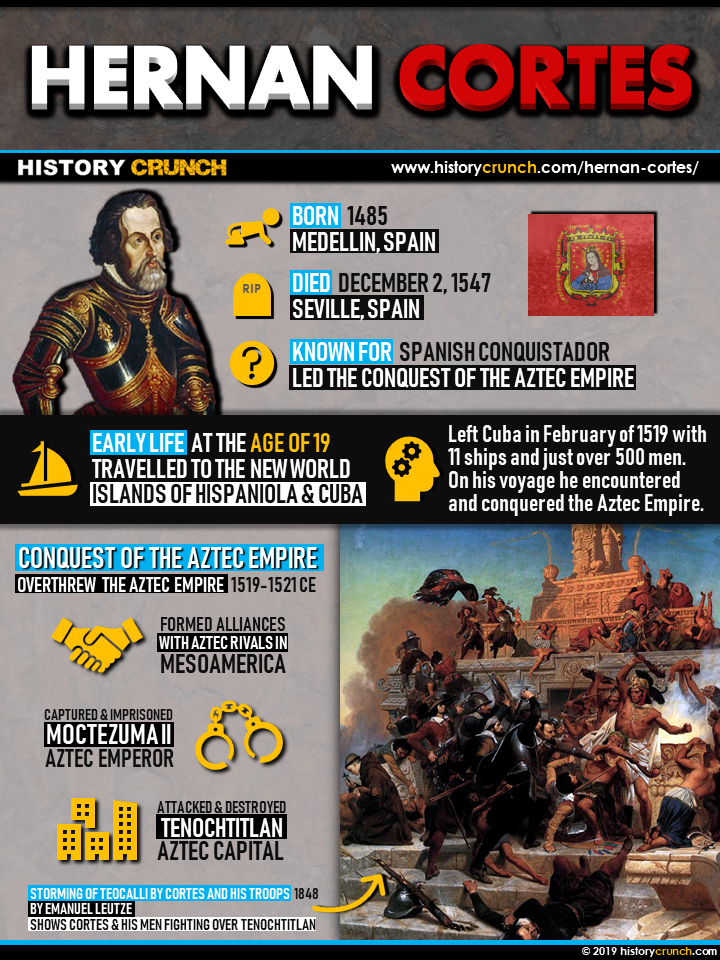
Hernan Cortes was one of the most significant and controversial figures of the Age of Exploration. Born in Spain in 1485, Cortes led the Spanish conquest of the Aztec Empire between 1519 and 1521, toppling one of the most powerful civilizations in the Americas and bringing Mexico under Spanish rule. He is a complex historical figure, remembered both for his extraordinary accomplishments as an explorer and for the enormous devastation he caused to the Aztec people and their civilization. This infographic was designed for students to visually summarize the key aspects of Hernan Cortes’s life and significance and is based on the History Crunch article titled Hernan Cortes.
Hernan Cortes – Infographic
About This Infographic
This Hernan Cortes infographic was created by the History Crunch team to help students and teachers quickly understand the life and significance of one of the most important and controversial figures of the Age of Exploration. It is designed as a visual learning and study tool, summarizing the essential information covered in our full article on Hernan Cortes. Teachers may use it as a classroom display, a discussion prompt, or a study aid for students preparing for assessments.
What This Infographic Covers
Hernan Cortes was born in Medellin, Spain in 1485 into a family of lesser nobility. He was sent to school at the age of 14 but returned home after just two years, uninterested in pursuing the legal career his parents had planned for him. Inspired by the stories of Christopher Columbus and the wealth of the New World, Cortes decided he wanted to seek his fortune through exploration. He set sail for the Americas at the age of just 19, arriving at the island of Hispaniola in 1504 before moving on to Cuba where he became a magistrate in one of the first Spanish colonial towns.
The infographic covers the lead-up to the conquest of the Aztec Empire. Through his contacts with indigenous peoples in the region, Cortes learned of the powerful Aztec civilization in Mesoamerica. He convinced Diego Velasquez, the Spanish governor of Cuba, to allow him to lead an expedition to Mexico. Velasquez later ordered him to halt the expedition but Cortes defied the order and set sail anyway with approximately 11 ships and just over 500 men. This act of defiance against his own superiors is one of the defining characteristics of Cortes as a historical figure.
The infographic covers the key factors that enabled Cortes to conquer the Aztec Empire despite being so vastly outnumbered. First, he formed a critical alliance with the Tlaxcala, a powerful Mesoamerican city-state that were traditional enemies of the Aztec and who provided him with thousands of additional warriors. Second, his arrival coincided with an Aztec prophecy about the return of the god Quetzalcoatl, which caused the Aztec ruler Moctezuma II to initially welcome the Spanish with gifts and hospitality rather than military resistance. Third, the spread of European diseases, particularly smallpox, devastated the Aztec population at the most critical stage of the conflict and severely weakened their ability to resist the Spanish assault. Cortes ultimately captured Moctezuma II, besieged Tenochtitlan and took control of the Aztec capital on August 13th, 1521.
Finally the infographic covers Cortes’s later life and legacy. Following the conquest he was appointed Governor of New Spain and awarded the title of Marques del Valle de Oaxaca by the Spanish king. He returned to Spain in 1541 and died on December 2nd, 1547. His conquest of the Aztec Empire inspired many other Spanish conquistadors, most notably Francisco Pizarro, whose conquest of the Inca Empire in Peru was directly modelled on Cortes’s methods. Today Cortes is remembered as one of the most famous explorers of the Age of Exploration while also being recognized as a figure responsible for the destruction of one of the great civilizations of the Americas.
How to Use This Infographic in the Classroom
This infographic works well as a visual introduction to Hernan Cortes before students read the full biography article. It can also be used as a review tool before an assessment, or as a discussion prompt asking students to evaluate Cortes as a historical figure, weighing his achievements as an explorer against the consequences of his actions for the Aztec people. Teachers may also use it alongside the map of the route of Hernan Cortes and the Spanish conquest of the Aztec Empire infographic to give students a comprehensive visual understanding of the conquest from multiple perspectives.
Related Articles
To learn more about the topics covered in this infographic, visit the following History Crunch articles: