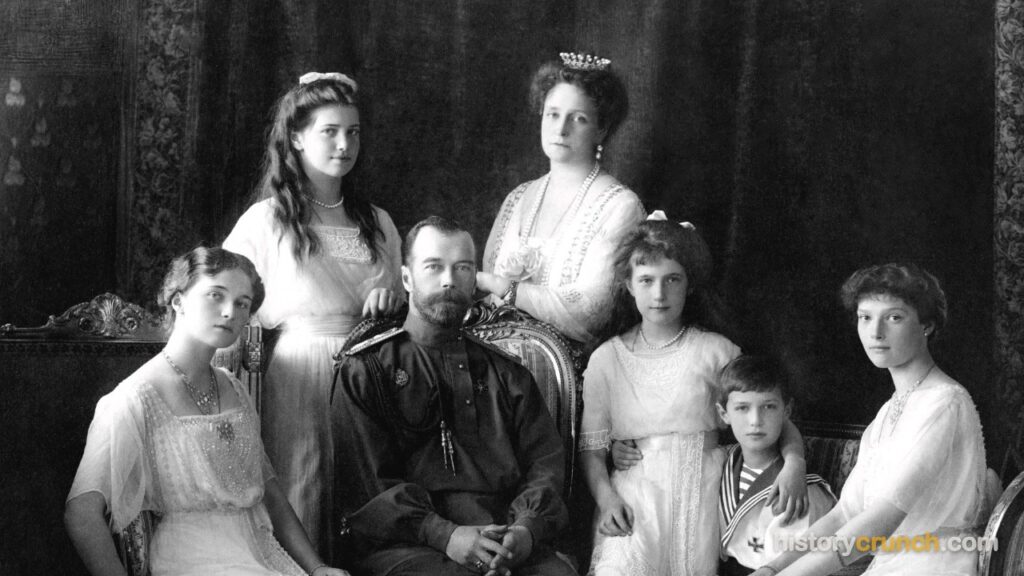
The execution of the Romanov family stands as one of the most important and haunting events of the Russian Revolution of 1917. In the early hours of July 17th, 1918, the last tsar of Russia, Nicholas II, was shot along with his wife, their five children, and four loyal servants in the basement of a house in the city of Yekaterinburg. The killings brought a violent end to the Romanov dynasty, which had ruled Russia for more than three hundred years. More than that, the event marked a symbolic break between the old imperial order and the new Communist state that the Bolsheviks were building.
The Romanov dynasty was the royal family that ruled Russia as tsars, or emperors, from 1613 until 1917. Under this system, called autocracy, the tsar held nearly complete power over the government, the military, and the lives of the Russian people. Nicholas II was the last of these rulers, and his fall from the throne set in motion the chain of events that ended with his family’s death.
What Was the Russian Revolution?
The Russian Revolution of 1917 was a series of major events that overthrew the Russian monarchy and led to the creation of the world’s first Communist state. It unfolded in two main stages during a single year. The first stage, the February Revolution, forced Tsar Nicholas II to give up his throne. The second stage, the October Revolution, brought a radical group called the Bolsheviks to power under their leader, Vladimir Lenin.
For years, anger had been building across Russia against the Romanov dynasty. Most Russians were poor peasants, while a small class of nobles lived in great wealth. When food shortages worsened during World War I, workers, soldiers, and women took to the streets demanding bread, peace, and an end to autocratic rule. This mounting pressure forced Nicholas II to abdicate the throne on March 15th of 1917, which ended the Romanov dynasty as a ruling house.
After the abdication, a temporary body called the Provisional Government took charge, but it struggled to solve Russia’s problems or end the war. In October of 1917, the Bolsheviks staged a takeover and seized power. Soon after, a brutal struggle known as the Russian Civil War broke out, pitting the Bolshevik “Reds” against a loose coalition of anti-Bolshevik “Whites.” It was during this civil war that the Romanov family met its end.
Who Were the Romanov Family?
The Romanov family at the center of these events was made up of Tsar Nicholas II, his wife Tsarina Alexandra, and their five children. Their four daughters were Olga, Tatiana, Maria, and Anastasia, and their youngest child was a son named Alexei. As the only boy, Alexei was the heir to the throne, but he suffered from hemophilia, a serious disease that prevents the blood from clotting normally.
Nicholas II had never truly wanted to rule an empire, yet he clung to the idea of autocratic power inherited from his father, Alexander III. In reality, his stubborn attempts to preserve absolute rule, combined with military defeats and hardship, made him deeply unpopular. By the time of the revolution, the family that had once lived in grand palaces had become symbols of everything the revolutionaries wished to destroy.
How Did the Romanovs Become Prisoners?
After Nicholas gave up the throne in 1917, the former royal family was placed under house arrest. At first they were held at their palace outside Petrograd, the capital that is today called St. Petersburg. As the political situation grew more dangerous, the Bolsheviks moved the family eastward, away from areas where they might be rescued.
The family was first sent to the town of Tobolsk in Siberia, and then, by the spring of 1918, to the city of Yekaterinburg in the Ural Mountains. There they were confined to a house that had belonged to a merchant. The Bolshevik guards gave the building a chilling nickname, calling it the “House of Special Purpose.” Life inside was harsh and humiliating, a stark contrast to the wealth the family had once known, as guards insulted them and watched their every move.
Why Were the Romanovs Executed?
The main reason for the execution was the fear that the Romanovs could be rescued and used against the Bolsheviks. During the Russian Civil War, anti-Bolshevik forces were advancing across the country. In the summer of 1918, a well-organized armed group called the Czechoslovak Legion, fighting alongside the White armies, was moving along the railway toward Yekaterinburg. The local Bolshevik authorities feared they might lose the city at any moment.
To the Bolsheviks, the tsar and his family were living symbols of the old regime. If enemy forces freed them, Nicholas could become a rallying point for those who wished to restore the monarchy and overturn the revolution. For this reason, the leaders decided that the entire family had to be killed rather than risk their escape. Some accounts place the final order with the local Ural Regional Soviet, while others point to the highest levels of Bolshevik leadership in Moscow, including Lenin himself.
What Happened on the Night of the Execution?
Late on the night of July 16th and into the early hours of July 17th, 1918, the family was awakened and told they were being moved for their own safety because of the approaching fighting. The commandant of the house, a Bolshevik named Yakov Yurovsky, led them down into a small basement room. The family was told they would have a photograph taken as proof that they were still alive.
A few chairs were brought in, and Nicholas carried his sick son Alexei down the stairs. Once the family and their servants were gathered, Yurovsky read out a short statement declaring that they had been sentenced to death. A confused Nicholas is said to have managed only a few startled words before the firing squad opened fire.
The scene that followed was chaotic and brutal. The first volley of shots did not kill everyone, and the executioners had to fire again and use bayonets to finish the killing. More specifically, several of the daughters survived the initial gunfire because they had sewn jewels and diamonds into their clothing, which acted like armor and deflected some of the bullets. In all, it took roughly twenty minutes to make certain that every member of the family and their four attendants was dead.
What Happened to the Bodies?
After the killings, the Bolsheviks tried to hide what they had done. The bodies were carried by truck to a forest outside Yekaterinburg, where the killers attempted to destroy and conceal them. Yurovsky’s plans proved clumsy, and the men had trouble hiding so many remains at once.
The bodies were first thrown into a mine shaft, but this hiding place was judged too easy to find. The next night, the remains were dug up and moved again to a more secluded spot along a road outside the city. There the bodies were partly burned and doused with acid before being buried in unmarked graves, an effort meant to keep the truth hidden forever.
The secrecy worked for decades. The Soviet government never told the full story, and rumors spread that one or more of the children, especially Anastasia, might have survived. In reality, the main grave was not located until 1979, and it was kept quiet until after the fall of the Soviet Union. Later DNA testing confirmed the identities of the family, and the discovery of two more sets of remains in 2007 accounted for all seven Romanovs.
Significance of Execution of the Romanov Family
The execution of the Romanov family was significant because it marked the final and complete end of the Romanov dynasty, which had ruled Russia for more than three centuries. With the death of Nicholas II and his heir Alexei, there could be no easy return to the old monarchy. The event closed the door on imperial Russia and opened the way for the Soviet Union.
The killings also deepened the bitterness of the Russian Civil War. The execution horrified many people, both inside Russia and around the world, and it hardened the divide between the Bolsheviks and their enemies. In fact, the event became a powerful symbol of the violence that defined the revolution and the years that followed.
Finally, the mystery surrounding the family’s fate kept the Romanovs in the public imagination long after their deaths. The Soviet cover-up, the missing remains, and the legends of surviving children turned the family into one of history’s most famous unsolved stories until modern science provided answers. Today the execution is remembered as a turning point that helped shape the political landscape of the entire twentieth century.
Frequently Asked Questions
When were the Romanov family executed?
The Romanov family was executed in the early hours of July 17th, 1918, during the Russian Civil War. The killings took place in the middle of the night, beginning late on July 16th and finishing after midnight, which is why some sources list either date.
Where were the Romanovs killed?
The Romanovs were killed in the basement of the Ipatiev House in the city of Yekaterinburg, located in the Ural Mountains region of Russia. The house was chosen partly because its basement could help muffle the sound of gunfire. Many years later, a church was built on the site to honor the family.
Who ordered the execution of the Romanovs?
The order came from the Bolsheviks, though historians still debate exactly who gave the final command. The local Ural Regional Soviet officially approved the killings, but many believe the decision was supported by top leaders in Moscow, including Vladimir Lenin. The man who directly carried out and organized the execution was the house commandant, Yakov Yurovsky.
Did Anastasia Romanov survive?
No, Anastasia Romanov did not survive, despite the famous legends and impostors who claimed to be her. For decades, the missing remains fueled hope that she had escaped, but modern DNA testing confirmed that all seven members of the family died in 1918. The discovery of additional remains in 2007 finally settled the question.
How many people died in the Romanov execution?
A total of eleven people were killed in the execution. This included Tsar Nicholas II, Tsarina Alexandra, and their five children, along with four loyal household servants who had chosen to stay with the family. Among the servants were the family doctor and several attendants who shared the Romanovs’ fate.
Cite This Article
To cite this article as a source, use one of the formats below.
MLA: Millar, B. “Execution of the Romanov Family: A Detailed Summary.” HistoryCrunch, 11 August 2026, https://historycrunch.com/execution-of-the-romanov-family/.
APA: Millar, B. (2026). Execution of the Romanov Family: A Detailed Summary. HistoryCrunch. https://historycrunch.com/execution-of-the-romanov-family/
Chicago: Millar, B. “Execution of the Romanov Family: A Detailed Summary.” HistoryCrunch. August 11, 2026. https://historycrunch.com/execution-of-the-romanov-family/
Sources
- The Met (Heilbrunn Timeline) — Roman art
- Adrian Goldsworthy, How Rome Fell / Caesar (military and political).