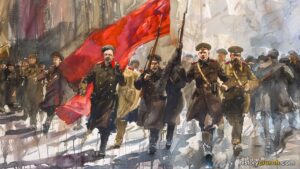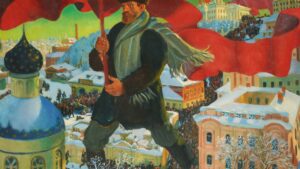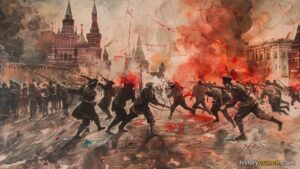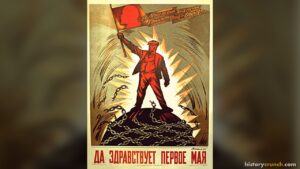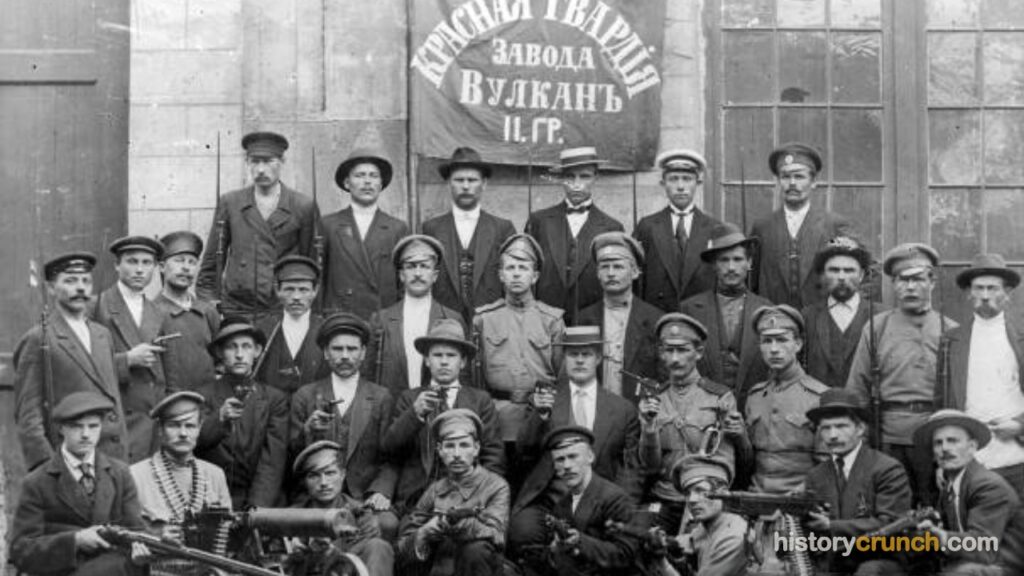
The struggle between the Red Army and the White Army was one of the most important conflicts of the early 20th century, and its outcome decided the political future of Russia for generations. This clash took place during the Russian Civil War, which raged from 1918 to 1922 in the aftermath of the Russian Revolution of 1917. On one side stood the Red Army, the military force of the Bolsheviks who had seized power in the October Revolution. On the other side stood the White Army, a loose coalition of groups united mainly by their opposition to Bolshevik rule. The result of their long and bloody fight was a Bolshevik victory and the birth of the world’s first communist state.
In simple terms, the “Reds” and the “Whites” were the two main sides in the Russian Civil War. The Red Army fought for the Bolshevik government and the ideals of communism, while the White Army fought to overthrow that government and restore some form of the old order. The word “Red” came from the color long associated with socialism and revolution, while the word “White” was linked to the color of the old Russian monarchy. Understanding how these two forces formed, fought, and differed helps explain why Russia became the Soviet Union.
What Was the Russian Revolution?
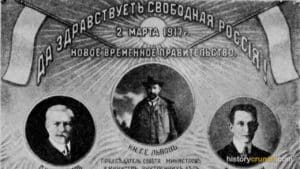
The Russian Revolution of 1917 was an incredibly significant event that transformed the course of history, not only for Russia but for the entire world. It unfolded in two main stages during the same year. The first stage, known as the February Revolution, forced Tsar Nicholas II to give up his throne and brought an end to the centuries-old Romanov dynasty.
After the tsar’s abdication, a temporary government called the Provisional Government took control of Russia. However, this new government struggled to solve the country’s biggest problems, including food shortages and Russia’s costly involvement in World War I. As frustration grew, a radical socialist group called the Bolsheviks, led by Vladimir Lenin, prepared to seize power for themselves.
The second stage was the October Revolution of 1917, also known as the Bolshevik Revolution. In October of 1917, Bolshevik forces overthrew the Provisional Government and established Bolshevik rule in Russia. This dramatic takeover created deep divisions across the country, and those divisions soon exploded into the Russian Civil War, the setting for the fight between the Red Army and the White Army.
Who Were the Red Army?
The Red Army was the military force of the Bolshevik government, created in early 1918 to defend the new communist state. It represented the socialist and communist forces of Russia following the events of the Russian Revolution. Its goal was to protect and strengthen the Soviet state and to transform Russia into a communist society based on the ideas of the German thinker Karl Marx.
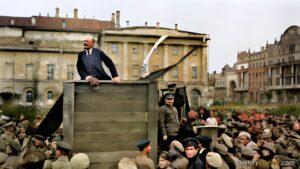
The most important figure behind the Red Army was Leon Trotsky, who served as the Bolshevik commissar in charge of military affairs. Trotsky played a crucial role in organizing and leading the force, and he is often credited with turning it into a disciplined and effective army. More specifically, he introduced conscription, meaning men could be required by law to serve, which allowed the army to grow into the millions.
In fact, Trotsky made a controversial decision to recruit thousands of former officers from the old tsarist army because of their military experience. To keep these officers loyal, the Bolsheviks placed political supervisors, called commissars, alongside them to watch their behavior. During the war, Trotsky famously traveled from front to front aboard an armored train, delivering speeches and directing operations in person.
Who Were the White Army?
The White Army, sometimes called the White Guard, was essentially everyone who opposed the Bolshevik takeover. Rather than being a single united force, it was a widespread coalition of many different groups. This coalition included supporters of the monarchy, conservatives, liberals, some rival socialists, and various nationalist factions.
What held these groups together was not a shared vision for the future but a common enemy. Some Whites wanted to bring back the tsar and the pre-revolutionary order, while others simply wanted a different kind of government than the one the Bolsheviks were building. As stated above, the name “White” came from the color linked to the old Russian Empire, and many of the army’s commanders had been officers under the tsar.
Several military leaders became famous figures within the White movement. Admiral Alexander Kolchak led White forces in the east of Russia and set up a rival anti-Bolshevik government. In the south, General Anton Denikin commanded a large White force known as the Volunteer Army, while other generals led White campaigns from the northwest and other regions.
How Did the Two Armies Compare?
The most important difference between the two sides was organization. The Red Army was centralized and united, with a clear chain of command and a single political ideology to rally behind. In reality, this unity gave the Reds a major advantage over their opponents throughout the war.
By contrast, the White Army was decentralized and divided. Its many groups disagreed about what kind of Russia they wanted, and its armies were spread out around the edges, or periphery, of the country rather than being concentrated in one place. This made it very difficult for White commanders to coordinate their attacks or to agree on a shared plan.
Geography also favored the Reds. The Bolsheviks controlled the central heartland of Russia, including the major cities of Petrograd and Moscow, along with much of the country’s industry and railroads. This meant the Red Army could move troops and supplies quickly along interior lines, while the scattered White forces had to fight far from one another and often relied on outside help.
What Role Did Foreign Powers Play?
The Russian Civil War was not a purely Russian affair, because several foreign nations became involved. A number of Allied powers from World War I, including Great Britain, France, the United States, and Japan, sent money, weapons, and even troops to support the White Army. These powers were alarmed by the spread of communism and hoped to see the Bolshevik government defeated.
Despite this outside help, foreign intervention did not save the Whites. In many cases, the presence of foreign forces on Russian soil actually helped the Bolsheviks, who used it to portray themselves as defenders of Russia against outside invaders. For instance, the Reds argued that the Whites were merely puppets of foreign governments, which weakened White support among ordinary Russians.
The war also spilled beyond Russia’s borders. It became tangled up with other conflicts, such as the Polish-Soviet War of 1919 to 1921, in which the Red Army clashed with Polish forces seeking an independent Poland. These overlapping struggles show just how complex and far-reaching the conflict had become.
How Did the War End?
The fighting swung back and forth during the early years of the war. In 1919, White armies under leaders such as Kolchak and Denikin launched major offensives that captured significant territory and, at times, threatened the survival of the Bolshevik government. For a period, it seemed possible that the Whites might win.
However, the Whites lacked the manpower, supplies, and popular support needed to hold their gains. As their advances stalled, the Red Army launched powerful counterattacks that pushed the White forces back. More specifically, the White campaigns aimed at Moscow and Petrograd failed, and the momentum of the war shifted decisively toward the Reds.
By 1920, the Red Army had consolidated its control over most of the country, and the surviving White forces were driven toward the coasts and eventually forced to flee. The last major White stronghold in the Crimean peninsula fell in late 1920. Scattered fighting continued for a time, but the war was effectively over by 1922, ending in a complete Bolshevik victory.
Significance of Red Army vs White Army in the Russian Revolution
The victory of the Red Army over the White Army was one of the most important outcomes of the entire Russian Revolution. It secured Bolshevik control over Russia and led directly to the creation of the Soviet Union in 1922, the world’s first large communist state. In this new country, power belonged firmly to the Communist Party.
The war also came at a terrible human cost. Millions of people died, and most of them were civilians who perished not only in combat but from disease and famine caused by the chaos of the conflict. The suffering left deep scars across Russia and shaped the harsh policies of the Soviet government in the years that followed.
Overall, the triumph of the Reds influenced world events for the rest of the 20th century. It inspired revolutionary movements around the globe and set the stage for later conflicts, including the ideological rivalry between the Soviet Union and Western nations that became known as the Cold War. In this way, the outcome of the fight between the Red Army and the White Army reached far beyond the borders of Russia.
Frequently Asked Questions
What Was the Difference Between the Red Army and the White Army?
The Red Army fought for the Bolshevik communist government, while the White Army was a coalition that wanted to overthrow it. The Reds were united behind a single ideology and controlled central Russia, whereas the Whites were made up of many groups with different goals scattered around the edges of the country. This basic split shaped nearly every part of the war.
Why Did the Red Army Win the Russian Civil War?
The Red Army won mainly because it was better organized, more united, and controlled the country’s industrial and population centers. Strong leadership from Trotsky, control of the railroads, and a clear political message all helped the Reds outmatch their divided opponents. The Whites, by comparison, never managed to work together effectively.
Who Led the Red Army?
Leon Trotsky was the driving force behind the Red Army as the Bolshevik commissar of war. He built the army from scratch, introduced conscription, and enforced strict discipline while recruiting experienced former tsarist officers. Vladimir Lenin, as head of the Bolshevik government, provided the overall political leadership.
Who Were the Main Leaders of the White Army?
The best-known White leaders were Admiral Alexander Kolchak in the east and General Anton Denikin in the south. Because the White movement had no single commander, these and other generals often operated independently. This lack of a unified leader was one of the biggest weaknesses of the White cause.
How Long Did the Russian Civil War Last?
The Russian Civil War lasted roughly from 1918 to 1922, about four years. The heaviest fighting took place in 1919 and 1920, and the last major White resistance collapsed by the end of 1920. The war formally wound down in 1922, the same year the Soviet Union was officially created.
Cite This Article
To cite this article as a source, use one of the formats below.
MLA: Millar, B. “Red Army vs White Army in the Russian Revolution: A Detailed Summary.” HistoryCrunch, 11 August 2026, https://historycrunch.com/red-army-vs-white-army-in-the-russian-revolution/.
APA: Millar, B. (2026). Red Army vs White Army in the Russian Revolution: A Detailed Summary. HistoryCrunch. https://historycrunch.com/red-army-vs-white-army-in-the-russian-revolution/
Chicago: Millar, B. “Red Army vs White Army in the Russian Revolution: A Detailed Summary.” HistoryCrunch. August 11, 2026. https://historycrunch.com/red-army-vs-white-army-in-the-russian-revolution/
Sources
- Sheila Fitzpatrick, The Russian Revolution.
- Wilson Center Digital Archive
- Library of Congress — Revelations from the Russian Archives
- Orlando Figes, A People's Tragedy.