Ancient Roman festivals were one of the most important parts of daily life in Ancient Rome, giving the Roman people regular days of rest, worship, and celebration throughout the year. These festivals honored the many gods of the Roman world, marked the changing seasons and the farming year, and brought entire communities together for sacrifices, processions, games, and feasts. Because the Romans believed that their success depended on keeping the gods happy, festivals were not simply parties. They were a serious religious duty that helped maintain what the Romans saw as a proper relationship between the people and their gods.
A Roman festival was a special day, or set of days, set aside from ordinary business and dedicated to one or more gods. The Latin word for these holy days was feriae, and on such days public work was suspended, courts were closed, and even enslaved people were often given a break from their usual labor. Some festivals were public events funded and organized by the Roman state, while others were private celebrations held by families in their own homes. Together they filled the Roman calendar and shaped the rhythm of the entire year.
What Was Ancient Rome?
Ancient Rome was one of the most powerful civilizations in world history. It began as a small city-state on the Italian peninsula and grew over many centuries into a vast empire that stretched from Britain in the northwest to Egypt in the southeast. At its height, the Roman Empire controlled much of Europe, North Africa, and parts of the Middle East, and Roman civilization is remembered for its lasting contributions to law, government, architecture, language, and culture.
Historians usually divide Roman history into three main periods. The first was the Roman Kingdom, which lasted from the traditional founding of the city in 753 BCE until 509 BCE. Next came the Roman Republic, from 509 to 27 BCE, when Rome was governed by elected officials and a powerful Senate. Finally came the Roman Empire, from 27 BCE to 476 CE, when Rome was ruled by emperors. Festivals were celebrated across all three of these periods, and many of them were believed to be extremely old, dating back to the earliest days of the city.
Religion sat at the very heart of Roman society. The Romans were polytheistic, meaning they worshiped many gods, each of whom was thought to control a different part of life or nature, such as war, love, the sea, or the harvest. In fact, Roman religion had deep roots in the traditions of earlier Italian peoples, including the Etruscans and the Latin tribes, and later absorbed a great deal of influence from the Greeks. Festivals were the most visible and public way that Romans honored these gods.
Why Were Festivals So Important to the Romans?
The Romans believed that their entire civilization depended on staying on good terms with the gods. More specifically, they thought that if the correct ceremonies were performed at the correct times, the gods would reward the city with victory, good harvests, and protection from disaster. If the ceremonies were neglected or done incorrectly, the gods might send famine, plague, or defeat in war. Festivals were therefore a way of paying the gods the respect they were owed.
Festivals also served an important social purpose. Because the ancient Romans did not have a weekend like the modern world, the days of a festival provided some of the only regular rest from work that ordinary people enjoyed. In reality, a large portion of the Roman year was taken up by holidays of one kind or another. These days allowed people to gather, share food, and take part in games and entertainment paid for by the state or by wealthy citizens.
Finally, festivals helped hold Roman society together. They reminded people of shared stories, such as the founding of the city, and they gave everyone from the wealthiest senator to the poorest laborer a role to play in the life of the community. In this way, festivals strengthened both religious devotion and a sense of common identity.
How Were Roman Festivals Organized?
Roman festivals fell into a few main types. Some were fixed festivals that took place on the same date every year, while others were movable, meaning their dates were announced each year by priests based on the calendar or the seasons. In addition to these annual events, festivals could also be held in response to a specific event, such as to thank the gods for a great victory or to beg for their help during a crisis.
Priests played a central role in organizing and carrying out festivals. The chief priest of the Roman state was known as the pontifex maximus, and he oversaw a group of religious officials responsible for the calendar and for making sure ceremonies followed ancient tradition. Priestesses were important too, most famously the Vestal Virgins, who tended the sacred fire in the Temple of Vesta. These officials were usually drawn from the leading families of Rome.
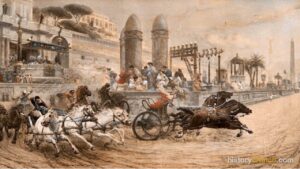
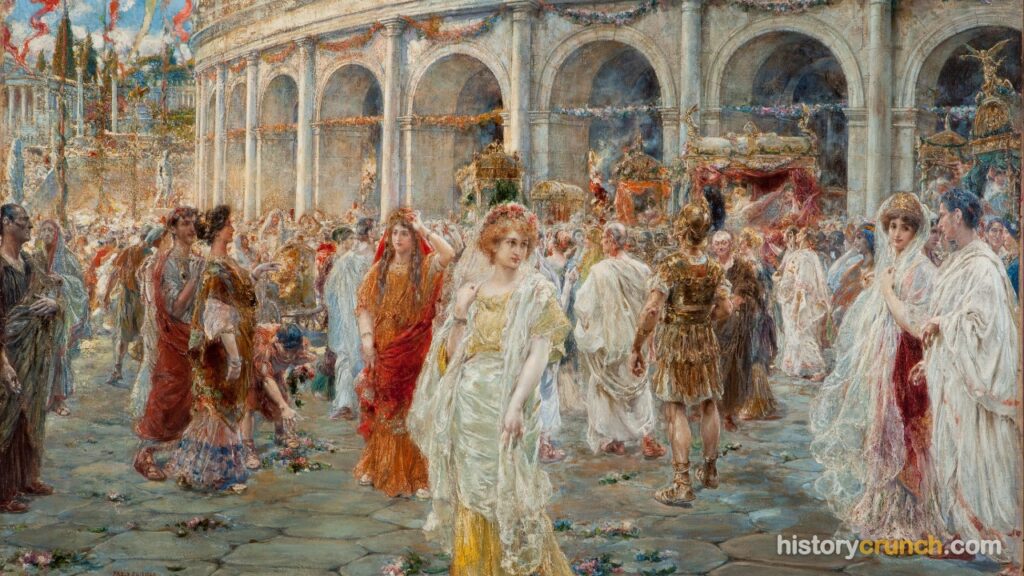
Most festivals shared a similar set of activities. Animals were sacrificed to the gods as offerings of devotion and respect, and processions moved through the streets, often carrying statues or images of the god being honored. Many festivals also included games, such as chariot races and theatrical shows, as well as feasts where people ate, drank, and enjoyed music together. As stated above, larger events were often paid for by the state so that ordinary people could take part without worrying about the cost.
What Were the Most Famous Roman Festivals?
One of the best known Roman festivals was Saturnalia, held in December in honor of Saturn, the god of farming and the sowing of seed. Saturnalia began with a sacrifice at the Temple of Saturn and grew into a period of feasting, gift giving, and general merrymaking that lasted about a week. During the festival, normal rules were relaxed in unusual ways. Public gambling was allowed, people wore special holiday caps, and for a short time enslaved people were freed from their duties, with masters sometimes even serving their slaves. Many of its customs, such as gift giving and lighting candles, later influenced the way winter holidays are celebrated in the Western world.
Another famous festival was Lupercalia, celebrated in mid-February. It was a purification and fertility festival connected to the legend of Romulus and Remus, the twin founders of Rome who, according to the story, were raised by a she-wolf. During the festival, priests sacrificed goats and a dog at the cave where the twins were said to have been suckled, and young men ran through the streets. Over time the festival became less wild, and by the age of the emperors some of its more shocking customs had been banned.
The Romans also celebrated Liberalia in March, in honor of the god Liber, who was associated with wine and fertility. For instance, Liberalia was the day when many young Roman boys officially came of age and put on the adult toga, marking their entry into manhood. It was celebrated with sacrifices, processions, and singing in the streets.
Many other festivals filled the calendar as well. The Parentalia and Feralia in February honored the spirits of dead family members, when Romans brought offerings of food to the tombs of their ancestors. The Parilia in April celebrated Pales, the god of shepherds and flocks, and was linked to the traditional birthday of the city of Rome. There were also grand games, such as the Megalesia in April, held in honor of the goddess Cybele, whose worship had been brought to Rome from Asia Minor.
How Did Festivals Fit the Farming Year?
Many Roman festivals were closely tied to farming, which is not surprising given that Rome began as a small community of farmers and shepherds. In fact, some of the oldest festivals were designed to protect crops, animals, and the land. Festivals in January, for example, included offerings meant to protect the spring sowing of seed, while others in May were held to purify the fields before the growing season.
These agricultural festivals show how the Roman religious calendar followed the natural cycle of the year. There were ceremonies for planting, for the health of the flocks, and for the harvest. More specifically, gods such as Ceres, the goddess of grain, and Saturn, the god of sowing, were honored because the Romans believed their favor was essential for a good crop. A failed harvest could mean hunger, so these festivals were taken very seriously.
By linking worship to the seasons, the Romans gave meaning to the passing of time and connected their daily survival to their religion. Even as Rome grew into a huge empire, these farming festivals continued to be observed, reminding city dwellers of the rural traditions from which their civilization had grown.
Significance of Ancient Roman Festivals
Ancient Roman festivals were significant because they lay at the meeting point of religion, politics, farming, and community life. They gave the Roman people a shared calendar of holy days that structured the entire year and offered regular rest from work. In this way, festivals touched the lives of every Roman, from the emperor down to the poorest citizen and enslaved person.
Festivals were also politically important. Powerful leaders often paid for lavish games and public feasts to win the goodwill of the people, and emperors used festivals to display their generosity and their close relationship with the gods. Because there was no separation between religion and government in Ancient Rome, controlling and funding festivals was one of the ways that leaders showed and strengthened their power.
Perhaps most importantly, the influence of Roman festivals did not disappear when the empire fell. When Rome adopted Christianity as its official religion in the fourth century CE, many old festival dates and customs were absorbed into the new Christian calendar. As a result, echoes of Roman festivals, from the timing of certain holidays to traditions such as gift giving, can still be recognized in celebrations around the world today.
Frequently Asked Questions
How many festivals did the ancient Romans have?
The Romans had dozens of festivals spread across the year, and by some counts holidays filled a large share of the calendar. The exact number changed over time as new festivals were added and older ones faded away. Some were major public events lasting several days, while many others were smaller observances marked only by priests or by individual families.
What did Romans do during a festival?
During a festival, Romans took a break from work and joined in religious and social activities. Typical events included animal sacrifices, processions carrying images of the gods, public feasts, and entertainment such as chariot races and plays. Wealthy Romans and the state often paid for these events so that everyone could join in, which made festivals a welcome relief from ordinary daily labor.
What is the most famous Roman festival?
Saturnalia is probably the most famous Roman festival, held each December in honor of the god Saturn. It was popular because it involved feasting, gift giving, and a temporary loosening of the usual social rules. Its customs are often compared to modern winter holiday traditions, which helps explain why it remains so well remembered today.
Who was in charge of Roman festivals?
Roman festivals were overseen by priests and priestesses who came mostly from the leading families of Rome. The most senior religious official was the pontifex maximus, who supervised the calendar and the correct performance of ceremonies. Julius Caesar himself held this position before becoming a supreme political leader, which shows how closely religion and politics were connected in Rome.
Did Roman festivals influence modern holidays?
Yes, several Roman festivals left their mark on holidays still celebrated today. When Rome became Christian, some festival dates and customs were reused for new religious holidays, which is why certain celebrations line up with older Roman ones. Traditions such as exchanging gifts and marking the turning of the seasons can be traced in part back to Roman practices.
Cite This Article
To cite this article as a source, use one of the formats below.
MLA: Millar, B. “Ancient Roman Festivals: A Detailed Summary.” HistoryCrunch, 7 July 2026, https://historycrunch.com/ancient-roman-festivals/.
APA: Millar, B. (2026). Ancient Roman Festivals: A Detailed Summary. HistoryCrunch. https://historycrunch.com/ancient-roman-festivals/
Chicago: Millar, B. “Ancient Roman Festivals: A Detailed Summary.” HistoryCrunch. July 7, 2026. https://historycrunch.com/ancient-roman-festivals/
Sources
- H.H. Scullard, From the Gracchi to Nero.
- Mary Beard, SPQR: A History of Ancient Rome.
- Adrian Goldsworthy, How Rome Fell / Caesar (military and political).