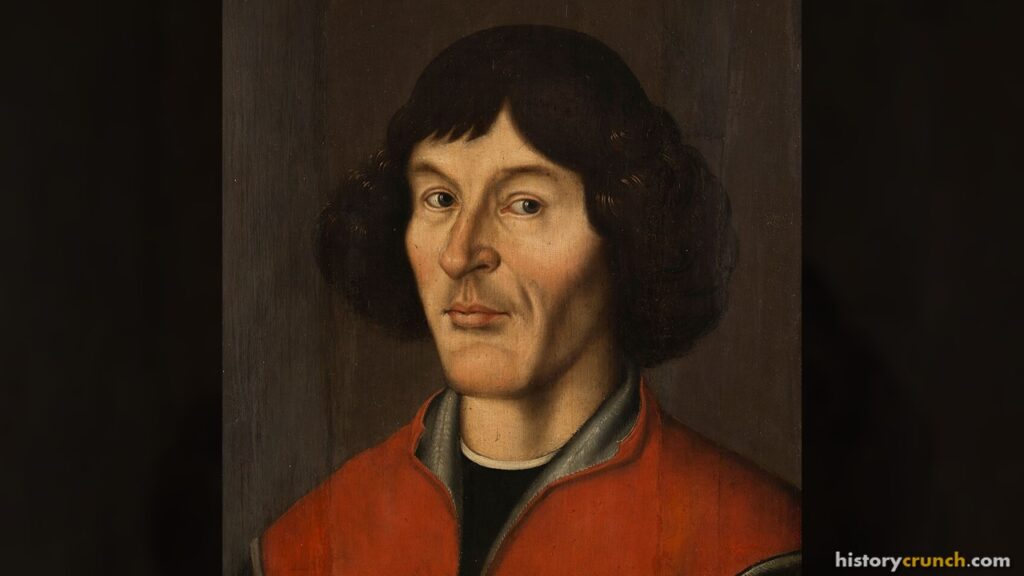
Nicolaus Copernicus was a Polish astronomer who lived during the time of the Renaissance. He is best known for developing the heliocentric model of the solar system, which placed the Sun at the center rather than the Earth. This idea challenged centuries of accepted thinking and laid the groundwork for the Scientific Revolution that followed. His most famous work, ‘On the Revolutions of the Celestial Spheres’, is considered one of the most important books in the history of science.
Nicolaus Copernicus – Early Life
Nicolaus Copernicus was born on February 19th, 1473, in the city of Torun, in the Royal Prussia region of the Kingdom of Poland. He was the youngest of four children. His father, also named Nicolaus Copernicus, was a successful merchant, and his mother, Barbara Watzenrode, came from a well-respected family. When his father died around 1483, Copernicus and his siblings were taken in and raised by their uncle, Lucas Watzenrode the Younger, who later became the Bishop of Warmia. This connection proved extremely important for Copernicus, as his uncle was able to provide him with an excellent education and open doors throughout his life.
Copernicus began his higher education at the University of Krakow around 1491. There, he studied mathematics, astronomy, and painting. He did not complete a degree at Krakow, but the time he spent there sparked a deep interest in astronomy. In 1496, he traveled to Italy to continue his studies. He enrolled at the University of Bologna, where he studied law, but also spent considerable time studying the stars alongside the astronomer Domenico Maria Novara. This relationship had a significant influence on the development of his thinking.
Nicolaus Copernicus – Education and Early Career
Copernicus continued his education in Italy over the following years. He studied medicine at the University of Padua and eventually earned a doctorate in canon law from the University of Ferrara in 1503. His education was broad and covered many fields, which was common for learned men of the Renaissance period. In reality, it was his time in Italy that helped shape the ideas he would develop throughout the rest of his life.
After returning to Poland, Copernicus served as a personal physician and secretary to his uncle, Bishop Lucas Watzenrode. He lived and worked in Lidzbark Warminski for several years before eventually settling in the city of Frombork around 1510. It was in Frombork that he would spend most of the rest of his life, working as a church canon while quietly developing his revolutionary astronomical theory. His duties as a canon were significant and kept him busy with administrative and financial tasks. Nevertheless, he continued his astronomical work in his spare time.
Nicolaus Copernicus – Heliocentric Model
The most significant contribution of Copernicus to science was his development of the heliocentric model of the solar system. Before Copernicus, the accepted view of the universe was the geocentric model, which had been put forward by the ancient Greek astronomer Ptolemy around 150 CE. The geocentric model held that the Earth sat at the center of the universe and that the Sun, Moon, and all other planets revolved around it. This view had been accepted by the Catholic Church and by most scholars in Europe for well over a thousand years.
Copernicus began to question this model after years of careful observation and mathematical study. More specifically, he noticed that the geocentric model required increasingly complicated calculations to explain the movements of the planets. He believed there had to be a simpler explanation. His answer was the heliocentric model, which argued that the Sun, not the Earth, was at the center of the solar system. Furthermore, he proposed that the Earth and the other planets revolved around the Sun and that the Earth also rotated on its own axis once per day. This was a radical departure from everything that had been taught and believed for centuries.
Copernicus first outlined his ideas in a short unpublished manuscript known as the ‘Commentariolus’, which he shared with a small number of trusted scholars around 1514. The manuscript laid out the basic principles of his heliocentric theory without the full mathematical detail he would later develop. He was cautious about publishing his ideas more widely, knowing that they would likely meet with resistance from the Church and from other astronomers.
Nicolaus Copernicus – ‘On the Revolutions of the Celestial Spheres’
Over the following decades, Copernicus worked to develop his theory into a full and detailed work. The result was ‘De revolutionibus orbium coelestium’, or ‘On the Revolutions of the Celestial Spheres’. The book laid out his heliocentric model in full mathematical detail and provided extensive calculations to support his claims. It remains one of the most important scientific texts ever written.
Copernicus was reluctant to publish the work for many years. He was aware that placing the Earth in motion around the Sun directly contradicted both Church teaching and common-sense observation, since people obviously do not feel the Earth moving beneath them. In reality, he feared the reaction his ideas might provoke. However, he was eventually encouraged to publish by a young German mathematician named Georg Joachim Rheticus, who traveled to Frombork specifically to study under Copernicus. Rheticus played a key role in convincing Copernicus to allow the book to be published and even arranged for its printing in Nuremberg.
‘On the Revolutions of the Celestial Spheres’ was published in 1543, the same year Copernicus died. According to tradition, he received a copy of the finished book on the very day he passed away, though he had already suffered a stroke and was near death. The book was initially dedicated to Pope Paul III, and it included a preface written by a Lutheran minister named Andreas Osiander, which stated that the heliocentric model was merely a mathematical tool for calculating planetary positions rather than a true description of reality. It is generally believed that Copernicus did not approve of this preface and that it was added without his full consent.
Nicolaus Copernicus – Death and Significance
Nicolaus Copernicus died on May 24th, 1543, in Frombork, Poland. He was 70 years old. He was buried in the Frombork Cathedral, and in 2010 his remains were confirmed and he was given a proper reburial with full honors.
The significance of Copernicus cannot be overstated. His heliocentric model fundamentally changed the way humans understood the universe and their place within it. In the decades and centuries that followed, his ideas were taken up and expanded by other major scientists. For instance, the Italian astronomer Galileo Galilei used the newly invented telescope to find observational evidence that supported the Copernican model. Furthermore, the German mathematician Johannes Kepler refined the model by showing that the planets moved in elliptical orbits rather than perfect circles. Eventually, the English scientist Isaac Newton built on the work of all three men to develop his laws of motion and gravity, which explained why the planets moved the way they did.
The overall shift in scientific thinking that Copernicus helped spark is often referred to as the Copernican Revolution. It marked the beginning of the Scientific Revolution of the 16th and 17th centuries and established the importance of observation, mathematics, and reason as tools for understanding the natural world. As such, Copernicus is remembered today as one of the most important figures in the history of science and the history of human thought.