The Great Fire of Rome was one of the most destructive disasters in the history of Ancient Rome. It broke out in the city in 64 AD and burned for several days, destroying large portions of one of the most important cities in the ancient world. The fire is closely associated with the reign of Emperor Nero, who ruled Rome at the time, and it gave rise to the debate of whether Nero himself was responsible for starting it. Beyond the destruction it caused, the Great Fire of Rome had significant consequences for the city, for Nero’s reign, and for the early Christian community in Rome.
What Was Ancient Rome?
Ancient Rome was one of the greatest civilizations in human history. It began as a small city on the Italian peninsula as early as the 8th century BC and grew over many centuries into a vast empire that stretched across much of Europe, the Middle East, and North Africa. At its height, the city of Rome itself was the largest and most powerful city in the western world, home to hundreds of thousands of people and filled with grand temples, public baths, markets, theaters, and towering apartment buildings. The city was densely packed and much of it was built from highly flammable materials, including wood, straw, and other organic materials that made fire a constant danger. Rome had experienced fires before 64 AD, but none approached the scale and destruction of the Great Fire.
Causes of the Great Fire of Rome
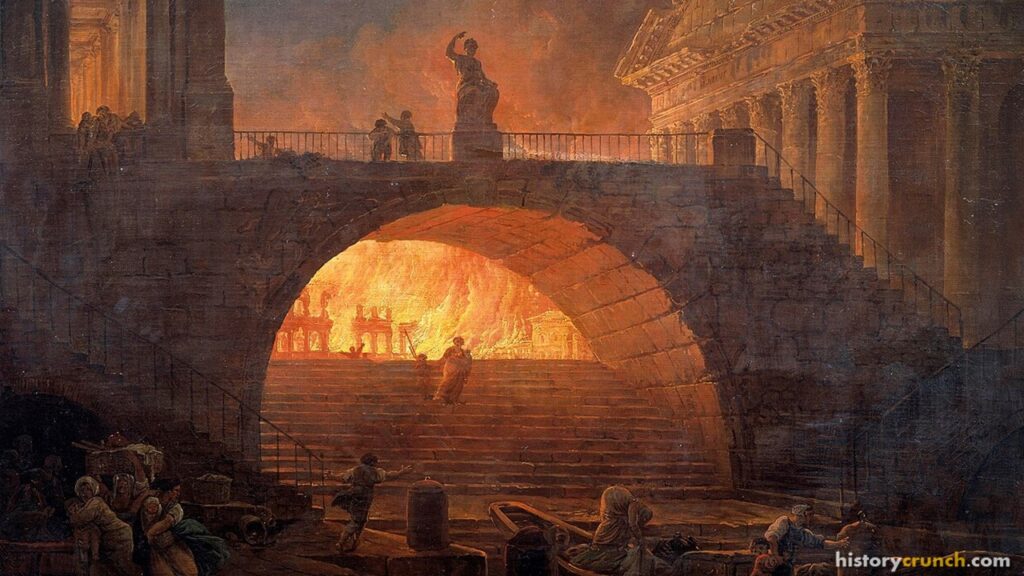
The Great Fire of Rome broke out on the night of July 18th or 19th in 64 AD, beginning in the merchant district near the Circus Maximus, the enormous chariot racing stadium that sat at the heart of the city. The area where the fire started was densely packed with shops and warehouses full of flammable goods, and the fire spread rapidly through the narrow streets of the surrounding neighborhoods. Strong winds helped carry the fire across the city, and the close proximity of Rome’s buildings meant that flames could jump easily from one structure to the next.
The exact cause of the fire has never been definitively established. Accidental fires were extremely common in ancient Rome due to the widespread use of open flames for cooking and heating in densely packed wooden buildings. Most historians today consider an accidental origin to be the most likely explanation. However, ancient sources also record the theory that the fire was deliberately set, and the person most commonly accused of ordering it was Emperor Nero himself. Roman historian Tacitus, who is one of the most important sources for this period of Roman history, recorded that many people believed Nero had started the fire in order to clear land in the city for a massive new palace complex he planned to build, which became known as the Domus Aurea or Golden House. However, Tacitus himself did not definitively confirm this accusation, and the question of whether Nero was responsible remains one of the most debated topics in ancient history.
The Fire and Its Destruction
The Great Fire of Rome burned for approximately six days before it was brought under control, only to reignite and burn for another three days. By the time it was finally extinguished, the fire had devastated large portions of the city. Ancient sources suggest that three of Rome’s fourteen districts were burned completely to the ground, while seven more were severely damaged. Only four of the city’s fourteen districts escaped the fire largely unharmed. Thousands of homes, temples, and public buildings were destroyed, and an enormous number of people were left homeless. The human death toll is not precisely known, as ancient sources do not provide reliable figures, but the fire caused tremendous suffering among the ordinary people of Rome who lost their homes and possessions.
Among the structures destroyed or damaged in the fire were many of Rome’s most ancient and sacred temples, as well as the archives that contained important historical records. The loss of these buildings and records was a significant cultural blow to the Roman world. The Circus Maximus, near where the fire started, was also heavily damaged. The sheer scale of the destruction made the Great Fire of Rome one of the most catastrophic events in the history of the city.
Nero and the Great Fire
Emperor Nero was not in Rome when the fire began. According to ancient sources, he was at his villa in Antium, which is located on the coast south of Rome, when news of the fire reached him. Nero is said to have returned to Rome quickly and to have organized relief efforts for the displaced population, opening public buildings and his own gardens to house the homeless and arranging for food to be brought in from surrounding areas. These actions suggest that Nero took the disaster seriously and attempted to respond to it in a responsible manner.
However, Nero’s reputation suffered greatly in connection with the fire, largely due to the famous story that he played his lyre and sang while Rome burned. This image, which gave rise to the common phrase “fiddling while Rome burns,” is almost certainly not historically accurate. The fiddle did not exist in ancient Rome, and most historians today believe the story was either an exaggeration or an invention by Nero’s enemies. Nevertheless, the story became deeply associated with Nero and contributed to his lasting reputation as an irresponsible and callous ruler. The suspicion that Nero had deliberately started the fire in order to clear land for his lavish Domus Aurea palace complex, which he began constructing on the ruins of burned areas of the city, added further fuel to the accusations against him.
Persecution of Christians
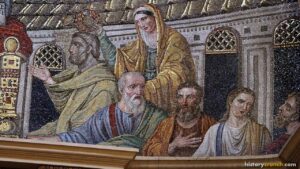
One of the most significant consequences of the Great Fire of Rome was the persecution of Christians that followed. According to the Roman historian Tacitus, Nero chose to blame the Christians of Rome for starting the fire in order to deflect suspicion away from himself. At the time, Christianity was a relatively new and poorly understood religion in Rome, and Christians were viewed with suspicion by many Romans. By accusing them of starting the fire, Nero gave the Roman public a convenient scapegoat and provided a justification for a brutal campaign of persecution against the Christian community.
The persecution of Christians under Nero following the Great Fire is considered one of the first large-scale Roman persecutions of Christians in history. Christians were arrested, tortured, and executed in large numbers. Ancient sources describe particularly gruesome methods of execution, including being burned alive and being thrown to wild animals in public arenas. Among those who are traditionally believed to have been martyred during this period of persecution are the Apostles Peter and Paul, two of the most important figures in the early Christian church. The persecution of Christians following the Great Fire of Rome therefore had a lasting and significant impact on the history of Christianity and on the relationship between the Roman Empire and the early Christian community.
Rebuilding Rome After the Fire
In the aftermath of the Great Fire, Nero undertook a major program of rebuilding the city of Rome. The rebuilding effort was significant not only for its scale but also because Nero used it as an opportunity to redesign parts of the city with wider streets, larger open spaces, and buildings constructed from more fire-resistant materials such as stone and brick. These changes were intended to reduce the risk of future fires spreading as rapidly as the Great Fire had. While the rebuilding brought genuine improvements to parts of the city, it also provided Nero with the cleared land he needed to construct the Domus Aurea, his vast new palace complex. The Domus Aurea covered an enormous area of central Rome and included gardens, artificial lakes, and lavishly decorated rooms, leading many Romans to feel that Nero had exploited the disaster for his own personal benefit.
Significance of the Great Fire of Rome
The significance of the Great Fire of Rome extends well beyond the physical destruction it caused. The fire and its aftermath reveal important aspects of Roman society, including the vulnerability of the densely packed city to disaster, the power of rumor and accusation in Roman political life, and the precarious position of minority groups such as Christians within the Roman Empire. The fire also had a direct impact on the reign and legacy of Nero, deepening the suspicion and resentment that many Romans felt toward him and contributing to the deterioration of his relationship with the Senate and the broader Roman population. Nero was eventually driven from power and committed suicide in 68 AD, just four years after the fire. The Great Fire of Rome remains one of the most famous and consequential events in the history of the ancient world and continues to be an important topic in the study of Ancient Rome today.