Napoleon Bonaparte was one of the most significant and influential leaders in the history of the modern world. Born on the island of Corsica on August 15th, 1769, he rose from a relatively modest background through the ranks of the French military to overthrow the Directory in 1799, become Emperor of France in 1804 and reshape the map of Europe through a decade of military campaigns. His introduction of the Napoleonic Code transformed legal systems across Europe while his ambition ultimately led to catastrophic defeats in Russia and at Waterloo before his final exile and death on the island of Saint Helena in 1821. This infographic was designed for students to visually summarize the key aspects of Napoleon’s life and significance and is based on the History Crunch article titled Napoleon Bonaparte.
Napoleon Bonaparte – Infographic
About This Infographic
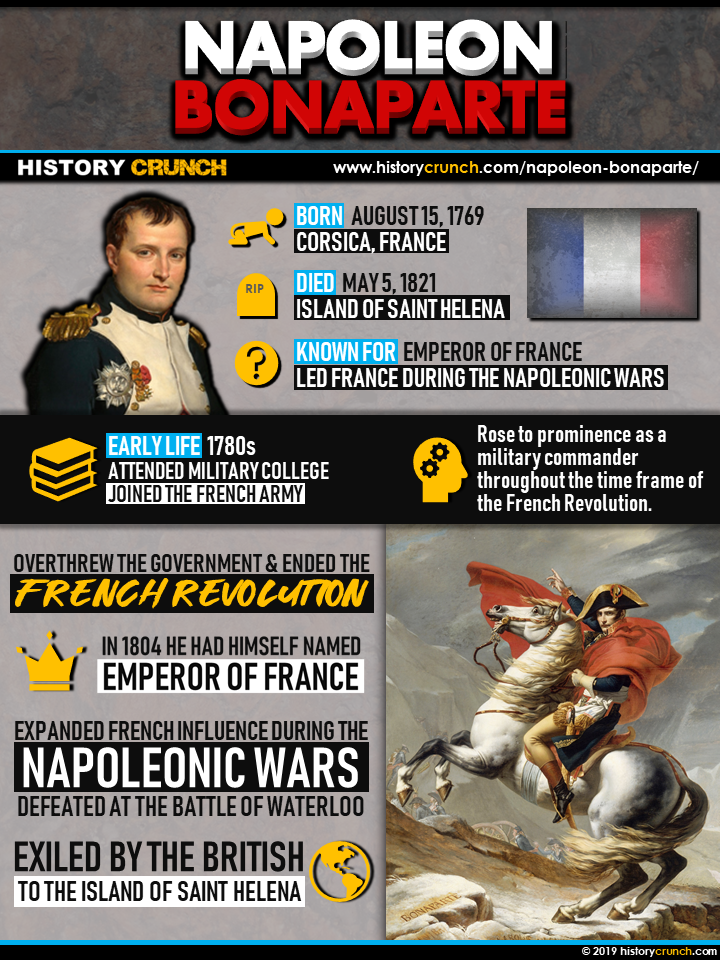
This Napoleon Bonaparte infographic was created by the History Crunch team to help students and teachers quickly understand the life and significance of one of the most studied figures in world history. It is designed as a visual learning and study tool, summarizing the essential information covered in our full article on Napoleon Bonaparte. Teachers may use it as a classroom display, a discussion prompt, or a study aid for students preparing for assessments.
What This Infographic Covers
The infographic begins with Napoleon’s early life and military career. He was born on August 15th, 1769 on the French island of Corsica as Napoleone di Buonaparte, changing his name to Napoleon Bonaparte in his twenties. He came from a family of minor Italian nobility. He received no formal education until age nine, but showed exceptional promise and obtained a place at the military college at Brienne before graduating from the prestigious Ecole Militaire in Paris in 1785 and becoming a second lieutenant in the French army. During the French Revolution he joined the Jacobins and distinguished himself militarily. He was promoted to brigadier general in 1793 after his successful command of artillery at the siege of Toulon, and rose further to commander of the Army of the Interior and then commander of the French army in Italy, where his forces captured extensive territory and defeated the Austrians. He also led campaigns in Egypt before returning to France as a national hero.
The infographic covers Napoleon’s seizure of power and rise to Emperor. On November 9th, 1799, he overthrew the unpopular and ineffective Directory government with the help of loyal troops and political allies and replaced it with the Consulate, naming himself First Consul. This moment marked the end of the French Revolution and the beginning of Napoleon’s personal rule over France. He became Emperor of France in 1804 and declared himself King of Italy in 1805. During this period he introduced the Napoleonic Code in 1804, a comprehensive civil code of laws that introduced the principle of rule of law, legal equality and secular institutions and influenced the development of modern legal systems across Europe and beyond.
The infographic covers the Napoleonic Wars and Napoleon’s military dominance of Europe. Over the following decade he fought a series of major campaigns against shifting coalitions of European powers including Austria, Russia, Prussia and Great Britain. His most celebrated victory came at the Battle of Austerlitz in 1805, where he defeated a combined Austrian and Russian force and forced Austria to sign the Treaty of Pressburg. Further victories at Jena and Friedland gave France dominance over much of continental Europe. At his peak Napoleon controlled the largest European empire since the Roman Empire.
Finally the infographic covers Napoleon’s decline, defeat and legacy. His invasion of Russia in 1812 with an army of 500,000 men ended catastrophically when the Russian winter, dwindling supplies and relentless Russian counterattacks reduced his force to fewer than 100,000 by the time he retreated. He was defeated by the Fourth Coalition at the Battle of Leipzig in 1813 and forced to abdicate and go into exile on the island of Elba. He escaped and returned to France in 1815 for the period known as the Hundred Days, but was decisively defeated at the Battle of Waterloo. He was exiled to the remote island of Saint Helena in the south Atlantic, where he died on May 5th, 1821.
How to Use This Infographic in the Classroom
This infographic works well as a visual introduction to Napoleon before students read the full biography article. It can also be used as a review tool before an assessment, or as a discussion prompt asking students to evaluate Napoleon as a historical figure, weighing his military achievements and legal reforms against the cost in human lives of his wars of conquest. Teachers may also use it alongside the French Revolution Overview infographic to help students understand how Napoleon both emerged from and ended the French Revolution.
Related Articles
To learn more about the topics covered in this infographic, visit the following History Crunch articles: