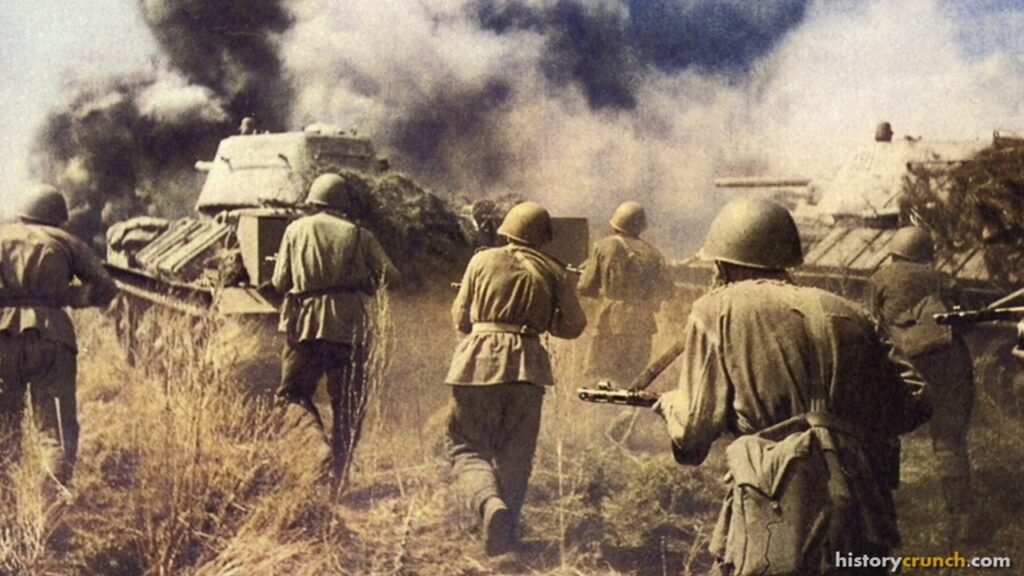
The Battle of Kursk was one of the most important battles of World War II and became the last major Nazi German offensive on the Eastern Front. Fought from July 5th, 1943, to August 23rd, 1943, around the city of Kursk in the Soviet Union, it began as a Nazi German attempt to destroy a large Soviet bulge in the front lines and ended in a major Soviet victory that shifted the war further in the Soviet Union’s favor.
Battle of Kursk – Background
The Battle of Kursk took place after Nazi Germany had already failed to defeat the Soviet Union in 1941 and had suffered a huge defeat at Stalingrad in early 1943. Even so, Adolf Hitler still hoped to regain the initiativeThe ability to choose when and where to attack, giving one side control over how the war develops. in the east. The German plan, called Operation CitadelThe German plan to attack the Kursk salient from the north and south simultaneously to destroy trapped Soviet forces., aimed to attack the Kursk salientA bulge in a front line that pushes out into enemy territory. from the north and south at the same time. A salient is a bulge in a front line that sticks out into enemy territory, and the one at Kursk stretched deep into the German lines.
Kursk mattered because it sat on an important part of the central front in western Russia. If the Germans could cut off the salient, they hoped to destroy large Soviet forces and restore momentum after Stalingrad. However, the Soviet leadership had a good idea that an attack was coming. Because of this, Soviet forces built deep belts of trenches, minefieldsAreas where explosive devices are buried underground to destroy enemy tanks and troops moving through them., anti-tank defenses, and reserve positions before the battle even began.

Battle of Kursk – Operation Citadel
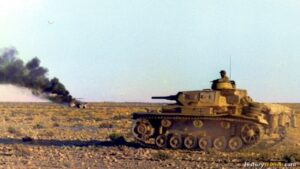
The German offensive began on July 5th, 1943. German forces attacked from the north and the south with tanks, infantry, artillery, and aircraft. The goal was to close the gap around the Kursk salient and destroy the Soviet forces inside it. The battle quickly became enormous in scale, with massive numbers of soldiers, tanks, and aircraft involved on both sides.
Regardless, the German attack did not achieve the quick breakthrough Hitler wanted. In the north, German forces advanced only a limited distance before strong Soviet defenses slowed them down. In the south, the Germans made greater progress, but they still faced deep minefields, strong anti-tank fire, and repeated Soviet resistance. As such, the offensive turned into a costly struggle rather than a fast encirclementA military tactic of surrounding enemy forces on all sides to trap and destroy them..
This mattered because German success in earlier years often depended on speed, surprise, and rapid movement. At Kursk, those advantages were much weaker. The Soviets had prepared too well, and the Germans paid heavily for every mile [1.6 km] they gained.
FactsthatCrunchAdolf Hitler ordered the Kursk offensive, code-named Operation Citadel, to begin on July 5th, 1943, but he had already delayed it several times to wait for more Panther and Tiger tanks, giving Soviet commanders months to prepare.
Hitler's decision to postpone Operation Citadel from May to July 1943 was meant to strengthen the attacking force, but it gave the Soviet army time to build the most heavily fortified defensive position of the entire war. When the assault finally came, German forces could not punch through, and the Red Army launched its own counterattacks within days.
Battle of Kursk – the Soviet Counterattack
One of the most famous parts of the Battle of Kursk came near Prokhorovka, in Russia, on July 12th, 1943. Fighting there became one of the best known armored clashes of the war. Although later historians have debated the exact scale and details of the fighting, Prokhorovka still became one of the central symbols of the Battle of Kursk because it showed how fierce the struggle had become.
By that point, the larger German offensive was already losing momentum. On the same day, the Soviets launched a major counteroffensiveA large attack launched by a defending force after stopping the enemy’s advance. against the German position around Orel, in Russia, north of the salient. This meant that Germany was no longer simply attacking. It was now also being forced to defend against growing Soviet pressure.
The wider war also affected Nazi German decisions. In July of 1943, the Western Allies invaded Sicily, which added new pressure on Hitler. At the same time, the Soviet counterattacks around Kursk kept growing stronger. Therefore, Hitler decided to halt the offensive before Germany had achieved its main goal.
After that, the Soviets pushed forward more forcefully. They launched new offensives, retook Orel and Belgorod, and eventually recaptured Kharkiv, in Ukraine, on August 23rd, 1943. That date is commonly used as the end of the Battle of Kursk.
FactsthatCrunchSoviet 5th Guards Tank Army Attacks the II SS-Panzer Corps near Prokhorovka
On the 12th of July, 1943, the Soviet 5th Guards Tank Army, commanded by General Pavel Rotmistrov, launched an attack against the German II SS-Panzer Corps, commanded by General Paul Hausser, near the town of Prokhorovka, about 54 miles (87 km) southeast of Kursk. The clash was part of the larger Battle of Kursk, where Germany's Operation Citadel had pushed south through Soviet defensive lines since the 5th of July. Recent research shows that roughly 616 Soviet tanks and 294 German tanks and assault guns took part in the main engagement that day, far fewer than older accounts had claimed.
Battle of Kursk – Significance
The Battle of Kursk was significant because it marked the clear end of Nazi Germany’s ability to launch major strategic offensives on the Eastern Front. Germany could still fight hard after Kursk, but it no longer had the strength to carry out another large attack of this kind against the Soviet Union. From this point forward, the Soviet Union increasingly held the initiative and pushed westward.
The battle was also important because it showed how much the war had changed since 1941. Earlier in the war, Germany had often overwhelmed Soviet forces with speed and surprise. At Kursk, the Soviet Union was better prepared, better organized, and more capable of absorbing a major attack before launching strong counteroffensives of its own. This showed that the Red ArmyThe military forces of the Soviet Union during World War II. had become a far more effective fighting force.
Finally, the Battle of Kursk was important because it helped shape the rest of the war in Europe. After Kursk, the Soviet Union continued pushing German forces backward across eastern Europe. In this way, the Battle of Kursk was not only a huge battle in itself. It was also one of the clearest turning points in the war between Nazi Germany and the Soviet Union.
FactsthatCrunchIn July and August of 1943, German forces launched Operation Citadel to cut off a large Soviet bulge near Kursk, but Soviet commanders had received advance warning and built deep defensive lines. The attack stalled within days, and a massive Soviet counteroffensive, Operation Kutuzov, pushed German forces back and seized the initiative permanently.
Germany could still plan and launch large armored offensives to seize territory on the Eastern Front
Germany spent the rest of the war on the Eastern Front defending ground rather than attacking
Explore World War II · 1939 – 1945
Keep exploring World War II with these History Crunch resources.
Key Vocabulary
Salient
Operation Citadel
Minefields
Encirclement
Counteroffensive
Initiative
Red Army
Frequently Asked Questions
When was the Battle of Kursk fought?
The Battle of Kursk was fought from July 5th, 1943, to August 23rd, 1943. It took place around the city of Kursk in the Soviet Union. The fighting lasted about seven weeks and involved huge numbers of soldiers, tanks, and aircraft.
What was Operation Citadel?
Operation Citadel was the German plan to attack the Kursk salient from the north and south at the same time. A salient is a bulge in a front line that sticks out into enemy territory. The goal was to cut off the bulge and destroy the large Soviet forces trapped inside it.
Why did the German attack fail?
The German attack failed mainly because the Soviets knew it was coming and prepared strong defenses. They built deep belts of trenches, minefields, and anti-tank positions before the battle began. German success had often depended on speed and surprise, but those advantages were much weaker at Kursk.
What happened at Prokhorovka?
Prokhorovka was the site of one of the best known armored clashes of the war, fought on July 12th, 1943. Historians still debate the exact scale of the tank fighting there. The clash became a central symbol of the battle because it showed how fierce the struggle had become.
Why was the Battle of Kursk a turning point?
The Battle of Kursk marked the end of Nazi Germany’s ability to launch major offensives on the Eastern Front. After Kursk, the Soviet Union held the initiative and pushed German forces westward. The battle showed that the Red Army had become a far more effective fighting force since 1941.
Cite This Article
To cite this article as a source, use one of the formats below.
MLA: Millar, B. “Battle of Kursk: A Detailed Summary.” HistoryCrunch, 4 October 2026, https://historycrunch.com/battle-of-kursk/.
APA: Millar, B. (2026). Battle of Kursk: A Detailed Summary. HistoryCrunch. https://historycrunch.com/battle-of-kursk/
Chicago: Millar, B. “Battle of Kursk: A Detailed Summary.” HistoryCrunch. October 4, 2026. https://historycrunch.com/battle-of-kursk/
Sources
- Imperial War Museum
- Max Hastings, Inferno / All Hell Let Loose.
- The National WWII Museum