The city of Rome was the political, economic and social center of the Roman Empire. As a city, its history stretches over 2,500 years. In fact, it began as a small settlement on the banks of the Tiber River and grew into the heart of an empire that controlled much of Europe, North Africa, and the Middle East.
CITY OF ROME – ORIGINS
The city of Rome is located on the Tiber River. The area was comprised of a series of hills and early settlements began on these hills. Historians have determined that human beings have been living in the area around Rome since about 14,000 years ago.
In terms of its ancient history, the city of Rome was originally said to have been settled in the 8th century BCE. In ancient Roman history, the city was said to have been founded by Romulus and Remus. The myth tells that they were twins and established the city together. However, a fight occurred and Romulus killed Remus and then named the city after himself. Regardless, historians agree that the city was likely first settled in 753 BCE.
Throughout the centuries that followed, Rome was ruled by a series of kings and then later an oligarchic republic, meaning it was ruled by a small set of elites. During this time the city quickly grew in importance and population. It furthered gained territory and influence through the Punic Wars against Carthage and Macedonian Wars against Macedonia. What follows is one of the most significant times in its entire history – the Roman Empire.
CITY OF ROME – ROMAN EMPIRE
The great Roman Empire extended from 27 BCE until 395 CE. This was a major height in the history of the city and saw it expand as it was the capital of the entire empire, which extended throughout much of Europe, Northern Africa and the Middle East. Because it was the capital of such a vast empire, the city of Rome prospered with trade with goods from distance places.
Civil wars and political unrest in the late Republic led to the rise of Julius Caesar, whose reign paved the way for his heir, Augustus, to become the first emperor in 27 BCE. Under Augustus, Rome entered a golden age known as the ‘Pax Romana‘, which was a period of relative peace that lasted for over two centuries. The city of Rome flourished during this time as the center of political power. As such, several major structures were built during this time. In fact, Augustus famously said, “I found Rome a city of brick and left it a city of marble.” During this time, the city of Rome filled with amazing monuments, such as: the Pantheon, the Colosseum, and the Circus Maximus.
At the time, every Roman town had an amphitheater which was a large stadium in which entertainment and Roman ‘games’ would take place. The largest and most famous Roman amphitheater was the Colosseum in Rome. It is also one of the most famous structures in all of Ancient Rome. It was built between 70 and 80 CE and was ordered to be built by Emperor Vespasian who ruled over Rome from 69 to 79 CE. His family name was ‘Flavian’; therefore the original name of the Colosseum was the Flavian Amphitheater.
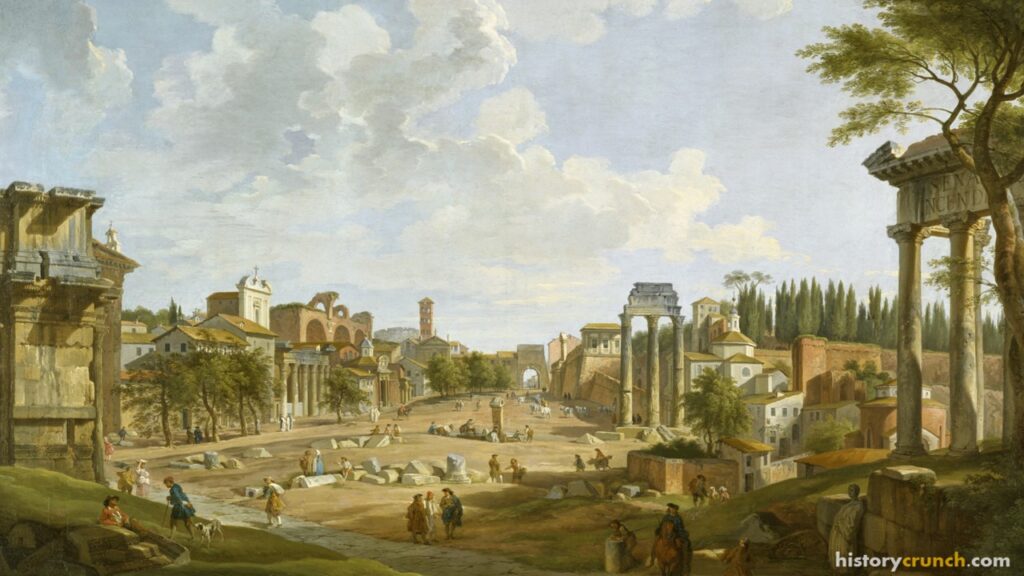
Life in the city of Rome was interesting and vibrant during this period of time. For instance, the population of the city included all different walks of life, including: senators, nobles, merchants, artisans, soldiers, slaves and more. They were all living side by side in a diverse city that reflected the Romans Empire’s vastness. At the time, the Roman Forum served as the political and religious center, while the Colosseum hosted gladiatorial games that drew huge crowds. Public baths, like the Baths of Caracalla and Baths of Diocletian, were social hubs where people from across the city could gather to relax and socialize.
Despite its prosperity during this time, the city of Rome also faced challenges, such as: overcrowding, pollution, fires, and social inequality. Wealthy Romans lived in luxurious villas, while the poor crowded into multi-story apartment buildings, often without running water or proper sanitation.
CITY OF ROME – SIGNIFICANCE
The city of Rome in Ancient Rome was a highly significant social, political and economic center. It was not only the political and administrative capital of the Roman Empire but also the birthplace of ideas and institutions that shaped Western civilization throughout history. For example, Roman law, architecture, engineering and language influenced many of the people and civilizations that came after. The city also represented the might and resilience of the empire, and was a place where emperors ruled, armies marched, and citizens experienced the triumphs and challenges of one of history’s greatest societies. For that reason, historians consider the city of Rome to be one of the most important centers in all of ancient history.