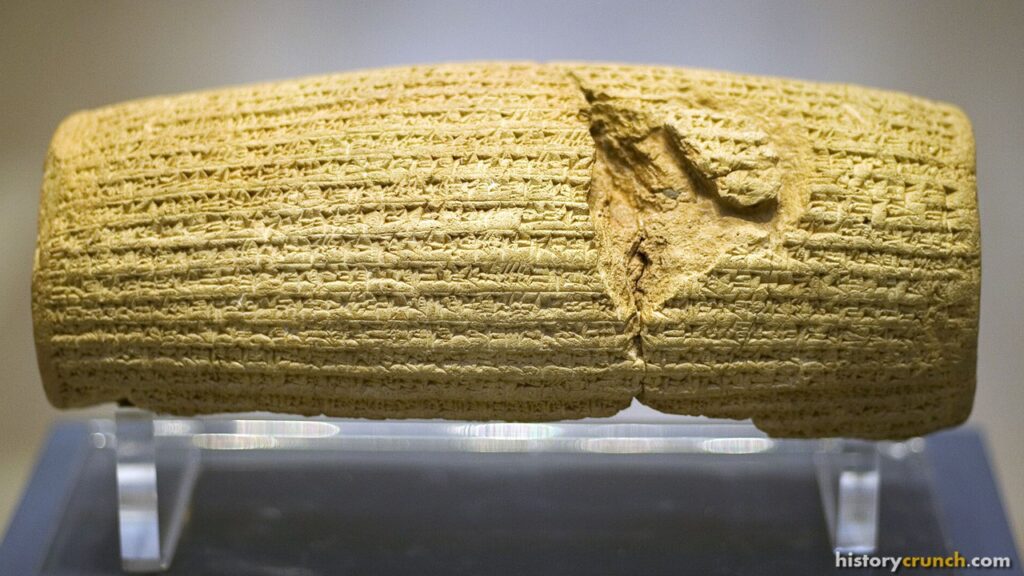
The Cyrus Cylinder is a clay cylinder that dates from approximately the 6th century BCE. Around its exterior is writing that explains declarations made by the Persian king Cyrus the Great. Cyrus the Great is famous for founding the Achaemenid Empire, which is today considered to be the first Persian Empire. The actual text of the Cyrus Cylinder discusses several matters but historians consider it to be one of the first texts related to human rights. For instance, the cylinder discusses the idea of religious freedom, equality rights and the banning of certain forms of persecution. As such, the Cyrus Cylinder is an important aspect of history, especially in relation to: ancient history, Mesopotamian history, and the history of human rights.
CYRUS CYLINDER – SUMMARY
As stated above, the Cyrus Cylinder is a clay cylinder that was first made in 539 BCE. It is approximately 9 inches (22.5 centimeters) long and 4 inches (10 centimeters) wide. The cylinder is covered on the outside with Akkadian cuneiform script, which was the main language used in the Mesopotamian region at the time. Ancient Mesopotamia was situated between the Tigris and Euphrates rivers in the Middle East, which today is the southern section of modern Iraq. In total, the Cyrus Cylinder has 45 lines of text, which historians have divided into six main parts. The first part consists of lines 1 to 19 of the Cyrus Cylinder and discusses the authority and status of Cyrus the Great, who had just become the King of Babylon. Furthermore, these first lines downplay the significance of the earlier king (Nabonidus), and connect Cyrus the Great to the Babylonian god Marduk. The second part consists of lines 20 to 22 and outlines Cyrus’ royal bloodline, thus proving his entitlement to rule. The third part consists of lines 22 to 34 and details Cyrus’ entry into Babylon and the manner in which he restored Babylon. The fourth part consists of lines 34 and 35 and offers a prayer to the Babylonian god Marduk for Cyrus. The fifth part consists of lines 36 and 37 and is a declaration by Cyrus in relation to offerings to the gods. The final part consists of lines 38 to 45 and outlines the building projects undertaken in Babylon by Cyrus.
The Cyrus Cylinder was discovered in 1879 following an archeological search for it that was carried out by Hormuzd Rassam. Rassam was an Assyrian and British archeologist who searched in the Middle East, including regions important to ancient Mesopotamia, on behalf of the British Museum. The Cyrus Cylinder was discovered in the ruins of a Babylonian temple that was built to honor the Babylonian god Marduk. As he was working for the British Museum in London, England, Rassam returned to London with the Cyrus Cylinder. It remains in the British Museum still to this day.
CYRUS CYLINDER – SIGNIFICANCE
As a historical item, the Cyrus Cylinder has been interpreted in many different ways. First, some consider it to be a vitally important example of ancient Mesopotamian traditions. For example, it was supposedly quite common for rulers in kingdoms from ancient Mesopotamia to make new declarations and reforms when they rose to power. In this way, the Cyrus Cylinder is very similar to earlier declarations that have been uncovered from the region. Second, some historians have highlighted the importance of the Cyrus Cylinder as providing an insight into the daily life of people in ancient Mesopotamia. For example, the Cyrus Cylinder provides key details about aspects of Mesopotamian religion, kings, and building projects. Finally, the Cyrus Cylinder is viewed by many to be a pivotal item in relation to the history of human rights. For instance, some have referred to the Cyrus Cylinder as one of the first ‘charter of rights’ in human history. In fact, the cylinder discusses the idea of religious freedom, equality rights and the banning of certain forms of persecution.