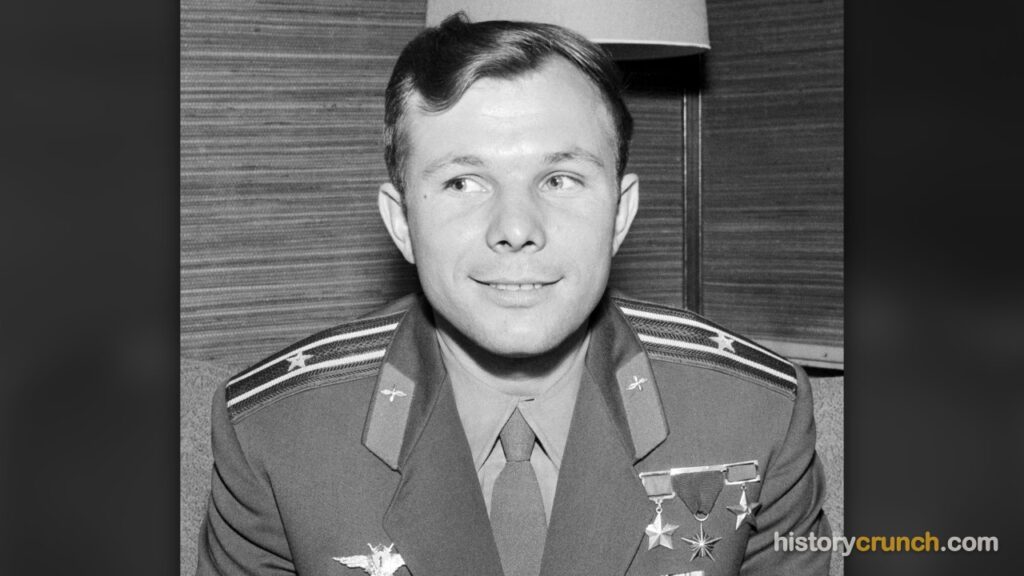
Yuri Gagarin holds a permanent place in world history as the first human being to travel into outer space. On April 12th, 1961, the Soviet cosmonaut orbited the Earth aboard a spacecraft called Vostok 1, a mission that lasted only 108 minutes but changed the course of the twentieth century. His flight came at the height of the Space Race, the intense competition between the United States and the Soviet Union to prove which country had the most advanced science and technology. By reaching space first, Gagarin handed the Soviet Union one of its greatest victories in the Cold War and turned himself into a hero known around the globe.
A cosmonaut is the Russian word for a person trained to travel into space, the same role that Americans call an astronaut. Gagarin was chosen from among thousands of Soviet military pilots to become one of the country’s first cosmonauts, and his single spaceflight made him the most famous of them all. For a fuller picture of the rivalry that made his mission so important, the story of the Space Race in the Cold War provides helpful context.
Early Life and Background
Yuri Alekseyevich Gagarin was born on March 9th, 1934, in the small village of Klushino, west of Moscow in the Smolensk region of the Soviet Union. His family were ordinary workers on a collective farm, which was a large farm owned and run by the state rather than by private families. His father was a carpenter and his mother worked as a dairymaid, and the family lived a simple rural life.
Gagarin’s childhood was shaped by the hardship of the Second World War. Beginning in the fall of 1941, German soldiers occupied his village as part of their advance on Moscow, and the occupation lasted for nearly two years. During this time his schooling was interrupted, and his family suffered along with millions of others across the country. After the war ended, the family moved to the nearby town of Gzhatsk, where the young Gagarin returned to school and studied subjects such as mathematics and physics.
As a teenager, Gagarin trained at a trade school near Moscow and learned to work as a metal molder, or foundryman, in a steel plant. He then continued his education at a technical college in the city of Saratov. It was there that he discovered the interest that would define his life, when he joined a local flying club and learned to pilot a small aircraft. In fact, this early love of flying set him on the path toward the Soviet military and, eventually, toward space.
Rise Through the Soviet Air Force
After finishing his studies, Gagarin joined the Soviet Air Force and trained as a fighter pilot. He graduated from military flight school and was stationed at an air base in the far north of the country, near the border with Norway. There he flew fighter jets in the harsh Arctic conditions and earned a reputation as a skilled and steady pilot.
In 1960, the Soviet space program began searching for its very first group of cosmonauts, and Gagarin was one of twenty pilots selected. The candidates went through a demanding series of physical and mental tests designed to find out who could survive the stresses of spaceflight. More specifically, the training included spinning centrifuge machines that pressed the body with heavy force, exercises to prepare for weightlessness, and many parachute jumps.
The group was eventually narrowed to a short list of six top pilots. Gagarin stood out not only for his physical fitness and flying ability but also for his calm personality and friendly nature. In the end, officials chose him to fly the first mission, with a fellow cosmonaut named Gherman Titov selected as his backup. This decision would soon make Gagarin the most famous person on Earth.
The First Human Spaceflight
On the morning of April 12th, 1961, Gagarin was woken early, helped into his bright orange spacesuit, and driven to the launch pad at the Baikonur Cosmodrome. He climbed into the Vostok 1 spacecraft, a nearly round capsule covered in a heat-resistant coating and fitted with a life support system, radios, and an ejection seat. As the rocket lifted off, Gagarin famously called out “Poyekhali,” a Russian word meaning “Let’s go.”
The flight lasted 108 minutes, during which Gagarin completed a single orbit of the Earth. His spacecraft traveled at roughly 17,000 miles per hour (27,400 km per hour) and reached a maximum height of about 200 miles (327 km) above the surface. As stated above, Soviet doctors were unsure how a human body would react to weightlessness, so they locked the manual controls and ran the entire flight from the ground. A sealed envelope with an override code was placed on board in case Gagarin needed to take control, but he never had to open it.
During the descent, the capsule went through violent spinning before the equipment section finally broke away, and Gagarin experienced a crushing force many times stronger than gravity. As a trained fighter pilot, he stayed conscious through the ordeal. About 4 miles (7 km) above the ground, he ejected from the capsule as planned and floated down under his own parachute, landing in a field in the Saratov region where a startled farmer and her daughter watched him arrive in his orange suit.
The Soviet Union hid the detail that Gagarin had landed separately from his spacecraft. In reality, the international rules for aviation records at the time required a pilot to come down inside his craft, so Soviet officials claimed for years that he had landed while still inside the capsule. The truth was only fully admitted much later.
Life as a Global Hero
News of Gagarin’s flight spread across the world almost instantly, and he became an international celebrity overnight. The Soviet government awarded him its highest honor, the title Hero of the Soviet Union, and celebrated him as living proof of the strength of the Soviet system. For a nation that had suffered terribly in the Second World War, his achievement was a source of enormous pride.
In the years that followed, Gagarin traveled to many countries as a goodwill ambassador, greeted by huge crowds wherever he went. His friendly smile and humble background made him popular far beyond the Soviet Union. In 1962 he was also elected as a deputy to the Supreme Soviet, the country’s highest legislative body, which gave him a public political role in addition to his fame as a cosmonaut.
Vostok 1 turned out to be Gagarin’s only spaceflight. He later served as a backup crew member for another mission, Soyuz 1, which ended in a fatal crash that killed his close friend Vladimir Komarov. Because Gagarin had become such an important national hero, Soviet officials worried that losing him in an accident would be a disaster, and they banned him from taking part in further space missions.
Later Life and Death
Even though he was kept out of space, Gagarin remained active in the Soviet space program. He worked as a deputy director at the cosmonaut training center, helping to prepare the next generation of cosmonauts for their own missions. He also studied at an air force engineering academy to deepen his knowledge of aircraft and spacecraft design.
After completing his studies in early 1968, Gagarin was once again allowed to fly regular aircraft. Only weeks later, on March 27th, 1968, he was killed when the training jet he was piloting crashed near the town of Kirzhach, along with his flight instructor. He was only 34 years old at the time of his death.
The loss of Gagarin shocked the entire Soviet Union and much of the world. His ashes were placed in a niche in the Kremlin wall in Moscow, an honor reserved for the country’s most important figures. In tribute, the town of Gzhatsk, where he had grown up, was renamed Gagarin in his memory.
Significance of Yuri Gagarin and the First Human Spaceflight
The significance of Yuri Gagarin and the first human spaceflight is enormous, because his mission proved for the first time that a person could survive a journey into outer space and return safely. Before Vostok 1, no one knew for certain whether a human could endure the launch, the weightlessness, and the fiery return through the atmosphere. Gagarin’s flight answered that question and opened the door to all human space travel that followed.
The flight was also a major victory for the Soviet Union in the Space Race. Coming just a few years after the Soviets launched the first satellite, Sputnik, in 1957, Gagarin’s mission put the Soviet Union firmly ahead in the contest with the United States. In reality, the shock of being beaten again pushed American leaders to commit to landing astronauts on the Moon, a goal that shaped the rest of the space competition throughout the 1960s.
More than sixty years later, Gagarin remains a symbol of courage and human achievement. Every April 12th is now marked around the world as a day to remember his flight, and his name is honored in the training centers, monuments, and stories that continue to inspire people who dream of exploring space.
Frequently Asked Questions
Who was Yuri Gagarin?
Yuri Gagarin was a Soviet pilot and cosmonaut who became the first human to travel into outer space. Born into a farming family in 1934, he trained as a fighter pilot before being chosen for the Soviet space program and making his historic flight in 1961.
When did Yuri Gagarin go to space?
Gagarin flew into space on April 12th, 1961, aboard the spacecraft Vostok 1. He launched from the Baikonur Cosmodrome in the morning and returned to Earth the same day, having circled the planet a single time.
How long did Gagarin’s spaceflight last?
Gagarin’s flight lasted 108 minutes from launch to landing, which is one hour and 48 minutes. In that short time he completed one full orbit of the Earth, traveling at thousands of miles per hour high above the surface.
Why was Yuri Gagarin’s flight important?
His flight was important because it proved that humans could survive travel in space, opening the way for every crewed mission that came afterward. It also gave the Soviet Union a huge propaganda win in the Cold War and pushed the United States to aim for the Moon.
How did Yuri Gagarin die?
Gagarin died on March 27th, 1968, when the training jet he was flying crashed near the town of Kirzhach. He was 34 years old, and his ashes were placed in the Kremlin wall in Moscow as a national honor.
Cite This Article
To cite this article as a source, use one of the formats below.
MLA: Millar, B. “Yuri Gagarin and the First Human Spaceflight: A Detailed Biography.” HistoryCrunch, 16 August 2026, https://historycrunch.com/yuri-gagarin-and-the-first-human-spaceflight/.
APA: Millar, B. (2026). Yuri Gagarin and the First Human Spaceflight: A Detailed Biography. HistoryCrunch. https://historycrunch.com/yuri-gagarin-and-the-first-human-spaceflight/
Chicago: Millar, B. “Yuri Gagarin and the First Human Spaceflight: A Detailed Biography.” HistoryCrunch. August 16, 2026. https://historycrunch.com/yuri-gagarin-and-the-first-human-spaceflight/
Sources
- Jerry Bentley & Herbert Ziegler, Traditions & Encounters: A Global Perspective on the Past.
- J.M. Roberts & Odd Arne Westad, The Penguin History of the World.