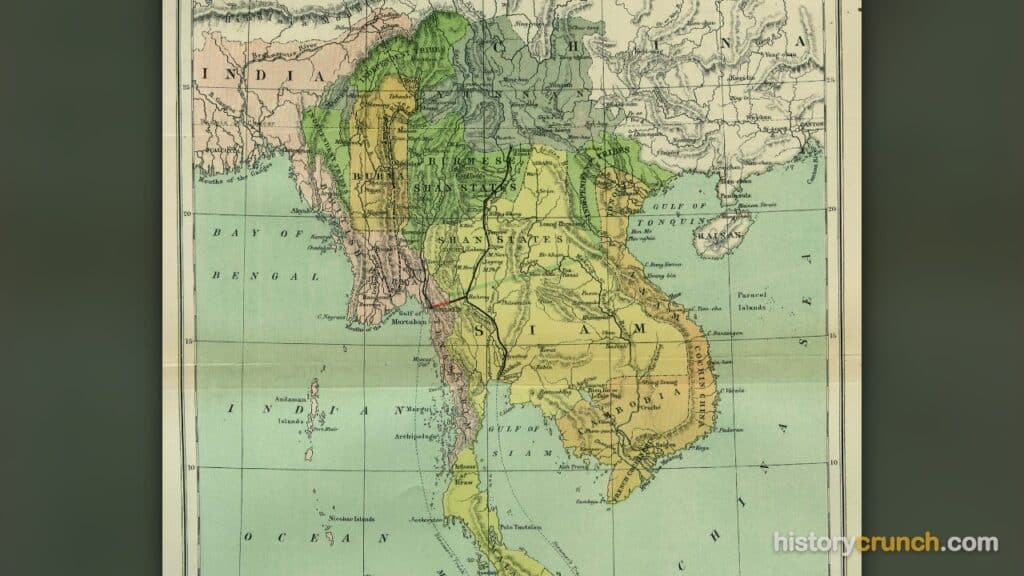
French Indochina was one of the most important colonial empires of the Age of Imperialism, and it reshaped the map, economy, and politics of Southeast Asia for nearly a century. It was the name France gave to the group of territories it ruled in mainland Southeast Asia, covering the lands that are today Vietnam, Cambodia, and Laos. French Indochina was a group of colonies in mainland Southeast Asia, and it was made up of countries such as Vietnam, Laos, and Cambodia that France assembled in 1887. France built this empire piece by piece over several decades, then held on to it until a costly war forced its withdrawal in 1954.
In simple terms, French Indochina was a colonial federation, meaning a single overseas empire made up of several different territories that were governed together by one European power. Some of these territories were ruled directly as colonies, while others were run as protectorates, which are states that keep their own local rulers on paper but are actually controlled by a foreign government. The whole arrangement was managed by a French official called the governor-general, who answered to the government back in Paris.
What Was the Age of Imperialism?
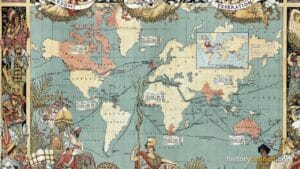
The Age of Imperialism, also called the New Imperialism, was a period from roughly the 1870s until the start of World War I in 1914 when European powers, along with the United States and Japan, raced to seize control of huge amounts of territory around the world. Between 1870 and 1914, European powers competed to claim territory across Africa, Asia, and the Pacific, and unlike earlier colonial ventures driven mainly by trade and religious conversion, this expansion was powered by industrial economies hungry for raw materials, strategic military bases, and new markets. This wave of conquest was different from earlier empire building.
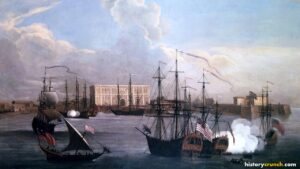
In fact, the Industrial Revolution gave these nations powerful new tools of conquest. Under New Imperialism, colonizing powers used advanced technologies such as the steamship, telegraph, and repeater rifle to exert power over colonized countries. More specifically, factories in Europe needed cheap raw materials to turn into finished goods, and they needed new markets where those goods could be sold. Nations also chased colonies for reasons of national pride and military strategy, since a large empire was seen as a mark of a great power.
Southeast Asia became a major target of this scramble. The expansion of Western colonial rule in most of Southeast Asia was a phenomenon only of the 19th and the beginning of the 20th centuries, and after about 1850 Western forces generally were more invasive, requiring only feeble justification for going on the attack, driven by growing Western technological superiority, a powerful European mercantile community, and a competitive scramble for strategic territory. The British, Dutch, and French each carved out large empires in the region. French Indochina was France’s share of this prize.
Why Did France Colonize Southeast Asia?
France had several reasons for pushing into Southeast Asia, and they fit the overall pattern of the Age of Imperialism. The first reason was religious. French imperialism in Southeast Asia began almost accidentally in 1858, when a French fleet bombarded the Vietnamese port of Tourane, present-day Danang, to avenge the execution of Catholic missionaries by the Vietnamese regime. Protecting Catholic missionaries gave France a public reason to send in its navy and soldiers.
The deeper reasons, however, were economic and political. France wanted raw materials for its factories, new markets for its goods, and a strong base to compete with rival powers such as Britain in Asia. Hoping to gain commercial advantages and military renown, French troops occupied the southern city of Saigon, present-day Ho Chi Minh City, in 1860, and by 1867 France had expanded its colony, which it named Cochinchine or Cochin China, over six adjoining provinces. In reality, the desire for profit and prestige drove the whole project forward.
How Was French Indochina Created?
France did not conquer the region all at once. Instead, it took the land bit by bit over several decades, often using its powerful navy. The first major step came in the south of Vietnam. After heavy fighting, a treaty was signed on the 5th of June, 1862 in Saigon, in which the Vietnamese emperor gave up several southern provinces to France. These provinces became the colony of Cochin China.
From this base, France kept expanding. In 1863, France forced neighboring Cambodia to accept its protection, turning it into a protectorate. Over the following years, France pushed north into the rest of Vietnam. In 1883 and 1884, France fought the Sino-French War to force China to abandon its old claims over Annam and Tonkin, and the Treaty of Huế in 1884 made Annam and Tonkin French protectorates. As stated above, France used a mix of military force and treaties to gain control of one region after another.
Finally, France tied all of these pieces together into a single empire. By 1887, France stitched the pieces together into the Union Indochinoise, made up of Cochinchina as a direct colony, Annam and Tonkin as protectorates under puppet emperors, Cambodia as a protectorate, and later Laos in 1893. Vietnam itself was split into three parts with different names: Tonkin in the north, Annam in the center, and Cochinchina in the south. In 1907 France persuaded Siam to relinquish control over two provinces in western Cambodia, one of which contained the ruins of Cambodia’s medieval capital of Angkor, giving French Indochina the physical dimensions it kept, apart from a brief break during World War II, until the end of the colonial era.
How Did France Govern Indochina?
French Indochina was run through a mix of direct and indirect rule. Cochinchina in the south was governed as a direct colony, while the rest of the provinces, Tonkin, Annam, Cambodia, and Laos, had the official status of French protectorate. In practice, though, the difference mattered less than it seemed, because French officials held real power everywhere and local kings and emperors were left with little control.
The most famous colonial administrator was Paul Doumer, who set up the system of government and economy that lasted for decades. In 1895, Paris appointed a civilian governor-general, Paul Doumer, and instructed him to set up a framework for colonial administration, investment, and business in Indochina. The capital of the empire moved over time to fit French needs. The capital was moved from Saigon in Cochinchina to Hanoi in Tonkin in 1902, and again to Da Lat in Annam in 1939.
France also tried to spread its own culture through a policy known as assimilation, which aimed to make colonized people more French. For instance, the French taught the Vietnamese to speak their language, French priests converted many Vietnamese to Catholicism, and French teachers educated Vietnamese students in French history, literature, and law. This affected mainly a small, wealthy elite rather than the whole population.
What Was the Economy of French Indochina Like?
The economy of French Indochina was built to benefit France, not the local people. The main goal was to pull valuable resources out of the colony and ship them back to Europe. The exploitation of natural resources for direct export was the chief purpose of all French investments, with rice, coal, rare minerals, and later also rubber as the main products. Southern Vietnam in particular became a huge rice-growing region for export.
Rubber grew especially important as the modern world demanded more of it. At the turn of the 20th century, the growing automobile industry in France resulted in the growth of the rubber industry in French Indochina, and plantations were built throughout the colony. To move all of these goods, France also built modern infrastructure. The French made many changes in Vietnam, modernizing the country by building railroads that connected the major cities.
These changes came at a heavy cost to ordinary people. Workers on plantations and in mines often labored in harsh conditions for very low pay, and heavy taxes fell on the local population to fund the colonial government. In reality, the wealth produced in Indochina flowed mostly to France and to a small group of colonial owners, while most Vietnamese, Cambodians, and Laotians remained poor.
How Did French Indochina Come to an End?
Resistance to French rule existed almost from the beginning, and it grew stronger over time. Local rebellions broke out in the late 1800s but were crushed by French forces. During World War II, Japan occupied Indochina, which weakened France’s grip and encouraged nationalist movements. The most important of these was the Viet Minh, an independence movement led by the communist and nationalist leader Ho Chi Minh.
After the war, France tried to take back full control, but the Viet Minh fought back in what became the First Indochina War. The war ended in a stunning French defeat. The Viet Minh achieved their decisive victory over the French Union forces at Dien Bien Phu, which broke France’s will to continue fighting. This battle marked the effective end of the French empire in the region.
The war was formally settled at an international meeting in Switzerland. A ceasefire was signed and France agreed to withdraw its troops from the region, French Indochina was split into three countries, Laos, Cambodia, and Vietnam, and Vietnam was to be temporarily divided along the 17th Parallel until elections could be held to unite the country. Those elections were never held, and the division of Vietnam soon became a flashpoint that helped spark the Vietnam War.
Significance of French Indochina
French Indochina is significant because it shows how the Age of Imperialism reshaped an entire region and left problems that lasted long after the colonizers left. For nearly a century, France controlled the lands of modern Vietnam, Cambodia, and Laos, drawing borders and building institutions that still influence these countries today. The colonial economy tied the region to global markets in rice and rubber but also created deep inequality and resentment.
The end of French Indochina also had huge consequences for world history. Despite its intentions to bring peace, the Geneva Accords laid the groundwork for the Vietnam War, as the division of Vietnam became a flashpoint in the Cold War. In this way, the French defeat drew the United States deeper into Southeast Asia and set the stage for one of the most important conflicts of the twentieth century.
Finally, French Indochina is a clear example of how colonized peoples fought back and eventually won their independence. The struggle against French rule helped create strong nationalist and communist movements across the region. As stated above, these movements did not disappear when France left, and they went on to shape the modern nations of Vietnam, Cambodia, and Laos.
Frequently Asked Questions
What Countries Made Up French Indochina?
French Indochina was made up of the lands that are today Vietnam, Cambodia, and Laos. Vietnam itself was divided into three separate parts under French rule, called Tonkin in the north, Annam in the center, and Cochinchina in the south. A small leased Chinese territory called Guangzhouwan was also managed as part of the colony for several decades.
When Did French Indochina Exist?
French Indochina officially existed from 1887, when France joined its territories into a single union, until 1954, when France withdrew after losing the First Indochina War. However, French involvement in the region began earlier, in 1858, when French forces first attacked a Vietnamese port. This means France was active in the region for close to a century in total.
Who Was Paul Doumer?
Paul Doumer was the first governor-general who organized French Indochina into an efficient colonial system. He built up the roads, railroads, and taxes that made the colony profitable for France, and he later returned home and even became president of France. Many people consider him the main architect of French colonial rule in the region.
Why Did the French Leave Vietnam?
France left Vietnam because it was defeated in the First Indochina War by the Viet Minh independence movement. The turning point was the crushing loss at the Battle of Dien Bien Phu in 1954, which convinced France that the war could not be won. A peace agreement soon followed that forced France to give up its empire in the region.
How Did French Rule Affect Vietnam Today?
French rule left lasting marks on Vietnam’s cities, food, religion, and government. French-style buildings and wide boulevards still stand in many Vietnamese cities, and popular foods such as the banh mi sandwich grew out of the French love of bread. At the same time, the harshness of colonial rule fueled the nationalist movements that shaped modern Vietnam.
Cite This Article
To cite this article as a source, use one of the formats below.
MLA: Millar, B. “French Indochina: A Detailed Summary.” HistoryCrunch, 16 August 2026, https://historycrunch.com/french-indochina/.
APA: Millar, B. (2026). French Indochina: A Detailed Summary. HistoryCrunch. https://historycrunch.com/french-indochina/
Chicago: Millar, B. “French Indochina: A Detailed Summary.” HistoryCrunch. August 16, 2026. https://historycrunch.com/french-indochina/
Sources
- William Doyle, The Oxford History of the French Revolution.
- Jeremy D. Popkin, A New World Begins: The History of the French Revolution.
- Peter McPhee, Liberty or Death: The French Revolution.
- Liberty, Equality, Fraternity (revolution.chnm.org), George Mason