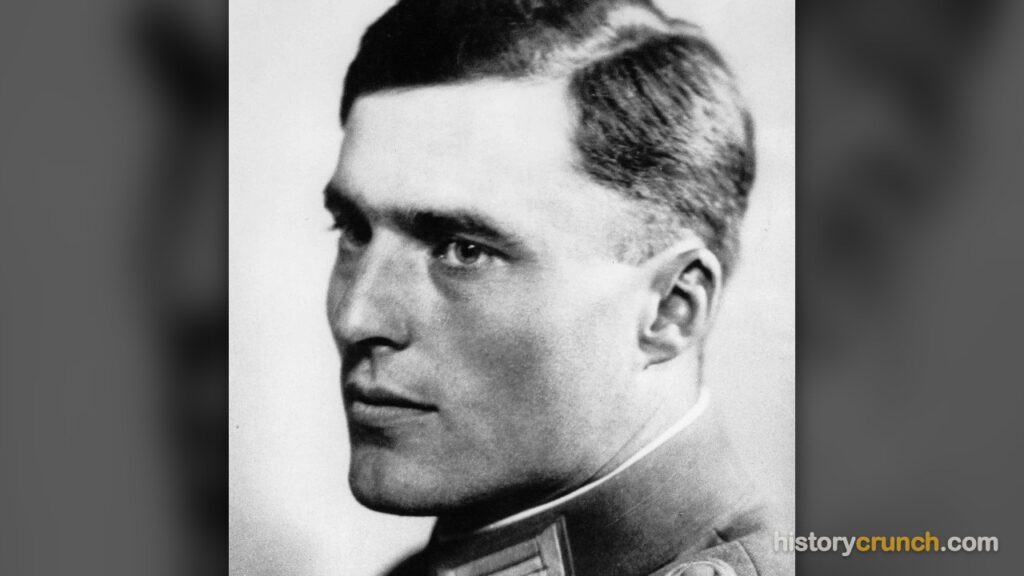
Claus von Stauffenberg was a German army officer who became one of the most important figures in the resistance against Adolf Hitler and the Nazi Party during World War II. He is best remembered for leading the failed assassination attempt against Hitler on July 20th, 1944, an event known as the July Plot. Although the plot failed and cost Stauffenberg his life, his willingness to risk everything to stop the Nazi regime made him a lasting symbol of German resistance and moral courage.
The German resistance to Nazism was a loose collection of individuals and groups inside Germany who opposed Hitler’s dictatorship and worked, in many different ways, to weaken or overthrow it. Some resisted through religion or writing, while others, like Stauffenberg and his fellow officers, believed that only the death of Hitler and the collapse of his government could save Germany and end the war. This kind of resistance was extremely dangerous, since dissent under the Nazi regime was punished by imprisonment or death.
Early Life and Background
Claus Philipp Maria Schenk Graf von Stauffenberg was born on November 15th, 1907, in the town of Jettingen in Bavaria, a region of southern Germany. He came from one of the oldest and most distinguished aristocratic Catholic families in the south of the country. His father served as a high official at the royal court of the Kingdom of Württemberg, and the family carried the noble title of Graf, which is the German word for count.
Stauffenberg grew up alongside his two older brothers, Berthold and Alexander, who were twins. As a young man he was tall, handsome, and gifted in many areas, including horseback riding, music, and literature. In fact, as a teenager he became connected to a circle of followers gathered around the poet Stefan George, a group that discussed poetry, philosophy, and ideas about duty and leadership. These early influences gave Stauffenberg a strong sense of moral responsibility that would shape his later decisions.
In 1926, Stauffenberg chose a career in the military and joined the 17th Cavalry Regiment in the city of Bamberg, a unit with long ties to his family. He proved to be a bright and capable soldier and was commissioned as an officer a few years later. In 1933, he married Nina von Lerchenfeld, and the couple would go on to have five children together.
Rise Through the German Army
Stauffenberg rose steadily through the ranks of the German army during the 1930s. Like many Germans of his generation, he was at first drawn to some of the promises Hitler made after coming to power in 1933, especially the idea of restoring German pride and strength after the hardships that followed World War I. However, the early appeal of the Nazi regime faded for him fairly quickly, as he came to see the cruelty and lawlessness that lay beneath it.
When World War II began in 1939 with the German invasion of Poland, Stauffenberg served as a staff officer, a role that involved planning and organizing military operations. He took part in the campaign in Poland and later in the invasion of France in 1940, where he earned a reputation as a skilled and well-respected officer. During these campaigns, though, he grew troubled by the brutal treatment of civilians in the conquered territories.
His disillusionment deepened after he was sent to the Eastern Front following the German invasion of the Soviet Union in 1941. More specifically, Stauffenberg was disgusted by the harsh and murderous policies the Nazis carried out against Slavic peoples and Jews in the occupied lands. As stated above, what had once seemed like a movement to strengthen Germany now looked to him like a regime built on terror and mass murder.
Wounds in North Africa and the Turn to Resistance
In 1943, Stauffenberg was transferred to serve as a staff officer with a tank division in the North African campaign. In April of that year, his vehicle was attacked by Allied aircraft, and he was severely wounded. As a result of his injuries, he lost his left eye, his entire right hand, and two fingers of his left hand.
These terrible wounds would have ended most military careers, but Stauffenberg recovered and returned to duty. In reality, his brush with death seemed to strengthen his sense that he had a duty to act against Hitler. He became increasingly convinced that it was the responsibility of German officers to remove the dictator and end the war before Germany was completely destroyed.
By this point, opposition to Hitler had been growing among a number of high-ranking army officers and civilian officials as Germany’s military situation grew worse. This network of conspirators included experienced figures such as Ludwig Beck, a former chief of the army general staff, along with generals like Henning von Tresckow and Friedrich Olbricht. Stauffenberg joined this group and quickly became one of its most determined and important leaders.
The July Plot and Operation Valkyrie
The conspirators built their plan around a real military operation called Operation Valkyrie. This was an official emergency plan that allowed the Reserve Army to take control of German cities in the event of a breakdown of order at home. The plotters intended to twist this plan for their own purpose, using it to seize power in Berlin the moment Hitler was confirmed dead.
Stauffenberg was in a unique position to carry out the assassination. Because he had been promoted to a senior post as chief of staff of the Reserve Army, he was able to attend meetings with Hitler directly. This gave him the rare chance to get close enough to the German leader to plant a bomb.
On July 20th, 1944, Stauffenberg attended a military conference at Hitler’s headquarters in East Prussia, a command post known as the Wolf’s Lair. He carried a bomb hidden inside a briefcase, which he placed under the heavy conference table close to Hitler. He then made an excuse to leave the room before the bomb exploded.
The bomb detonated with tremendous force, killing several people in the room and wrecking the building. Believing that no one could have survived, Stauffenberg quickly left the compound and flew to Berlin to begin the coup. However, Hitler survived the blast with only minor injuries, in part because the heavy table leg shielded him and because the briefcase had been moved slightly away from him before the explosion.
Failure of the Coup and Death
When Stauffenberg reached Berlin, he and the other plotters tried to launch Operation Valkyrie and take control of the government. For a few hours it seemed as though the coup might succeed, as orders went out to arrest Nazi officials and secure key locations. In reality, the plan quickly fell apart once word spread that Hitler was still alive.
Uncertain about whether Hitler had truly died, many officers who might have supported the uprising hesitated and refused to act. As the hours passed, forces loyal to Hitler regained control and moved against the conspirators. That same night, Stauffenberg and several of his closest fellow plotters were arrested at their headquarters in Berlin.
Stauffenberg was executed by firing squad in the early hours of July 21st, 1944, only a day after the attempt. He was thirty-six years old. In the weeks and months that followed, the Nazi regime carried out a sweeping and brutal purge, arresting thousands of people connected, or merely suspected of being connected, to the plot. Roughly two hundred of these people were put to death, including a number of senior army officers.
Significance of Claus von Stauffenberg
The significance of Claus von Stauffenberg lies in the fact that he led the most famous and most nearly successful attempt to assassinate Hitler and overthrow the Nazi regime from within Germany. While dozens of plots against Hitler were considered or attempted over the years, the July Plot came the closest to changing the course of World War II. For that reason, Stauffenberg’s name became closely tied to the idea of German resistance.
After the war, views of Stauffenberg changed over time. In the years right after 1945, some Germans still regarded the plotters as traitors who had turned against their own country in wartime. Over the following decades, however, Stauffenberg and his fellow conspirators came to be honored as heroes who risked and gave their lives to stand against tyranny.
Today, Stauffenberg is remembered in Germany as a symbol of conscience and courage. Memorials mark the place in Berlin where he was executed, and the story of the July Plot is studied as an example of moral resistance under an extremely dangerous dictatorship. His failure to kill Hitler is often seen as less important than the bravery and dignity of the attempt itself.
Frequently Asked Questions
Who Was Claus von Stauffenberg?
Claus von Stauffenberg was a German army officer and aristocrat who led the July Plot to assassinate Adolf Hitler in 1944. He came from a noble Catholic family in southern Germany and served with distinction before turning against the Nazi regime. His decision to act was driven by both his religious faith and his belief that Hitler was leading Germany to ruin.
Why Did Stauffenberg Try to Kill Hitler?
Stauffenberg tried to kill Hitler because he became convinced that the Nazi regime was criminal and was destroying Germany. He was horrified by the mass killings of Jews and other people in the occupied territories, which he witnessed during the war on the Eastern Front. He believed that removing Hitler was the only way to end the war and restore a decent government.
What Was Operation Valkyrie?
Operation Valkyrie was an official emergency plan that the plotters secretly turned into the blueprint for their coup. Originally, it was designed to let the Reserve Army restore order inside Germany during a crisis, such as an uprising by foreign workers. The conspirators planned to use it instead to seize control of the government the moment Hitler was killed.
Why Did the July Plot Fail?
The July Plot failed mainly because Hitler survived the bomb blast at his headquarters. The heavy conference table shielded him, and the briefcase holding the bomb had been moved slightly away from him just before it exploded. Once it became clear that Hitler was alive, many officers refused to support the coup, and it collapsed within hours.
What Happened to Stauffenberg After the Plot?
Stauffenberg was arrested and executed by firing squad in Berlin during the night of July 20th into July 21st, 1944. The Nazi regime then launched a massive investigation and purge, arresting thousands of suspected conspirators and executing around two hundred of them. Hitler even ordered efforts to erase the Stauffenberg name, and members of his family were arrested as punishment.
Cite This Article
To cite this article as a source, use one of the formats below.
MLA: Millar, B. “Claus von Stauffenberg: A Detailed Biography.” HistoryCrunch, 15 August 2026, https://historycrunch.com/claus-von-stauffenberg/.
APA: Millar, B. (2026). Claus von Stauffenberg: A Detailed Biography. HistoryCrunch. https://historycrunch.com/claus-von-stauffenberg/
Chicago: Millar, B. “Claus von Stauffenberg: A Detailed Biography.” HistoryCrunch. August 15, 2026. https://historycrunch.com/claus-von-stauffenberg/
Sources
- United States Holocaust Memorial Museum, Holocaust Encyclopedia.