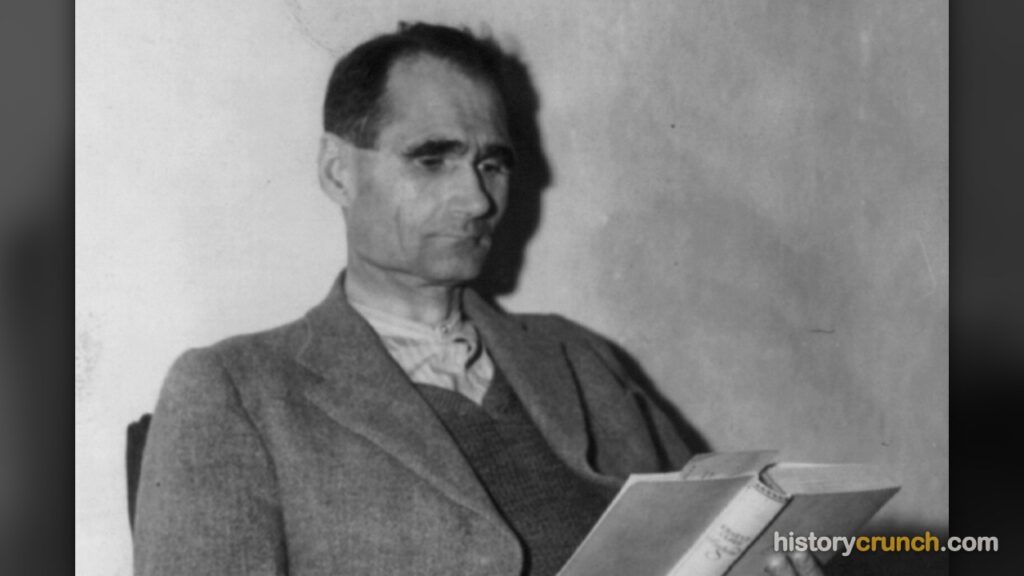
Rudolf Hess was one of the most important early members of the Nazi Party and served for years as Adolf Hitler‘s deputy, making him one of the highest-ranking figures in Nazi Germany before and during the Second World War. Yet he is best remembered for a strange and dramatic act. In May of 1941, while the war raged across Europe, Hess climbed into a fighter plane and flew alone to Scotland in a self-appointed mission to make peace between Germany and Britain. The flight ended his career, landed him in captivity, and left behind a mystery that people still argue about today.
Hess was what is often called a true believer, meaning a follower who was completely devoted to a cause and its leader. He was one of Hitler’s earliest and most loyal supporters, and for years he stood near the very top of the Nazi regime. Understanding his life helps explain how ordinary people were drawn into an extreme movement, and how that movement rose to power in Germany in the years after the First World War.
Early Life and Background
Rudolf Richard Hess was born in Alexandria, Egypt, on April 26th, 1894. His father owned a successful export business in the port city, but he insisted that his son study in Germany from the age of 14. The family was wealthy, and Hess grew up in comfortable surroundings before being sent back to Europe for his schooling.
Hess then worked in his father’s business until the outbreak of the First World War in 1914, when he enlisted as a volunteer. The First World War was a massive conflict fought between 1914 and 1918, and it reshaped Germany and much of Europe. Hess joined the same regiment in the Bavarian army in which Adolf Hitler served, the 1st Bavarian Infantry Regiment. He earned the rank of lieutenant, and after being wounded twice and winning the Iron Cross Second Class, he decided to join the German air force, although the war ended just a few months later.
After the war, Hess moved to Munich, where he studied history, economics, and politics at the city’s university. In fact, it was during these years that he came under the influence of ideas that would shape the rest of his life. As stated above, Germany was in turmoil after its defeat, and many young men like Hess were angry, restless, and searching for someone to blame and someone to follow.
Rise to Power
In the early 1920s, Hess joined the young Nazi Party and quickly became devoted to its leader, Adolf Hitler. Historians have described Hess as one of the first “Hitler disciples,” a follower completely captivated by the man he chose to serve. This personal loyalty, more than any political skill, explains much of his later rise.
An early and devoted follower of Nazism, Hess took part in Hitler’s failed Beer Hall Putsch in 1923. He escaped to Austria but voluntarily returned to Germany to join Hitler in Landsberg jail. The Beer Hall Putsch was a failed attempt by the Nazis to seize power in the German state of Bavaria, and it landed Hitler and several followers in prison.
Prison time proved to be a turning point for Hess. During Hitler’s eight months behind bars, he dictated his life story, a book called Mein Kampf, to Hess. Hess transcribed and edited that dictation, and he later served as Hitler’s private secretary in the 1920s. This close working relationship placed him at the very center of the Nazi movement.
When the Nazis took control of Germany, Hess was rewarded for his loyalty. He was appointed Deputy to the Führer in 1933, and he held that position until 1941. The title of Führer, a German word meaning “leader,” was the name Hitler gave himself as dictator of Germany. Hitler later lost faith in Hess’s leadership ability and made him second in the line of succession after Hermann Göring. More specifically, while Hess held an impressive title, real power increasingly slipped toward other Nazi officials.
The Flight to Scotland
The single event that made Hess famous around the world took place in the spring of 1941. By then the Second World War had been raging for nearly two years, and Germany had failed to force Britain out of the fight. Hess convinced himself that he could succeed where others had failed by personally arranging peace.
On May 10th, 1941, Hess took off in a long-range Messerschmitt from an airfield near Augsburg at about 5:45 in the evening. Acting as his own pilot, he flew to Scotland in what was said to have been an idealistic attempt to broker peace between Britain and Germany. The flight itself was remarkable. Hess displayed considerable skill by navigating the course alone, using only charts and maps, on a foggy dark night over largely unfamiliar terrain, all while avoiding being shot down by British air defenses.
By about 10:30, Hess was over Scotland, out of fuel, and forced to bail out just 12 miles (19 km) from his destination. Shortly after midnight he crashed his plane at Eaglesham, Scotland. After bailing out and injuring his leg, he was quickly taken prisoner by a local farmer. His hope had been to reach the Duke of Hamilton, a British nobleman he believed could help arrange a deal.
Hess believed he could persuade Britain to withdraw from the Second World War, which would allow Germany to concentrate on fighting the Soviet Union. In reality, the timing revealed just how important this idea was to the Nazi leadership. Only weeks later, Germany launched a massive invasion of the Soviet Union, and Hitler wanted no war on two fronts.
The mission was a complete failure. Hess’s diplomatic overtures were dismissed as nonsense by both the British government and Hitler. Hess had acted without Hitler’s blessing, and he was shunned as a lunatic. The story was soon given out to the German media that mystics, astrologers, and nature healers had manipulated a mentally disturbed Hess. In this way, the Nazi regime tried to distance itself from an embarrassing episode.
Captivity and the Nuremberg Trials
Hess’s unauthorized mission to negotiate peace led to the British government holding him as a prisoner of war through the end of the Second World War. For the rest of the conflict, one of Hitler’s most senior deputies sat in British custody, cut off from the regime he had helped build.
After the war ended, Hess faced justice alongside other surviving Nazi leaders. Held in Britain until the end of the war, Hess was tried at Nuremberg with other top Nazis. The Nuremberg Trials were a series of trials held in Nuremberg, Germany, in 1945 and 1946, in which former Nazi leaders were charged as war criminals before an international court. The judges came from the United States, the Soviet Union, Britain, and France, and they put senior Nazis on trial on charges that included crimes against peace, war crimes, and crimes against humanity.
Hess was found guilty at the Nuremberg Trials and sentenced to life in prison. He avoided a death sentence in part because he had been in captivity during the worst years of Nazi atrocities. Even so, he was held responsible for helping the regime prepare and wage aggressive war, and he would spend the rest of his life behind bars.
Later Life and Death
Hess served his sentence at Spandau Prison in West Berlin, a facility set aside for Nazi officials imprisoned after the Nuremberg Trials. As the years passed, the other prisoners were released one by one. From 1966 until his death in 1987, Hess was the only prisoner at Spandau. He lived out the last decades of his life almost entirely alone inside the large prison.
He was still serving his life sentence and 93 years old at the time of his death in 1987. The death of Rudolf Hess was officially ruled a suicide. According to a report by the Royal Military Police, Hess hanged himself with an electric cord inside a small building on the grounds of Spandau Prison.
Even his death has been surrounded by doubt. His physical frailty led to some speculation about how a very old and weak man could have managed to hang himself. Because so much about his flight and imprisonment remained secret, conspiracy theories have followed his story for decades. Most careful research, however, supports the official account that the prisoner was indeed Hess and that he died by his own hand.
Significance of Rudolf Hess
Rudolf Hess is significant because his life traces the full arc of the Nazi movement, from its earliest days to its final reckoning. In the years following the First World War, he rose from being a shy and introverted university student to the height of power in Nazi Germany as deputy Führer, second only to Adolf Hitler himself. His story shows how personal devotion to a single leader could carry a follower to enormous influence.
His flight to Scotland also stands as one of the strangest single events of the Second World War. It revealed deep confusion within the Nazi leadership on the eve of the invasion of the Soviet Union, and it handed British and Allied officials a valuable prisoner. For the rest of the war, the Hess affair remained a source of rumor and suspicion on both sides.
Finally, Hess became a lasting symbol at the Nuremberg Trials, where the surviving leaders of a criminal regime were forced to answer for their actions. As a longstanding personal aide to Hitler and Deputy Party Leader of the Nazi Party until 1941, he represented the inner circle that helped build the Third Reich. His long imprisonment and lonely death at Spandau closed the final chapter of Hitler’s original circle of followers.
Frequently Asked Questions
Who was Rudolf Hess?
Rudolf Hess was Adolf Hitler’s deputy and one of the earliest members of the Nazi Party. He was one of the most powerful men in Germany during the 1930s, and he is best known today for his surprise solo flight to Scotland in 1941 in an attempt to make peace with Britain.
Why did Rudolf Hess fly to Scotland?
Hess flew to Scotland because he believed he could personally convince Britain to leave the war. He hoped to reach the Duke of Hamilton, a British nobleman he thought could help arrange peace, which would free Germany to focus its full strength against the Soviet Union.
Did Hitler order Rudolf Hess to fly to Britain?
No, Hitler did not order the flight, and it appears Hess acted entirely on his own. When Hitler learned what had happened, he was furious and embarrassed, and the Nazi regime publicly claimed that Hess had become mentally unstable.
What happened to Rudolf Hess after the war?
Hess was tried at the Nuremberg Trials and sentenced to life in prison. He was sent to Spandau Prison in West Berlin, where he remained for decades and eventually became the prison’s only inmate.
How did Rudolf Hess die?
Hess died in 1987 at the age of 93, in what was officially ruled a suicide by hanging inside Spandau Prison. Because he was so old and frail at the time, some people have questioned the ruling, though the official investigation stood by its finding.
Cite This Article
To cite this article as a source, use one of the formats below.
MLA: Millar, B. “Rudolf Hess: A Detailed Biography.” HistoryCrunch, 14 August 2026, https://historycrunch.com/rudolf-hess/.
APA: Millar, B. (2026). Rudolf Hess: A Detailed Biography. HistoryCrunch. https://historycrunch.com/rudolf-hess/
Chicago: Millar, B. “Rudolf Hess: A Detailed Biography.” HistoryCrunch. August 14, 2026. https://historycrunch.com/rudolf-hess/
Sources
- J.M. Roberts & Odd Arne Westad, The Penguin History of the World.
- Jerry Bentley & Herbert Ziegler, Traditions & Encounters: A Global Perspective on the Past.