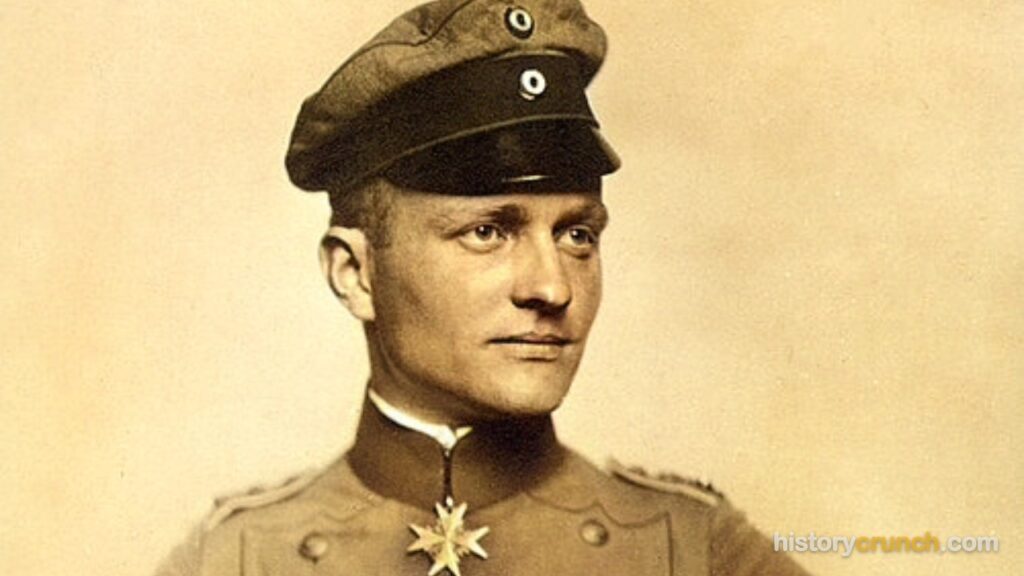
Manfred von Richthofen was the most famous fighter pilot of World War I, and he remains one of the most recognized figures in the history of air warfare. World War I was the first major conflict in which airplanes played an important role, and Richthofen became the war’s leading ace. Known to the British as the “Red Baron” because of his bright red aircraft, he was officially credited with shooting down 80 enemy planes before his death in 1918.
A “flying aceA fighter pilot who shot down at least five enemy aircraft in aerial combat during World War I.” was the name given to a fighter pilot who shot down at least five enemy aircraft in aerial combat. During World War I, aces became national heroes on both sides of the fighting. Their victories were counted and published in newspapers, and the most successful pilots were treated like celebrities. Richthofen stood at the very top of this list.
Early Life and Background
Manfred von Richthofen was born on May 2nd, 1892, into a wealthy family of Prussian nobles. His birthplace was near the city of Breslau, which at the time was part of the German Empire and is today the city of Wroclaw in Poland. As a member of the nobility, he carried the German title FreiherrA German noble title roughly equal to the English rank of baron., which is roughly equal to the English rank of baron. This title is the reason he later became known as the Red Baron.
As a boy, Richthofen enjoyed a life of privilege on the family estate. He loved hunting, riding horses, and playing sports, and he was far more interested in these activities than in his schoolwork. His father was a career army officer, and it was understood from an early age that Manfred would also enter the military.
At the age of 11, Richthofen was sent to a Prussian military school to begin his training. He spent several years as a cadet before finishing his education. In 1911, he joined a cavalrySoldiers who fought on horseback, a type of unit that became largely useless in the trench warfare of World War I. regiment of the Prussian army, following the tradition of soldiers who fought on horseback, and he became a lieutenant in 1912.
 FactsthatCrunch
Service in the Cavalry and Move to Aviation
When World War I began in the summer of 1914, Richthofen served as a cavalry officer. However, the nature of the fighting quickly changed the role of mounted soldiers. The war on the Western Front settled into trench warfare, in which armies dug long lines of trenches and fought from fixed positions. In this kind of fighting, cavalry had little use, and Richthofen soon found himself assigned to boring duties behind the lines.
Frustrated with this work, Richthofen requested a transfer to the German Imperial Air Service in 1915. At first he served as an observer, riding in a two-seat aircraft and watching enemy positions on the ground. In time he decided he wanted to become a pilot himself so that he could take a more active part in the fighting.
During this period, Richthofen met one of Germany’s most famous early fighter pilots, Oswald Boelcke. Boelcke had become a national hero and had helped develop the rules of air combat that other German pilots followed. This meeting would prove to be a turning point in Richthofen’s life, since Boelcke’s example inspired him to train as a fighter pilot.
FactsthatCrunchTrench warfare on the Western Front made cavalry units useless, leaving Richthofen stuck doing routine duties behind the front lines.
World War I quickly settled into fixed trench lines where soldiers on horseback had no real fighting role. Richthofen had joined the cavalry in 1911, so the shift to trench warfare forced him to find a new way to serve. He requested a transfer to the German Imperial Air Service in 1915.
Rise to Fame as a Fighter Pilot
In 1916, Boelcke was building a new fighter squadron known as a JagdstaffelA German fighter squadron made up of several planes that flew and fought together as a team., or Jasta for short. This was a unit made up of several fighter planes that flew and fought together as a team. Boelcke personally chose the pilots he wanted, and he selected Richthofen to join the new squadron called Jasta 2 on the Western Front.
Richthofen scored his first confirmed aerial victory on September 17th, 1916, over Cambrai in France. To mark the occasion, he ordered a small silver cup engraved with the date and the type of enemy plane he had shot down. He continued this habit with each new victory, collecting dozens of cups until wartime shortages of silver in Germany forced him to stop.
His mentor Boelcke died in October of 1916 after a midair collision with a fellow German pilot during a dogfight. Richthofen witnessed the accident, which deeply affected him. Only a month later, in November of 1916, Richthofen shot down the respected British ace Lanoe Hawker in one of his most famous early victories. He would later describe Hawker with admiration as a brave and skilled opponent.
By January of 1917, Richthofen had 16 confirmed victories, and he was awarded the Pour le MériteThe highest military honor awarded in the German Empire, given to Richthofen in January 1917., the highest military honor in the German Empire. That same month he was given command of his own squadron, known as Jasta 11. Under his leadership, the unit became one of the most successful fighter squadrons on the entire Western Front.
FactsthatCrunch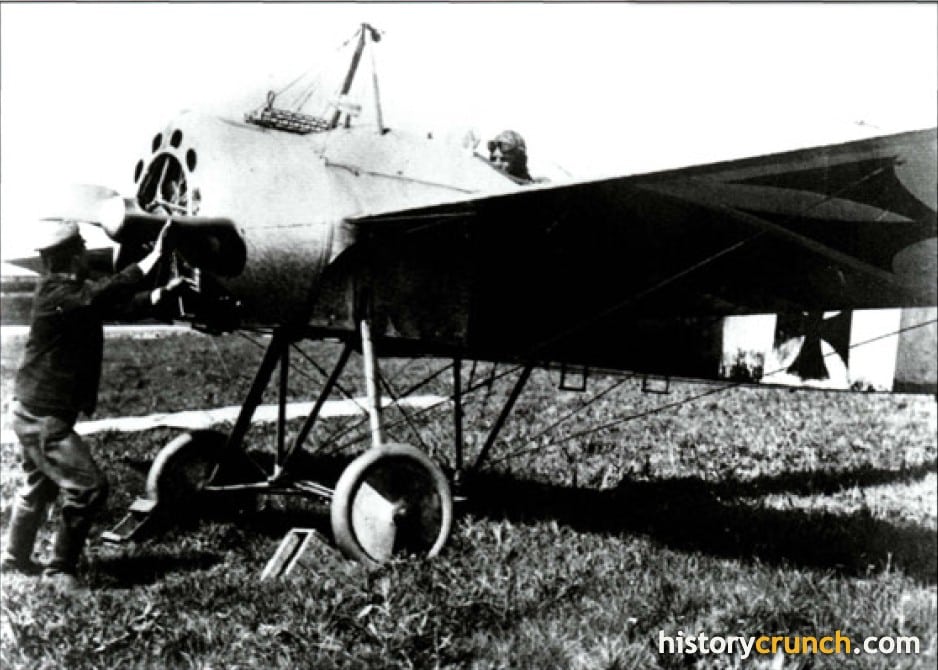
The Red Baron and the Flying Circus
It was around this time that Richthofen earned his famous nickname. He had his aircraft painted a bright red color, which was partly a tribute to his old cavalry regiment. The bold color made him instantly recognizable in the sky, and the British began to call him the Red Baron. In France he was known as “Le Petit Rouge,” meaning “the Little Red,” while in Germany he was called “der Rote Kampfflieger,” meaning “the Red Battle Flyer.”
In June of 1917, Richthofen was placed in command of an even larger formation known as Jagdgeschwader 1, which combined several squadrons into a single fighting wing. This unit was highly mobile and could be moved quickly by rail to wherever it was needed along the front. Because of its constant travel and its brightly painted aircraft, enemy pilots nicknamed the group the “Flying Circus.”
Richthofen is most often pictured flying the Fokker Dr.I triplane, an aircraft with three stacked wings that gave it excellent agility. Although he flew this famous plane only during the final months of his career, it became the machine most closely linked to his name. More importantly, Richthofen was known less for daring stunts and more for careful, disciplined tactics. He followed the combat rules taught by Boelcke, choosing his attacks carefully and using teamwork rather than reckless flying.
FactsthatCrunchRichthofen painted his aircraft bright red partly as a tribute to his old cavalry regiment, the very unit that trench warfare had made useless.
When World War I began in 1914, Richthofen served as a cavalry officer. The trench warfare on the Western Front left mounted soldiers with almost nothing to do, and he transferred to aviation out of frustration. By painting his plane the bold red color linked to his cavalry past, he carried a symbol of that world into the modern air war above the same trenches that had made mounted soldiers useless.
Death of the Red Baron
By the spring of 1918, Richthofen had reached 80 confirmed victories, more than any other pilot in the war. On April 21st, 1918, he led his squadron into combat against British planes near the Somme River in France. During the fight, he chased an enemy aircraft low over the ground and ventured deep into Allied territory, which broke his own careful rules of combat.
As Richthofen flew low in pursuit, he came under fire from Australian machine gunners on the ground as well as from a Canadian pilot, Captain Arthur Roy Brown. Richthofen was struck in the chest by a single bullet and managed to bring his plane down in a rough landing before he died. He was only 25 years old.
For many years there has been debate over who actually fired the fatal shot. Captain Brown received official credit for the victory, but many historians believe the deadly bullet more likely came from the Australian gunners on the ground. In reality, the exact answer may never be known. What is certain is that his enemies respected him greatly, and Allied forces buried him with full military honors.
FactsthatCrunchOn April 21st, 1918, Richthofen broke his own rules of combat. What did he do that violated those careful tactics?
Significance of Manfred von Richthofen
Manfred von Richthofen is significant because he became the symbol of the airplane’s arrival as a weapon of war. World War I was the first conflict in which aircraft were widely used, and Richthofen’s record of 80 victories made him the top ace of the entire war. His success helped show military leaders on all sides how important control of the skies would become in future conflicts.
He was also significant for the way he led and trained other pilots. As a commander, he mentored younger fliers and passed on the careful tactics he had learned, helping to create some of Germany’s other leading aces. In this way his influence stretched far beyond his own victories in the air.
Finally, Richthofen became a lasting cultural icon. Both sides in the war viewed him as a kind of chivalrousBehaving with the honorable, knightly qualities traditionally associated with medieval warriors. knight of the sky, an image that survived long after his death. Over the following century he has appeared in countless books, films, models, and games, keeping the memory of the Red Baron alive for new generations.
FactsthatCrunchIn January of 1917, Richthofen was given command of his own squadron, Jasta 11, and used that role to mentor younger pilots in the careful tactics he had learned from Oswald Boelcke, passing those methods directly to the next generation of German fliers.
Richthofen flew as one pilot among many, winning victories on his own
His teaching shaped several of Germany's other leading aces, spreading his influence well beyond his own 80 victories
Explore World War I
Keep exploring World War I with these History Crunch resources.
Key Vocabulary
Flying ace
Freiherr
Cavalry
Jagdstaffel
Pour le Mérite
Chivalrous
Frequently Asked Questions
Why was Manfred von Richthofen called the Red Baron?
He was called the Red Baron because he painted his aircraft bright red and because he held the noble title of Freiherr, which is similar to a baron. The nickname was created by the British, who could easily spot his red plane in the sky. The name stuck and became the way he is remembered in the English-speaking world.
How many planes did the Red Baron shoot down?
Manfred von Richthofen was officially credited with 80 aerial victories, the highest total of any pilot in World War I. He achieved these victories over a period of about 19 months between September of 1916 and his death in April of 1918. No other ace on either side matched his record during the war.
What plane did the Red Baron fly?
The Red Baron is most famous for flying the Fokker Dr.I triplane, which had three wings stacked on top of each other for extra agility. Earlier in his career he also flew Albatros fighters, which he used for the majority of his victories. He only flew the famous triplane during the last several months of his life.
Who taught the Red Baron to be a fighter pilot?
Richthofen was inspired and trained by Oswald Boelcke, one of Germany’s earliest and most famous fighter aces. Boelcke personally chose Richthofen to join his new squadron and taught him the rules of air combat known as the Dicta Boelcke. Richthofen used these careful tactics throughout his career and passed them on to other pilots.
Was the Red Baron a real person?
Yes, the Red Baron was a real German pilot named Manfred von Richthofen who lived from 1892 to 1918. Although his story has appeared in many movies, cartoons, and games, he was a genuine historical figure who fought in World War I. His fame in popular culture is so great that some people are surprised to learn he actually existed.
Cite This Article
To cite this article as a source, use one of the formats below.
MLA: Millar, B. “Manfred von Richthofen: A Detailed Biography.” HistoryCrunch, 14 August 2026, https://historycrunch.com/manfred-von-richthofen/.
APA: Millar, B. (2026). Manfred von Richthofen: A Detailed Biography. HistoryCrunch. https://historycrunch.com/manfred-von-richthofen/
Chicago: Millar, B. “Manfred von Richthofen: A Detailed Biography.” HistoryCrunch. August 14, 2026. https://historycrunch.com/manfred-von-richthofen/
Sources
- J.M. Roberts & Odd Arne Westad, The Penguin History of the World.
- Jerry Bentley & Herbert Ziegler, Traditions & Encounters: A Global Perspective on the Past.