Ethiopian resistance to imperialism stands out as one of the most important stories of the Age of Imperialism, because Ethiopia became the only African nation to defeat a European power and keep its independence during the Scramble for Africa. In the late 1800s, the major powers of Europe raced to seize African land, drawing borders and claiming territory across nearly the whole continent. Ethiopia, an ancient kingdom in the Horn of Africa, stood almost alone against this wave. Under Emperor Menelik II, Ethiopian forces united, armed themselves with modern weapons, and crushed an invading Italian army at the Battle of Adwa in 1896.
Imperialism is the policy of one country extending its power over other lands and peoples, usually through military force, settlement, or economic control. During the Age of Imperialism, European nations built massive empires by taking over territory in Africa and Asia. Resistance to imperialism refers to the many ways colonized peoples fought back against this control, whether through warfare, diplomacy, or refusing to accept foreign rule. Ethiopia is the most famous example of successful resistance in Africa.
What Was the Scramble for Africa?
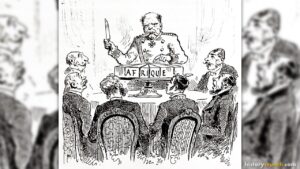
The Scramble for Africa is the term that historians use to refer to the expansion of European empires into Africa during the Age of Imperialism. The Scramble for Africa is considered to have occurred from approximately 1870 until the outbreak of World War I in 1914. During these years, powerful European nations such as Britain, France, Germany, Belgium, Portugal, and Italy competed to claim as much African land as they could. In fact, by the early 1900s almost the entire continent had fallen under European control.
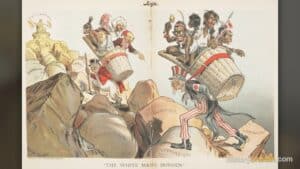
Several forces drove this rush for territory. European nations wanted raw materials such as rubber, ivory, and copper to feed their growing factories, and they wanted new markets to sell their goods. As stated above, many Europeans also held false beliefs about their own racial superiority, and they used these ideas to justify taking over African societies. Europeans also promoted Christianity as superior to the religious beliefs of the indigenous peoples that they encountered, including those in Africa, and Christian missionaries often accompanied early explorers to the African interior.
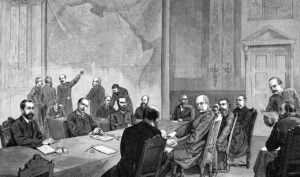
To manage their competition, the European powers met at the Berlin Conference of 1884 and 1885, where they set rules for dividing the continent among themselves. Notably, no African leaders were invited to this meeting. New technologies, such as the machine gun, the steamship, and medicine to fight tropical disease, gave Europeans a powerful advantage. As a result, most African societies that resisted were quickly overpowered. Ethiopia was the great exception.
Why Was Ethiopia Different?
Ethiopia, also known historically as Abyssinia, was one of Africa’s oldest and most enduring kingdoms, with roots stretching back thousands of years. Unlike many African regions that were made up of smaller, separate groups, Ethiopia had a long tradition of statehood, a shared Christian identity through the Ethiopian Orthodox Church, and a strong military heritage. These traditions gave the kingdom a sense of national unity that helped it stand together against outside threats.
Geography also worked in Ethiopia’s favor. The country sits on a high, rugged plateau cut by deep valleys and steep mountains. This difficult terrain made invasion hard and gave Ethiopian defenders a natural advantage over armies unfamiliar with the land. More specifically, invading forces could easily become lost, run short of supplies, or be ambushed in the highlands.
Finally, Ethiopia had skilled and adaptive leaders. In the late 1800s, Emperor Menelik II worked to modernize his army and unite the many regions of his empire under a single banner. He understood that survival meant matching Europe’s weapons and playing the European powers against one another, and he pursued both goals with great skill.
Who Was Emperor Menelik II?
Emperor Menelik II ruled Ethiopia during the height of the Scramble for Africa and became the central figure in the country’s resistance to imperialism. He was both a brilliant military strategist and a shrewd diplomat. Above all, he recognized that Ethiopia could not defend itself with old weapons against modern European armies.
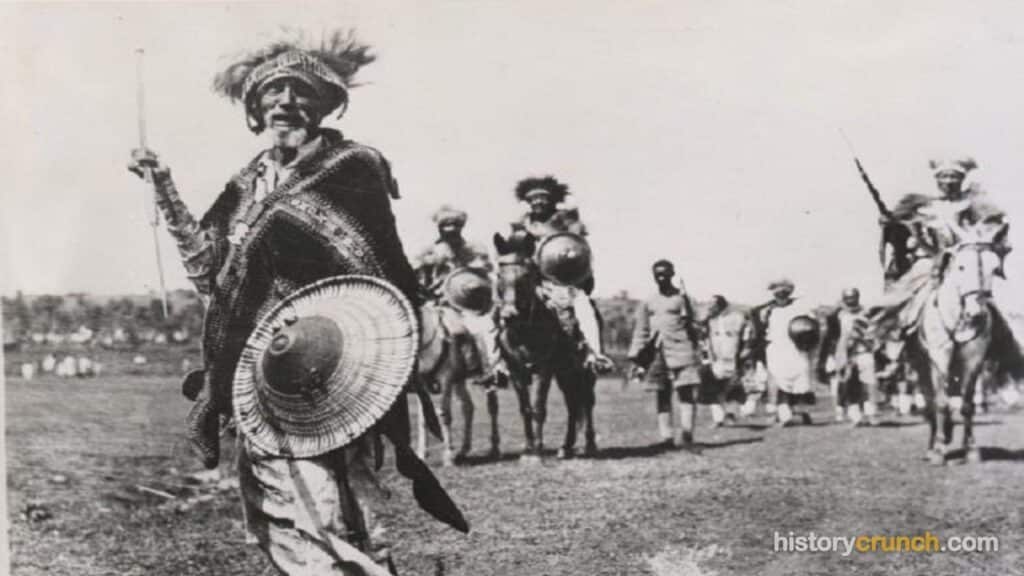
To prepare for the threat, Menelik imported large quantities of modern firearms and artillery from European countries, including France and Russia. In response to Italy’s actions, Emperor Menelik II mobilized a massive army, with estimates ranging from 73,000 to over 100,000 men, mostly equipped with modern rifles imported from France and Russia. He also centralized his authority, improved roads and communication, and worked to build a sense of shared national identity that reached across ethnic and regional lines. These reforms made it possible to raise and supply a huge army quickly when the moment came.
What Was the Treaty of Wuchale?
The crisis that led to war began with a disputed treaty. On May 2, 1889, Menelik II and Pietro Antonelli, acting on behalf of the King of Italy, signed the Treaty of Wuchale, named after the Ethiopian town where the two countries’ representatives met to negotiate the agreement. Under the treaty, Italy was granted the northern Ethiopian territories of Bogos, Hamasen, and Akale-Guzai, which make up modern Eritrea and northern Tigray, in exchange for a sum of money and the provision of 30,000 muskets and 28 cannons.
The trouble came from a single article written in two languages. Article XVII of the Treaty of Wuchale stated that the emperor of Ethiopia “could” have recourse to the good offices of the Italian government in his dealings with other foreign powers, but the Italian text of the treaty had the word “must.” In the Amharic version, Ethiopia remained fully independent and free to deal directly with other nations. In the Italian version, Ethiopia became a protectorate, meaning Italy would control its foreign affairs.
Using their own version, the Italians announced to the other European governments that Ethiopia was now under Italian protection. Menelik was furious, since he had never agreed to give up his country’s independence. In September 1890, Menelik II repudiated their claim, and in 1893 he officially denounced the entire treaty. This set the stage for a direct military showdown.
What Happened at the Battle of Adwa?
When diplomacy failed, Italy chose to impose its protectorate by force, and its army advanced into northern Ethiopia. Facing the Ethiopians was a much smaller Italian colonial force under General Oreste Baratieri, which was unfamiliar with the terrain and hampered by poor reconnaissance. Baratieri also had faulty maps and little reliable information about where the Ethiopian columns actually were.
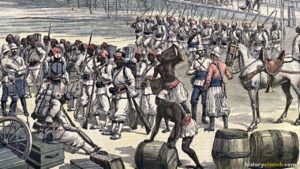
The decisive clash came on March 1st, 1896, near the town of Adwa. Menelik and his wife, Empress Taytu, led a huge, well-armed, and well-organized force against the Italians. The Italian columns became separated in the rough highland terrain, and the Ethiopians used their knowledge of the land to attack the scattered units one by one. By midday the battle was over, and the Italian army had been shattered.
The defeat was total. Thousands of Italian soldiers were killed, wounded, or captured, and the survivors fled toward the Italian colony of Eritrea. It was the first time an African country successfully defended its independence against a colonization attempt. News of the disaster shocked Europe. In fact, when word of the defeat reached Italy, the Italian prime minister was forced to resign and riots broke out in the streets of Rome.
How Did Ethiopia Secure Its Independence?
Menelik used his victory wisely. Rather than chasing the defeated Italians all the way to the coast, he chose to negotiate from a position of strength. In October 1896, with the Treaty of Addis Ababa, the Kingdom of Italy formally recognized Ethiopia’s independence. This agreement also canceled the hated Treaty of Wuchale, ending the false claim that Ethiopia was an Italian protectorate.
The outcome was remarkable during an era when nearly all of Africa was falling under European rule. While Italy kept the coastal colony of Eritrea, Ethiopia itself remained a free and sovereign nation. For decades afterward, Ethiopia stood as living proof that African resistance could succeed against a European power.
The story did not end there. Years later, in 1935, the Italian dictator Benito Mussolini ordered a new invasion of Ethiopia, hoping to avenge the humiliation of Adwa. That conflict briefly placed Ethiopia under Italian occupation, but Ethiopian fighters continued to resist, and the country regained its independence in 1941 during World War II.
Significance of Ethiopian Resistance to Imperialism
The significance of Ethiopian resistance to imperialism is enormous, both in African history and around the world. The victory at Adwa proved that a united and well-led African nation could defeat one of Europe’s imperial armies. This shattered the widely held European belief that African peoples were unable to resist conquest, and it forced the world to take Ethiopia seriously as an independent state.
Ethiopia’s success also inspired hope far beyond its borders. In the years that followed, the triumph at Adwa became a powerful symbol for other anti-colonial movements and for people of African descent across the globe. Ethiopia stood as a rare example of freedom in a continent under foreign control, and its story encouraged later generations to demand their own independence.
Finally, Ethiopian resistance shows that success against imperialism came from more than weapons alone. National unity, strong and flexible leadership, clever diplomacy, favorable geography, and a deep shared identity all worked together. In reality, it was the combination of these strengths that allowed Ethiopia to remain independent when almost every other African society was overwhelmed.
Frequently Asked Questions
Why was Ethiopia the only African country to resist European colonization?
Ethiopia stayed independent because it combined a united kingdom, modern weapons, skilled leadership, and rugged terrain to defeat the invaders. Its long history as a single Christian state gave it a strong sense of shared identity, which helped different regions fight together instead of being divided and conquered one by one, as happened elsewhere in Africa.
Who won the Battle of Adwa?
Ethiopia won the Battle of Adwa in a decisive victory over Italy on March 1st, 1896. Emperor Menelik II’s much larger army surrounded and destroyed the separated Italian columns in the highlands, killing or capturing thousands of enemy soldiers and ending Italy’s attempt to conquer the country.
What caused the First Italo-Ethiopian War?
The war was caused by a dispute over the Treaty of Wuchale, which had two conflicting versions. The Italian text claimed Ethiopia had become a protectorate, while the Amharic text kept Ethiopia fully independent, and when Menelik rejected Italy’s claim, Italy tried to enforce it by military invasion.
What role did Empress Taytu play in the resistance?
Empress Taytu was a leading figure who urged Menelik and other Ethiopian leaders to stand firm against Italian aggression. She helped rally support for war after the treaty dispute and was present with the army during the campaign, making her an important part of the national resistance effort.
Did Ethiopia ever get taken over by Italy?
Ethiopia was briefly occupied by Italy from 1936 to 1941, when Benito Mussolini invaded to avenge the defeat at Adwa. However, Ethiopian fighters kept resisting throughout the occupation, and the country regained its independence in 1941 during World War II, so it was never permanently colonized like the rest of Africa.
Cite This Article
To cite this article as a source, use one of the formats below.
MLA: Millar, B. “Ethiopian Resistance to Imperialism: A Detailed Summary.” HistoryCrunch, 14 August 2026, https://historycrunch.com/ethiopian-resistance-to-imperialism/.
APA: Millar, B. (2026). Ethiopian Resistance to Imperialism: A Detailed Summary. HistoryCrunch. https://historycrunch.com/ethiopian-resistance-to-imperialism/
Chicago: Millar, B. “Ethiopian Resistance to Imperialism: A Detailed Summary.” HistoryCrunch. August 14, 2026. https://historycrunch.com/ethiopian-resistance-to-imperialism/
Sources
- Fordham Modern History Sourcebook
- Eric Hobsbawm, The Age of Empire 1875-1914.
- State Department — Office of the Historian
- John Darwin, After Tamerlane / Unfinished Empire.