France was one of the most powerful nations of the Age of Imperialism, and by the early 20th century it controlled the second largest colonial empire in the world after Britain. Between the mid-19th century and the outbreak of World War I in 1914, France conquered and governed vast regions of Africa, Southeast Asia, and the Pacific. Understanding the role that France played during this era helps explain the political and cultural conditions that still exist in many parts of the world today, especially in North and West Africa and in Vietnam.
Imperialism is the term historians use to describe the process by which one country extends its political, economic, or cultural authority over another country or region. This usually involves the dominant country taking control of another through direct invasion, political rule, or by gaining power over that region’s economy. In the case of France, imperialism meant conquering distant territories, planting French settlers and officials, and reshaping local governments to serve French interests.
What Was the Age of Imperialism?
The Age of Imperialism was a period of intense colonial expansion that occurred primarily from the mid-18th century until the early part of the 20th century. During this time, the major European nations, along with the United States and Japan, expanded their empires and exerted their influence across large sections of the globe. In fact, powerful nations such as Britain, France, Germany, Belgium, Spain, Portugal, and Italy raced to claim territory and establish colonies across Africa, Asia, and beyond.
Historians have identified five main causes or motives of the Age of Imperialism, which were economic gain, colonization, religion, ethnocentrism, and prestige. More specifically, European nations wanted raw materials and new markets for their factories, places to resettle growing populations, and opportunities to spread Christianity. They also held ethnocentric views, meaning they believed their own culture was superior to others, and they viewed the size of their empires as a measure of national greatness. These same motives drove France to build a huge overseas empire during the 19th century.
Why Did France Build a New Empire After 1870?
France had actually built a large colonial empire once before, during the Age of Exploration, but it lost most of that first empire to Britain through a series of wars in the 18th and early 19th centuries. As a result, historians describe France as building a “second colonial empire” during the 1800s. This new push began with the conquest of Algeria in North Africa in 1830, and it expanded rapidly after 1870.
The year 1870 was an important turning point for France. In that year, France suffered a humiliating defeat in the Franco-Prussian War against the newly unified Germany, and it lost the border regions of Alsace and Lorraine. In reality, many French leaders came to see empire building as a way to restore national pride and prestige after this loss. As stated above, prestige was one of the main causes of the Age of Imperialism, and for France the desire to appear strong again was especially powerful.
France also had strong economic reasons for expansion. Like the other industrial powers, France needed raw materials such as rubber, cotton, and minerals to feed its factories, along with new markets to sell finished goods. In addition, French leaders spoke of a mission civilisatrice, a French phrase meaning “civilizing mission,” which was the belief that France had a duty to spread its language, culture, and Christianity to the peoples it ruled. This idea was rooted in ethnocentrism and helped the French justify their conquests.
How Did France Expand in North and West Africa?
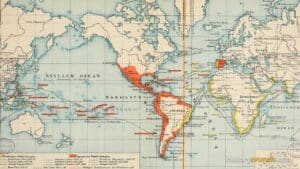
Africa became the center of French imperial expansion, and France eventually gained the largest share of African territory of any European power. Much of this land lay across North and West Africa, though a great deal of it was thinly populated desert in the Sahara. The French conquest of Algeria, which began in 1830 and continued through the 1840s, formed the foundation of this African empire.
Algeria became a special case within the French empire because France treated it almost as part of France itself rather than as a distant colony. Large numbers of European settlers, known as colons, moved to Algeria and demanded the rights and privileges of French citizens. Meanwhile, the much larger Arab and Berber population was treated as inferior and denied equal rights, which created deep tensions that would last for more than a century.
France later added the neighboring territories of Tunisia and Morocco as protectorates, a form of rule in which a local government stayed in place but real power belonged to France. Across West Africa, France built a huge federation of colonies that eventually included the lands that are now Senegal, Mauritania, Mali, Guinea, Ivory Coast, Niger, Burkina Faso, and Benin. To connect and control these regions, the French built ports, roads, railroads, and telegraph lines, including a major port and rail network centered on the city of Dakar in Senegal.
Berlin Conference and the Scramble for Africa
The competition among European nations for African land is known as the Scramble for Africa, which took place roughly from 1870 until 1914. During these years, almost all of Africa came under the control of the major European powers, and France was one of the leading competitors alongside Britain, Germany, Belgium, Italy, Portugal, and Spain. This rush for territory was so fast and so intense that it threatened to spark wars between the European powers themselves.
To manage this competition, the major European nations met at the Berlin Conference, which was held from 1884 to 1885. At this meeting, European leaders set rules for claiming African land and drew boundaries on maps of a continent that most of them had never visited. Importantly, no African leaders were invited, and the borders they created ignored the existing communities and cultures of the African people. After the conference, the pace of colonization sped up dramatically, and France used the new rules to expand its holdings even further.
The rivalry between France and Britain in Africa nearly led to open war in 1898 during the Fashoda Incident. In that year, a small French force marched east and raised the French flag at Fashoda, a town in what is now South Sudan, hoping to link French holdings across the continent from west to east. A much larger British force, fresh from a victory in Sudan, demanded that the French withdraw. In the end, France backed down to avoid war, and the crisis eventually pushed the two nations closer together against the growing threat of Germany.
How Did France Expand in Asia and the Pacific?
France did not limit its empire to Africa, and it also became a major imperial power in Southeast Asia. Beginning in the mid-1800s, French forces captured the city of Saigon in Vietnam and slowly extended their control over the surrounding region. Over time, France combined the territories of Vietnam, Cambodia, and Laos into a single colony known as French Indochina.
In these Asian colonies, France pursued the same goals it pursued in Africa. For instance, the French extracted valuable resources such as rice, rubber, and coal, and they built railroads, roads, and harbors to move these goods to market. At the same time, French officials promoted the French language and Christianity, while local traditions and self-rule were pushed aside. France also gained islands and trading posts in the Pacific Ocean and the Caribbean, giving its empire a truly global reach.
How Did France Rule Its Colonies?
France governed its empire through a mix of colonies, protectorates, and spheres of influence. In some places, France ruled directly through French officials, while in others it left local rulers in place but controlled the real decisions from behind the scenes. French administrators often saw themselves as carrying out the mission civilisatrice, believing they were improving the lives of the people they governed.
In reality, colonial rule was often harsh and unequal. Colonized peoples were usually treated as “subjects” rather than citizens, which meant they lacked the legal rights, property rights, and voting rights that French citizens enjoyed. French schools taught French culture and history rather than local traditions, which placed great pressure on colonized societies to conform to European ways of life. As a result, resistance movements arose in many French colonies and would eventually grow into powerful independence movements in the 20th century.
Significance of France in the Age of Imperialism
The significance of France in the Age of Imperialism is enormous, because France built the second largest empire in the world and left a lasting mark on three continents. By 1914, France controlled roughly ten million square kilometers of territory and tens of millions of people, spread across North Africa, West Africa, Indochina, and the Pacific. This made France one of the two dominant colonial powers of the era, along with Britain.
The French empire also helped shape the tense rivalries that led to World War I. For instance, the competition between France and other European powers over Africa, seen most clearly in the Fashoda Incident and later crises over Morocco, deepened the alliances and hostilities that eventually exploded into war in 1914. In this way, French imperialism was part of the overall system of rivalry that made Europe so unstable in the early 20th century.
Finally, the legacy of French imperialism remains visible around the world today. The French language is still spoken widely across West and North Africa and in parts of Southeast Asia, and the borders drawn by France still shape many modern nations. At the same time, the harsh conditions of colonial rule created deep resentments that later fueled bitter wars of independence, especially in Vietnam and Algeria, which France ultimately lost. As such, the history of France in the Age of Imperialism continues to influence the politics, cultures, and identities of many countries in the present day.
Frequently Asked Questions
Which countries did France control during the Age of Imperialism?
France controlled a large empire that stretched across Africa, Asia, and the Pacific. In Africa this included Algeria, Tunisia, Morocco, and a huge block of West Africa covering lands that are now Senegal, Mali, Niger, Guinea, Ivory Coast, and several others. In Asia, France ruled Vietnam, Cambodia, and Laos as the colony of French Indochina, and it also held islands in the Pacific and the Caribbean.
Was France the biggest empire during the Age of Imperialism?
France had the second largest empire during the Age of Imperialism, behind Britain. While France gained the largest share of African territory by land area, much of it was thinly populated desert. Britain’s empire was larger overall and contained more people and more economically valuable territory, including India and Egypt.
Why did France start building colonies again after 1870?
France expanded its empire after 1870 largely to restore national pride following its defeat in the Franco-Prussian War. That war cost France the regions of Alsace and Lorraine and damaged its reputation as a great power. Building a large overseas empire allowed French leaders to show national strength while also gaining new resources and markets for French industry.
What was the Fashoda Incident?
The Fashoda Incident was a diplomatic crisis in 1898 that nearly caused a war between France and Britain. A small French force claimed the town of Fashoda in Sudan as part of a plan to link French territory from west to east across Africa. A larger British force arrived and demanded the French leave, and France backed down to avoid war, which later helped bring the two nations closer together.
What was the French “civilizing mission”?
The “civilizing mission,” or mission civilisatrice in French, was the belief that France had a duty to spread its language, culture, and Christianity to the peoples it ruled. French officials used this idea to justify conquering and governing distant lands. In reality, it was rooted in ethnocentrism and often led to the suppression of local languages, customs, and religions.
Cite This Article
To cite this article as a source, use one of the formats below.
MLA: Millar, B. “France in the Age of Imperialism: A Detailed Summary.” HistoryCrunch, 12 August 2026, https://historycrunch.com/france-in-the-age-of-imperialism/.
APA: Millar, B. (2026). France in the Age of Imperialism: A Detailed Summary. HistoryCrunch. https://historycrunch.com/france-in-the-age-of-imperialism/
Chicago: Millar, B. “France in the Age of Imperialism: A Detailed Summary.” HistoryCrunch. August 12, 2026. https://historycrunch.com/france-in-the-age-of-imperialism/
Sources
- Eric Hobsbawm, The Age of Empire 1875-1914.
- Daniel R. Headrick, The Tools of Empire.
- John Darwin, After Tamerlane / Unfinished Empire.
- State Department — Office of the Historian