Nationalism was one of the most powerful forces to shape modern Europe, and its rise completely transformed the map of the continent during the 1800s. Over the course of the 19th century, nationalism helped tear apart old empires, unite scattered kingdoms into new nations, and stir up the tensions that would eventually explode into World War I in 1914. In simple terms, nationalism is the belief that people who share a common language, culture, history, and traditions form a natural community called a nation, and that each nation has the right to govern itself. Understanding why this idea mattered so much helps explain how the modern nations of Europe came to exist and why the continent looked so different in 1900 than it had in 1800.
Nationalism as a political idea rests on a few main principles. The first is the idea of a shared national identity, which holds that a people bound together by language and culture belong together as one nation. The second is self-determination, which is the belief that each nation has the right to rule itself without being controlled by a foreign power or a royal family that does not share its identity. The third is national loyalty, which asks citizens to place their loyalty to the nation above loyalty to a king, a religion, or a local community. Together these ideas gave ordinary people a new way of thinking about who they were and who should hold political power.
What Was 19th-Century Europe?
The 19th century in Europe was a period of enormous change in politics, industry, and society. At the start of the century, much of the continent was still ruled by kings, queens, and large multiethnic empires in which many different peoples lived under a single royal family. For instance, the Austrian Empire and the Ottoman Empire each contained dozens of ethnic groups who spoke different languages and had different traditions. During this same period, the Industrial Revolution was spreading across Europe, moving people into growing cities and creating a large middle class that increasingly demanded a voice in government.
Into this world came powerful new political ideas, and nationalism was one of the most important. In fact, the 19th century is often called the great age of nationalism in Europe. As industry, printing, education, and railroads connected people more closely than ever before, it became easier for large groups to imagine themselves as one nation. These conditions helped nationalism grow from a small idea shared by a few thinkers into a mass movement that reshaped the entire continent.
How Did Nationalism Begin in Europe?
The roots of modern European nationalism lie in the revolutions of the late 1700s, especially the American Revolution of 1776 and the French Revolution of 1789. The French Revolution was particularly important because it introduced the idea that a country belonged to its people, called the nation, rather than to a king. This was a revolutionary shift, since for centuries loyalty had flowed upward toward a monarch or an empire rather than sideways toward fellow members of a nation.
Nationalism then spread across Europe in a surprising way. When Napoleon Bonaparte‘s armies marched across the continent in the early 1800s, they carried revolutionary ideas with them wherever they went. Yet Napoleon’s conquests also sparked nationalist feeling among the very peoples he conquered. More specifically, Germans, Spaniards, and others who resisted French occupation developed a stronger sense of their own national identity in opposition to the foreign invaders. As a result, nationalism was spread both by those who embraced the ideals of the French Revolution and by those who resisted French rule.
Why Was Cultural Nationalism Important?
After Napoleon’s final defeat in 1815, European leaders tried to restore the old order of kings and empires at a meeting called the Congress of Vienna. However, they could not erase the memory of the revolutionary years, and nationalist ideas continued to grow beneath the surface. One of the most important forms this took was cultural nationalism, in which writers, scholars, and artists worked to strengthen a sense of shared identity among their people.
Cultural nationalism was a major part of the 19th-century nationalist movements in places such as Germany, Ireland, and the Czech lands. In these regions, intellectuals collected folk tales, songs, and traditions, standardized national languages, and celebrated the unique heritage of their people. This cultural work mattered because it gave nations a sense of pride and unity long before they had their own governments. In reality, the songs and stories collected by these thinkers became powerful tools that later political movements used to demand self-rule.
How Did Nationalism Cause the Revolutions of 1848?
By the middle of the 19th century, the pressure created by nationalism and other new ideas burst into open revolt. In 1848, a wave of revolutions swept across much of Europe, shaking France, the German states, the Austrian Empire, Italy, and Hungary. These uprisings combined the demands of liberals, who wanted constitutions and greater rights, with the demands of nationalists, who wanted peoples of the same nation to unite and govern themselves.
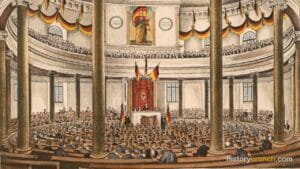
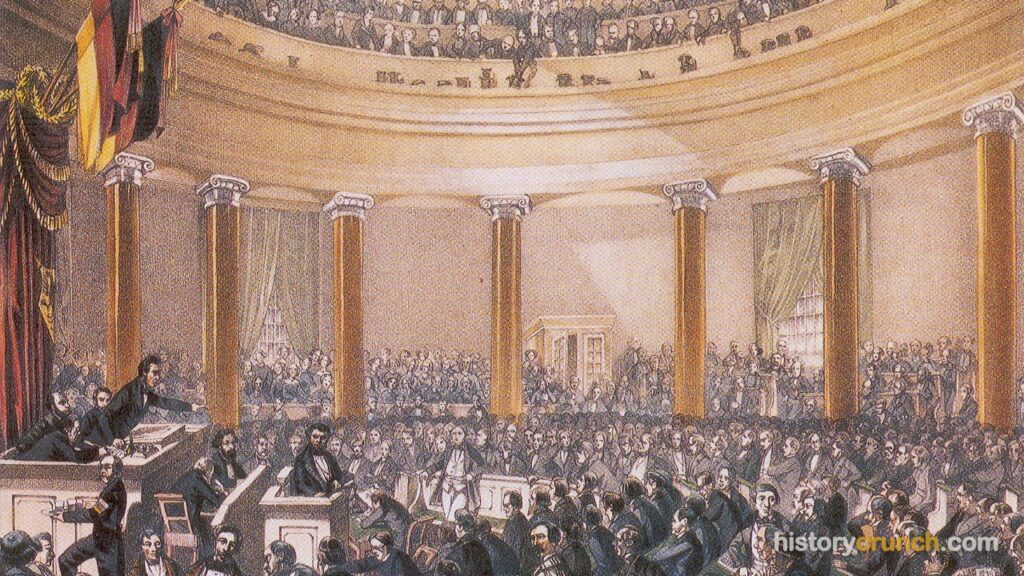
Most of the revolutions of 1848 failed, and conservative monarchs soon regained control almost everywhere. In the German states, for example, a gathering known as the Frankfurt Assembly tried to create a united Germany but collapsed when the King of Prussia refused the crown it offered. Even though these revolutions failed in the short term, they showed just how strong nationalist feeling had become. As stated above, the memory of 1848 would inspire a new generation of leaders who found more practical ways to build nations.
How Did Nationalism Unite Italy and Germany?
The most dramatic achievements of European nationalism were the unifications of Italy and Germany in the mid-19th century. Before this time, both regions were divided into many separate states rather than existing as single countries. In Italy, leaders such as Count Camillo di Cavour and the soldier Giuseppe Garibaldi worked to combine the scattered Italian states into one Kingdom of Italy through a movement known as the Risorgimento, which means “resurgence” in Italian.
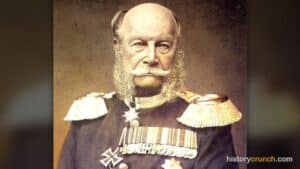
In the German states, unification was led by Otto von Bismarck, the prime minister of Prussia. Rather than relying on speeches and protests, Bismarck used a practical strategy of war and diplomacy that came to be called Realpolitik, a German word meaning politics based on power rather than ideals. He led Prussia into a series of successful wars against Denmark, Austria, and France, which rallied the German states around a common cause. After the defeat of France, the German Empire was declared in 1871. These two new nations changed the balance of power in Europe and proved that nationalism could create powerful states as well as tear old ones apart.
How Did Nationalism Threaten the Old Empires?
While nationalism united some peoples, it pulled others apart. The large multiethnic empires of Europe were especially threatened, because each contained many different peoples who now demanded nations of their own. In the Balkans, for instance, groups such as the Greeks, Serbs, Bulgarians, and Romanians pushed for independence from the Ottoman Empire based on their shared language, religion, and culture.
These nationalist demands created serious instability, especially in southeastern Europe. The Austrian and Ottoman empires struggled to hold together as the peoples inside them grew more determined to rule themselves. In fact, the rise of nationalism in the Balkans produced exactly the kind of tension that would help spark a much larger conflict in the years leading up to 1914.
Significance of Significance of Nationalism in Europe
The significance of nationalism in Europe is enormous, because it transformed the political map of the entire continent and created many of the nations that still exist today. Over the course of the 19th century, nationalism replaced the old world of kings and empires with a new world of nation-states in which peoples claimed the right to govern themselves. This shift helped bring about the unifications of Italy and Germany and the slow breakup of the multiethnic empires that had ruled Europe for centuries.
Nationalism also had a darker side that shaped the 20th century. As European nations grew proud and competitive, nationalism fueled an arms race, imperial rivalry, and deep distrust among the great powers. These tensions were among the main causes of World War I, which began in 1914 after the growth of Balkan nationalism helped trigger the fighting. Because it inspired both the creation of new nations and the conflicts that tore Europe apart, nationalism remains one of the most important ideas for understanding modern history. In many ways, the debates it started about identity, borders, and self-rule continue to shape Europe in the present day.
Frequently Asked Questions
What is nationalism in simple terms?
Nationalism is the belief that people who share a common language, culture, and history form a nation that has the right to rule itself. It encourages citizens to feel loyalty to their nation above all else. This idea can bring people together, but it can also create conflict when different national groups compete for the same land or power.
Why is the 19th century called the age of nationalism?
The 19th century is called the age of nationalism because that is when the idea grew from a small belief into a mass movement that reshaped Europe. During these years, new railroads, newspapers, and schools connected people and helped them imagine themselves as members of a single nation. This spread of communication made it far easier for nationalist ideas to reach ordinary people across an entire country.
Who were the most important nationalist leaders in Europe?
Some of the most important nationalist leaders in Europe were Otto von Bismarck in Germany and Count Camillo di Cavour and Giuseppe Garibaldi in Italy. Bismarck used war and clever diplomacy to unite the German states, while Cavour and Garibaldi worked to combine the divided Italian states into one kingdom. Earlier thinkers such as Giuseppe Mazzini also inspired Italian nationalism through his Young Italy movement founded in 1831.
Did nationalism help or hurt Europe?
Nationalism both helped and hurt Europe, depending on how it was used. On the positive side, it gave many peoples the pride and unity they needed to build their own free nations. On the negative side, it created rivalry, distrust, and competition among nations that helped lead to major wars, including World War I. Because of these mixed results, historians often describe nationalism as one of the most powerful and double-edged forces in modern history.
How did nationalism lead to World War I?
Nationalism led to World War I by increasing competition and distrust among Europe’s great powers and by stirring up unrest in the Balkans. Nationalist groups there wanted independence from the Austrian and Ottoman empires, which created dangerous tension in the region. This unrest boiled over in 1914 when a Serbian nationalist assassinated the Austrian heir Franz Ferdinand, an event that helped trigger the outbreak of the war.
Cite This Article
To cite this article as a source, use one of the formats below.
MLA: Millar, B. “Significance of Nationalism in Europe: A Detailed Summary.” HistoryCrunch, 12 August 2026, https://historycrunch.com/significance-of-nationalism-in-europe/.
APA: Millar, B. (2026). Significance of Nationalism in Europe: A Detailed Summary. HistoryCrunch. https://historycrunch.com/significance-of-nationalism-in-europe/
Chicago: Millar, B. “Significance of Nationalism in Europe: A Detailed Summary.” HistoryCrunch. August 12, 2026. https://historycrunch.com/significance-of-nationalism-in-europe/
Sources
- Jonathan Steinberg, Bismarck: A Life.
- David Blackbourn, The Long Nineteenth Century / History of Germany 1780-1918.