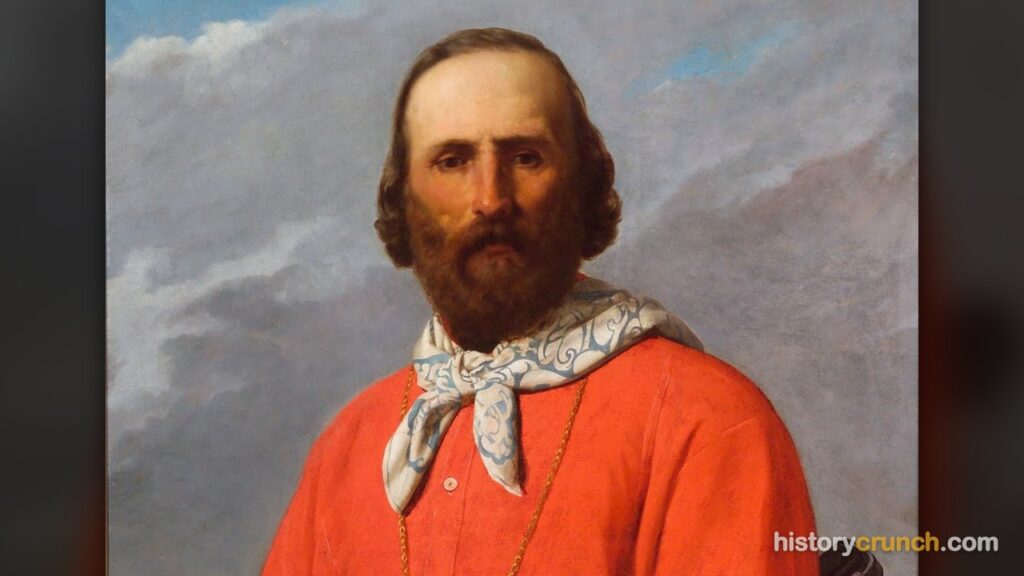
Giuseppe Garibaldi was one of the most important figures in the movement to create a unified Italy, and his daring military campaigns helped turn the dream of a single Italian nation into reality. A soldier, sailor, and revolutionary, he became famous across the world for leading small volunteer armies against much larger professional forces. His most celebrated feat was the conquest of Sicily and southern Italy in 1860, which cleared the way for the many separate states of the Italian peninsula to join together. Garibaldi is remembered as a central hero of the Italian Unification, the movement also known by its Italian name, the Risorgimento.
The Risorgimento, which roughly translates to “Rising Again” or “Resurgence,” was a major political movement of the 1800s that gradually brought together the separate states and kingdoms of the Italian peninsula into one nation. Before this movement, Italy was not a single country but a patchwork of territories, each with its own rulers, laws, and traditions, and several of them were controlled by foreign powers such as Austria. Garibaldi belonged to the wing of the movement that dreamed of a democratic, popular Italy built through the courage of ordinary volunteers, a vision that placed him alongside thinkers and fighters who wanted the nation to rise from the will of its own people.
Early Life and Background
Giuseppe Garibaldi was born on July 4th, 1807, in the port city of Nice, which at that time was part of the French Empire and later belonged to the Kingdom of Sardinia. His family were fishermen and coastal traders, and the sea shaped his early years. Drawn to sailing from a young age, he worked as a merchant sailor for about ten years and eventually qualified as a ship’s captain.
Garibaldi’s life changed when he encountered the ideas of Italian nationalism. In the early 1830s he met supporters of Giuseppe Mazzini, a passionate thinker who dreamed of an Italy united as a democratic republic. In fact, Garibaldi joined Mazzini’s secret movement, known as Young Italy, which encouraged idealistic young men to fight for Italian independence. In 1834 he took part in a failed plot to spark a republican uprising in Piedmont, and for this he was sentenced to death in his absence and forced to flee the country.
Years of Exile in South America
Escaping the death sentence, Garibaldi spent more than a decade in exile in South America, and these years shaped him into the fighter he would later become. He offered his services to rebel causes, first supporting separatists in southern Brazil and later fighting on behalf of Uruguay against a powerful dictator based in Argentina. During these conflicts he mastered the art of guerrilla warfare, a style of fighting in which small, mobile bands of soldiers use surprise, speed, and knowledge of the land to defeat larger armies.
While in Brazil, Garibaldi met a young woman named Anita, who became his wife and fought at his side in battle. Together they endured hardship and danger, and Anita became almost as legendary as her husband. It was also in these years that Garibaldi formed the Italian Legion, a band of Italian exiles who wore distinctive red shirts. More specifically, this red shirt would later become the famous symbol of his followers back in Italy.
Return to Italy and the Revolutions of 1848
In 1848, a wave of revolutions swept across Europe, and Italy was no exception. Hearing that his homeland was rising up against Austrian control, Garibaldi returned with a group of his loyal legionnaires to join the fight. He offered his help to the leaders of the day, but at first he was viewed with suspicion because of his past as a condemned rebel.
Undeterred, Garibaldi threw himself into the struggle. He fought bravely in the north and then rushed to defend the short-lived Roman Republic, which had been set up after the pope fled the city. When French troops arrived to crush the republic and restore the pope’s power, Garibaldi led a stubborn defense of Rome before being forced to retreat. His dramatic escape across central Italy, during which his beloved wife Anita died, only added to his growing fame as a hero. Even in defeat, his courage won him admirers across Europe and the nickname “Hero of the Two Worlds,” a tribute to his campaigns in both South America and Europe.
Expedition of the Thousand
Garibaldi’s greatest achievement came in 1860 with the campaign known as the Expedition of the Thousand. By this time, the northern parts of Italy were being brought together under the Kingdom of Sardinia, guided by its prime minister, Count Cavour, and its king, Victor Emmanuel II. A revolt had broken out in Sicily against its rulers, the Bourbon kings of the Kingdom of the Two Sicilies, and Garibaldi decided to lead a volunteer army south to support the uprising.
In May of 1860, Garibaldi gathered roughly 1,000 volunteers, most of them students and skilled workers rather than trained soldiers. They wore red shirts and grey trousers, which earned them the famous name “Redshirts.” Setting sail from near Genoa aboard two steamships, the volunteers landed at the town of Marsala on the west coast of Sicily on May 11th, 1860. Though poorly armed with old muskets, they were about to attempt something that seemed almost impossible.
Against all odds, Garibaldi’s small force began to win. At the Battle of Calatafimi, the Redshirts defeated a much larger Bourbon force, and their victory inspired thousands of Sicilians to join the cause. In reality, the professional army defending the island numbered more than 20,000, yet Garibaldi’s daring leadership and the support of the local people carried the day. Within weeks he captured the capital, Palermo, and by the summer he controlled nearly all of Sicily.
Garibaldi did not stop there. He crossed the narrow strait to the Italian mainland and marched north, and in September of 1860 he triumphantly entered the great city of Naples. His campaign had toppled the Bourbon kingdom and placed all of southern Italy in his hands. As stated above, Garibaldi believed in a democratic Italy, yet he made a decision that changed history. Rather than keep the conquered lands for himself or press for a republic, he handed the entire south to King Victor Emmanuel II, joining it to the growing Italian state.
Later Life
With his gift of the south, the Kingdom of Italy was proclaimed in 1861, uniting most of the peninsula under a single crown. Garibaldi, however, was never fully at ease with the cautious politicians who now guided the new nation. He retired to his simple home on the small island of Caprera, but he did not put away his sword for good.
Two great goals remained unfinished, for the city of Rome and the region of Venetia were still outside the new kingdom. Garibaldi longed to add Rome to Italy, but the city was protected by French troops loyal to the pope. Twice he tried to march on Rome with volunteers, and both times he was stopped, once by Italian forces at the Battle of Aspromonte, where he was wounded and captured. In 1866 he did win a victory against Austrian forces at Bezzecca as Italy gained Venetia, and Rome finally became the capital of a united Italy in 1871.
In his final years, Garibaldi lived quietly on Caprera, honored as a living legend. His fame stretched far beyond Italy, and admirers around the world saw him as a symbol of freedom. He died on the island on June 2nd, 1882, mourned as one of the founders of the Italian nation.
Significance of Giuseppe Garibaldi
Giuseppe Garibaldi is remembered as one of the most important figures in the creation of modern Italy. His conquest of Sicily and southern Italy in 1860 was the turning point that allowed the many separate states of the peninsula to unite, and without his bold campaign the Kingdom of Italy might never have taken shape when it did. For this reason he is often ranked beside Mazzini, Cavour, and Victor Emmanuel II as one of the four great makers of Italian unity.
Beyond his battlefield victories, Garibaldi came to stand for a set of powerful ideas. He championed freedom, national pride, and the belief that ordinary people could shape their own destiny. In fact, his willingness to hand his conquests to the king, rather than seize power for himself, made him a rare example of a soldier who placed the good of his nation above personal ambition.
Garibaldi’s story also fits into the overall Age of Nationalism that swept across Europe in the 1800s, a period when peoples who shared a language and culture sought to form their own nation-states. Alongside the unification of Germany, the unification of Italy stands as one of the clearest examples of this powerful force. For this reason, Garibaldi’s life remains a lasting symbol of the struggle for freedom and national identity, and his memory is honored in countless statues, streets, and monuments both in Italy and around the world.
Frequently Asked Questions
Who was Giuseppe Garibaldi?
Giuseppe Garibaldi was an Italian soldier and revolutionary who helped unite Italy into a single nation in the 1800s. He led volunteer armies in daring campaigns and is celebrated as one of the founding heroes of modern Italy. His talents as a general were matched by his deep belief in freedom and national pride.
Why was Garibaldi called the “Hero of the Two Worlds”?
Garibaldi earned the nickname “Hero of the Two Worlds” because he fought for freedom on two continents. In South America he battled for rebel causes in Brazil and Uruguay, and in Europe he fought to unite Italy. The title reflected how his fame and his ideals crossed oceans and reached admirers far beyond his homeland.
Who were the Redshirts?
The Redshirts were the volunteer soldiers who followed Garibaldi, named for the red shirts they wore into battle. Many of them were young students and workers rather than trained soldiers, yet they achieved remarkable victories under Garibaldi’s leadership. The red shirt first appeared during his years in South America and became a lasting emblem of his cause.
How did Garibaldi help unify Italy?
Garibaldi helped unify Italy by conquering Sicily and southern Italy in 1860 and then handing these lands to the king of Sardinia. This act joined the south to the north and made possible the creation of the Kingdom of Italy in 1861. His military success gave the unification movement the momentum it needed to finish the job.
What happened to Garibaldi at the end of his life?
Garibaldi spent his final years living simply on the island of Caprera, where he died in 1882. Although he retired from most public life, he remained a beloved national hero and continued to inspire people who admired his devotion to freedom. His attempts to add Rome to Italy were blocked during his lifetime, but the city did become the nation’s capital before he died.
Cite This Article
To cite this article as a source, use one of the formats below.
MLA: Millar, B. “Giuseppe Garibaldi: A Detailed Biography.” HistoryCrunch, 12 August 2026, https://historycrunch.com/giuseppe-garibaldi/.
APA: Millar, B. (2026). Giuseppe Garibaldi: A Detailed Biography. HistoryCrunch. https://historycrunch.com/giuseppe-garibaldi/
Chicago: Millar, B. “Giuseppe Garibaldi: A Detailed Biography.” HistoryCrunch. August 12, 2026. https://historycrunch.com/giuseppe-garibaldi/
Sources
- Jerry Bentley & Herbert Ziegler, Traditions & Encounters: A Global Perspective on the Past.
- J.M. Roberts & Odd Arne Westad, The Penguin History of the World.