The unification of Germany in 1871 stands as one of the most important developments in the history of nineteenth century Europe, and understanding what caused it helps explain how a patchwork of separate states became a single powerful empire. For most of the modern era, the German-speaking lands of Central Europe were not a country at all. Instead, they were divided into dozens of independent kingdoms, duchies, and free cities, each with its own ruler, laws, and army. Over the course of the 1800s, a mixture of powerful forces, including the rise of nationalism, the growing strength of Prussia, economic cooperation, and the leadership of Otto von Bismarck, pushed these scattered states toward becoming a unified German nation.
German unification refers to the process by which the many separate German states joined together to form a single nation-state, the German Empire, which was proclaimed in January of 1871. This process was not the result of a single event but the outcome of long-term causes that built up over several decades and short-term causes that brought matters to a head. More specifically, the unification came about through a combination of shared national feeling, economic ties, and a series of wars directed by Prussia.
What Was Nineteenth Century Europe?
Nineteenth century Europe was an era of dramatic change, shaped by revolution, industrial growth, and the rise of new nation-states. The century opened in the shadow of the French Revolution and the wars of Napoleon Bonaparte, which had spread ideas about freedom, equality, and national identity across the continent. After Napoleon’s defeat in 1815, the leading powers of Europe tried to restore order and control these new ideas, but they could not fully hold them back.
In fact, one of the defining features of the century was nationalism, the belief that people who share a common language, culture, and history should govern themselves as one nation. This idea reshaped the map of Europe and led to the creation of unified countries, including both Germany and Italy. At the same time, the Industrial Revolution was transforming society, as new railroads, factories, and forms of communication linked together people who had once lived far apart.
How Did the Congress of Vienna Set the Stage?
The Congress of Vienna was a major diplomatic meeting held in Vienna, Austria, from 1814 to 1815 that reorganized Europe after the defeat of Napoleon. One of its major outcomes was the creation of the German Confederation, a loose association of 39 German states that replaced the old Holy Roman Empire, which had been dissolved in 1806. The Confederation was designed to coordinate the states and to keep a careful balance between the two most powerful members, Austria and Prussia.
However, the German Confederation was weak and had no central government, army, or court of its own. In reality, it was meant to keep the German states divided rather than to unite them, since the conservative leaders who created it feared the spread of nationalism and liberalism. As a result, many Germans came to see the Confederation as an obstacle to unity, and their frustration became one of the long-term causes of unification.
Why Was the Rise of Nationalism So Important?
The most important long-term cause of German unification was the rise of nationalism in the nineteenth century. In the decades following the Napoleonic Wars, a growing number of Germans developed a strong sense of shared national identity based on their common language, history, and culture. This nationalistic feeling created a widespread desire for a single German nation, especially among the educated middle classes, students, and liberal political movements.
For instance, the defeat of Napoleon by several German states in the early 1800s had helped fuel a strong sense of shared German pride. Writers, poets, and scholars encouraged this feeling by celebrating German literature, folk tales, and traditions, which strengthened the idea that the German people belonged together. Many Germans, particularly liberal intellectuals and students, began to call for the creation of a unified German state with a democratic constitution.
How Did the Zollverein Bring the States Together?
Another important cause of unification was economic cooperation among the German states, especially through a customs union called the Zollverein. The Zollverein was created in 1834 and led by Prussia, and it removed tariffs and trade barriers between its member states. As stated above, the German lands had long been divided, and these trade barriers had made travel and business difficult and expensive.
By joining the Zollverein, the German states began trading freely with one another, which drew them closer together and made cooperation seem natural. In reality, this economic union tied the states to Prussia rather than to Austria, since Austria was deliberately left out of the arrangement. In this way, the Zollverein laid an economic foundation for the political unity that would come later, and it strengthened Prussia’s position as the leader of the German world.
Why Did the Growing Power of Prussia Matter?
Another important cause was the growing power and ambition of Prussia. Prussia was the largest and most powerful of the German states outside of Austria, and it had a highly efficient military, a strong economy, and a well-organized government. Over the course of the nineteenth century, Prussia’s leaders came to believe that they, rather than Austria, should lead a unified Germany.
This rivalry between Prussia and Austria was a central feature of German politics, since both wanted to be recognized as the true leader of the German-speaking peoples. Many nationalists favored a “smaller Germany” that would unite the German states under Prussia while excluding Austria and its large non-German population. In fact, this preference for a Prussian-led Germany shaped the entire path that unification would eventually take.
What Role Did the Revolutions of 1848 Play?
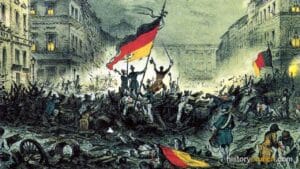
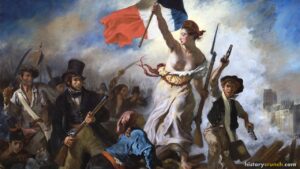
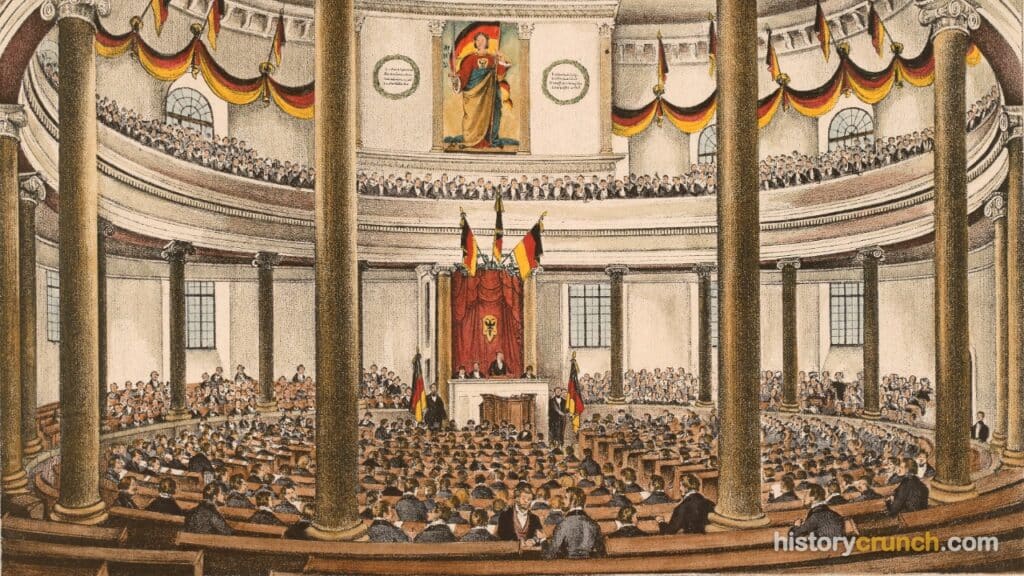
In 1848, revolutions broke out across Europe, including in many of the German states, as people demanded greater political freedom and national unity. German nationalists and liberals gathered in a parliament at Frankfurt and tried to create a unified nation with a constitution. For a brief moment, it seemed that Germany might be united peacefully and through popular support.
However, these revolutions ultimately failed. The Frankfurt Parliament lacked an army and real authority, and the King of Prussia refused the crown that the parliament offered him. The failure of 1848 taught many Germans a lasting lesson, namely that unification was unlikely to be achieved by peaceful discussion alone and might instead require the strength and leadership of a powerful state like Prussia.
How Did Otto von Bismarck Lead Unification?
The task of achieving unification ultimately fell to the conservative Prussian statesman Otto von Bismarck, who became Minister-President of Prussia in 1862. Bismarck was a skilled and ruthless politician who believed that the great questions of the day would be decided not by speeches and votes but by “blood and iron,” meaning military strength and warfare. He is often remembered by the nickname the “Iron Chancellor” because of his forceful style of leadership.
Bismarck united the German states through a combination of clever diplomacy and three carefully chosen wars. The first was a short war against Denmark in 1864, and the second was the war against Austria in 1866, which removed Austria as a rival and allowed Prussia to lead the German states north of the River Main. The third and final conflict was the Franco-Prussian War of 1870 to 1871, in which Bismarck provoked France into war and rallied the southern German states to Prussia’s side. Following the victory over France, the German Empire was proclaimed in January of 1871, completing the process of unification.
Significance of Causes of German Unification
The causes of German unification are significant because they explain how a divided collection of states became one of the most powerful nations in the world in a short span of time. The combination of nationalism, economic cooperation, Prussian strength, and Bismarck’s leadership shows that great historical changes usually come from many forces acting together rather than from a single event. Understanding these causes helps make sense of why unification took the shape it did, with Prussia at the center and Austria left out.
Beyond Germany itself, unification changed the balance of power in Europe. The new German Empire was large, industrial, and militarily strong, and its sudden rise worried neighboring countries such as France and Britain. In fact, the tensions created by a powerful, unified Germany would help shape European rivalries for decades and contributed to the outbreak of World War I in the early twentieth century. For these reasons, the causes of German unification remain a key subject for anyone seeking to understand modern European history.
Frequently Asked Questions
What Were the Main Causes of German Unification?
The main causes of German unification were the rise of nationalism, economic cooperation through the Zollverein, the growing power of Prussia, and the leadership of Otto von Bismarck. These long-term and short-term causes worked together over several decades. Nationalism created the desire for unity, while Prussia and Bismarck provided the strength and strategy to make it happen.
When Was Germany Unified?
Germany was unified in January of 1871, when the German Empire was officially proclaimed. The ceremony took place at the Palace of Versailles in France, shortly after Prussia and its German allies defeated France in the Franco-Prussian War. King William I of Prussia was crowned as the first emperor of the new German nation.
What Was the Zollverein?
The Zollverein was a customs union among the German states, created in 1834 and led by Prussia. It removed trade barriers and tariffs between its members, which allowed goods and money to move freely across the German lands. By linking the states economically and leaving out Austria, the Zollverein helped prepare the way for political unification under Prussia.
Why Was Austria Left Out of a United Germany?
Austria was left out mainly because Prussia wanted to lead a united Germany without a rival, and because Austria’s empire contained many non-German peoples. Nationalists who favored a “smaller Germany” preferred a nation made up only of German states under Prussian leadership. Bismarck’s victory over Austria in the war of 1866 settled this rivalry in Prussia’s favor.
Who Was Otto von Bismarck?
Otto von Bismarck was a conservative Prussian statesman who served as Minister-President of Prussia and later as the first Chancellor of the German Empire. He is widely regarded as the person most responsible for uniting the German states, which he achieved through diplomacy and three wars. His forceful approach to politics earned him the nickname the “Iron Chancellor.”
Cite This Article
To cite this article as a source, use one of the formats below.
MLA: Millar, B. “Causes of German Unification: A Detailed Summary.” HistoryCrunch, 12 August 2026, https://historycrunch.com/causes-of-german-unification/.
APA: Millar, B. (2026). Causes of German Unification: A Detailed Summary. HistoryCrunch. https://historycrunch.com/causes-of-german-unification/
Chicago: Millar, B. “Causes of German Unification: A Detailed Summary.” HistoryCrunch. August 12, 2026. https://historycrunch.com/causes-of-german-unification/
Sources
- Norman Davies, Europe: A History.