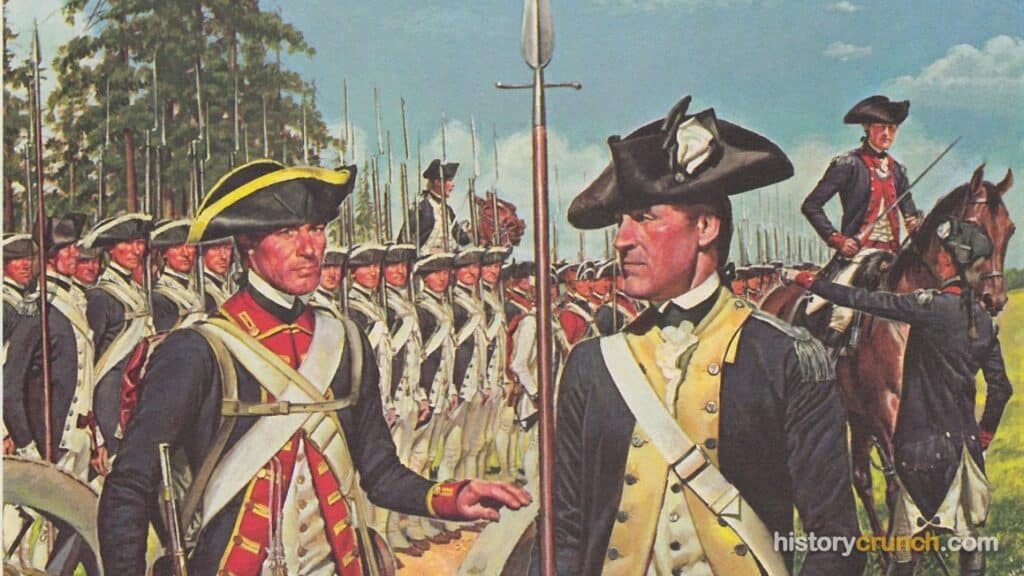
The weapons of the American Revolution shaped how the war was fought and helped decide whether the thirteen American colonies could win their independence from Great Britain. The American Revolution, also called the Revolutionary War, was fought between 1775 and 1783, and the outcome often came down to which side had reliable firearms, enough gunpowder, and soldiers trained to use them. On both sides, the fighting depended on a small group of familiar weapons, including the flintlock musket, the long rifle, the bayonet, the pistol, and heavy artillery. Understanding these weapons helps explain why battles were fought the way they were and why supplying an army was one of the hardest problems the young United States ever faced.
A weapon in this period is best understood as a tool that a soldier used either at a distance or in close combat. Firearms such as muskets and rifles were meant to strike an enemy from far away, while blades such as bayonets and swords were meant for hand-to-hand fighting once the two lines came together. Artillery meant the large guns, mounted on wheeled carriages, that fired heavy projectiles across long distances.
What Was the American Revolution?
The American Revolution grew out of more than a decade of rising tension between Britain and its thirteen American colonies. The disputes centered on taxation, self-government, trade, and the rights of colonists as British subjects. No single event caused the war, but a series of British policies and colonial protests pushed the two sides further apart until armed conflict became unavoidable.
Fighting began in April of 1775 at the Battles of Lexington and Concord, near Boston, when British troops marched out to seize colonial military supplies. In July of 1776, the colonies declared their independence and formed the United States. In fact, what began as a rebellion within the British Empire soon became an international war, as France entered on the American side in 1778 and Spain joined in 1779. The war ended after the British surrender at Yorktown in 1781, and independence was formally recognized by the Treaty of Paris in 1783.
How Did Muskets Work in the Revolutionary War?
The musket was the primary weapon used by both sides during the American Revolution. A musket was a smoothbore firearm, which means the inside of the barrel was smooth rather than grooved. It was also muzzle-loaded, so the soldier poured gunpowder and dropped a lead ball down the open front end of the barrel before firing.
Most muskets of the period used a flintlock mechanism. When the trigger was pulled, a piece of flint struck a steel plate called a frizzen, creating sparks that ignited the gunpowder and fired the ball. Soldiers usually loaded from a paper cartridge that held both the powder and the ball, which made reloading faster and easier in the middle of a battle.
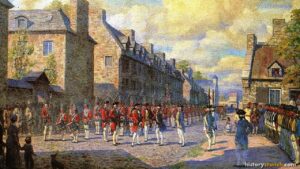
Smoothbore muskets were not very accurate. They could reliably hit a target only up to about 100 yards (91 m), and even at that distance a single shot was likely to miss. More specifically, a skilled soldier could fire only about three to four shots per minute, since loading took roughly 15 to 20 seconds. Because of this, armies did not aim at individual enemies from far away. Instead, they lined up shoulder to shoulder and fired all at once in massed volleys, hoping that a wall of lead balls would strike the enemy line.
What Was the Brown Bess?
The most famous musket of the war was the British-made Brown Bess, officially known as the Land Pattern musket. It was the standard weapon of the British army and had been in service for decades before the Revolution began. The Brown Bess was heavy, weighing more than ten pounds (4.5 kg), and it fired a large lead ball roughly .75 inches in diameter.
The Brown Bess became the most commonly used weapon of the entire war, and not only for the British. In reality, American soldiers used it too, especially early in the conflict, because colonial storehouses already held large numbers of these guns and patriots seized more of them from British supplies. American gunsmiths also built copies of it under contract for colonial governments. As a result, the same basic weapon could be found in the hands of soldiers on both sides.
Why Was the Charleville Musket Important?
The other major musket of the war was the Charleville, a French weapon named for one of France’s main arsenals. It was similar to the Brown Bess but was lighter and fired a slightly smaller ball, about .69 inches in diameter. Many American soldiers found it reliable, easy to maintain, and well suited to battle.
The Charleville became far more important after France entered the war on the American side in 1778. French support brought thousands of these muskets across the Atlantic, and the Charleville soon became the main firearm of the Continental Army, which was the regular army created by Congress. This steady supply of weapons was one of the most valuable things France provided, because the American small-arms industry was still very young and could not produce enough guns on its own.
How Was the Long Rifle Different From a Musket?
The American long rifle was a very different kind of firearm. Unlike a smoothbore musket, it had a rifled barrel, meaning the inside of the barrel had spiral grooves. These grooves made the ball spin as it left the barrel, which made it fly much straighter and hit targets far more accurately at long range.
The long rifle had been introduced to the colonies by German and Swiss settlers and was originally used for hunting in the backcountry. In battle, it acted as an early form of sniper weapon, letting skilled marksmen pick off officers and other targets from a great distance. However, the rifle had serious drawbacks. It was slow to load, it could not easily hold a bayonet, and it required real skill to use well. For these reasons, the rifle was used only in limited numbers, while the faster-loading musket remained the main battlefield weapon.
What Close-Combat Weapons Were Used?
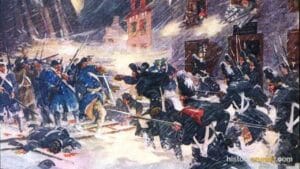
Because muskets were slow to reload, fighting often ended in close combat, and the most important close-combat weapon was the bayonet. A bayonet was a long blade that attached to the muzzle of a musket, turning the firearm into a kind of spear. After firing a shot or two, soldiers could charge forward and fight hand to hand without stopping to reload.
The bayonet was a serious advantage for the British early in the war, since their soldiers were highly trained in bayonet charges while many American militia units were not. For instance, American troops sometimes broke and ran when faced with a determined bayonet charge. This weakness improved over time as the Continental Army received better training. Officers and cavalry also carried swords and sabers, and some soldiers used pistols or tomahawks in close fighting, though these were far less common than the musket and bayonet.
What Role Did Artillery Play?
Artillery meant the large guns, usually cannons, that fired heavy projectiles over long distances. These guns were mounted on wheeled carriages so they could be moved and aimed, and they were operated by teams of trained gunners. Cannons could be devastating at both long and short range, smashing enemy formations, defending forts, and battering fortifications during a siege.
Artillery was especially important in siege warfare, where one army trapped another inside a fortified position. As stated above, the war ended with the siege of Yorktown, where American and French cannons pounded the British lines until surrender became the only option. Artillery was expensive and hard to move, which made it a valuable resource that both sides worked hard to protect and capture.
Significance of Weapons of the American Revolution
The weapons of the American Revolution mattered because they shaped both the tactics of the war and the struggle to keep an army supplied. The slow, inaccurate musket forced armies to fight in tight lines and rely on massed volleys and bayonet charges, which explains why so many battles looked the way they did. The long rifle, though used in small numbers, showed how accurate firepower could change warfare in the years to come.
Just as important, the war revealed how much the American cause depended on getting enough weapons. The Continental Army began the war short of firearms, gunpowder, and trained gunners, and it often relied on captured British muskets to fill the gap. French aid, especially the flood of Charleville muskets and skilled artillery support, helped tip the balance toward American victory. In this way, the weapons of the Revolution were not just tools of battle but a key part of the story of how the United States won its independence.
Frequently Asked Questions
What was the most common weapon in the American Revolution?
The most common weapon was the smoothbore flintlock musket, especially the British Brown Bess. Both armies relied on it because it could be loaded and fired quickly enough for massed volleys, and it could also hold a bayonet for close combat. Its wide use is the main reason battles were fought in tight lines of soldiers.
Why were muskets so inaccurate?
Muskets were inaccurate because they had smoothbore barrels with no grooves to steady the ball in flight. The ball also fit loosely inside the barrel, so it bounced as it traveled out and could veer off in almost any direction. This is why soldiers were trained to fire in large groups rather than aim at single targets.
Did the Americans make their own weapons?
The Americans made some of their own weapons, but their gun-making industry was too small to arm the whole Continental Army. Gunsmiths often built muskets by combining British and American parts, and finished government weapons were sometimes stamped to show they were public property. Because supply fell short, the army also depended heavily on captured and imported guns.
How did the bayonet change the way battles were fought?
The bayonet allowed a soldier to keep fighting after firing without stopping to reload, turning the musket into a spear for close combat. This made bayonet charges a powerful tactic, and well-drilled British troops used them to great effect early in the war. American forces became far more dangerous with the bayonet once their training improved.
How did French help improve American weapons?
French aid gave the Continental Army a steady supply of reliable Charleville muskets after France joined the war in 1778. Before that, American troops often carried a mix of hunting guns and captured British arms, which made supply and repair difficult. The French muskets, along with gunpowder and artillery support, helped the Americans fight the British on more equal terms.
Cite This Article
To cite this article as a source, use one of the formats below.
MLA: Millar, B. “Weapons of the American Revolution: A Detailed Summary.” HistoryCrunch, 10 August 2026, https://historycrunch.com/weapons-of-the-american-revolution/.
APA: Millar, B. (2026). Weapons of the American Revolution: A Detailed Summary. HistoryCrunch. https://historycrunch.com/weapons-of-the-american-revolution/
Chicago: Millar, B. “Weapons of the American Revolution: A Detailed Summary.” HistoryCrunch. August 10, 2026. https://historycrunch.com/weapons-of-the-american-revolution/
Sources
- Yale Avalon Project
- Bernard Bailyn, The Ideological Origins of the American Revolution.