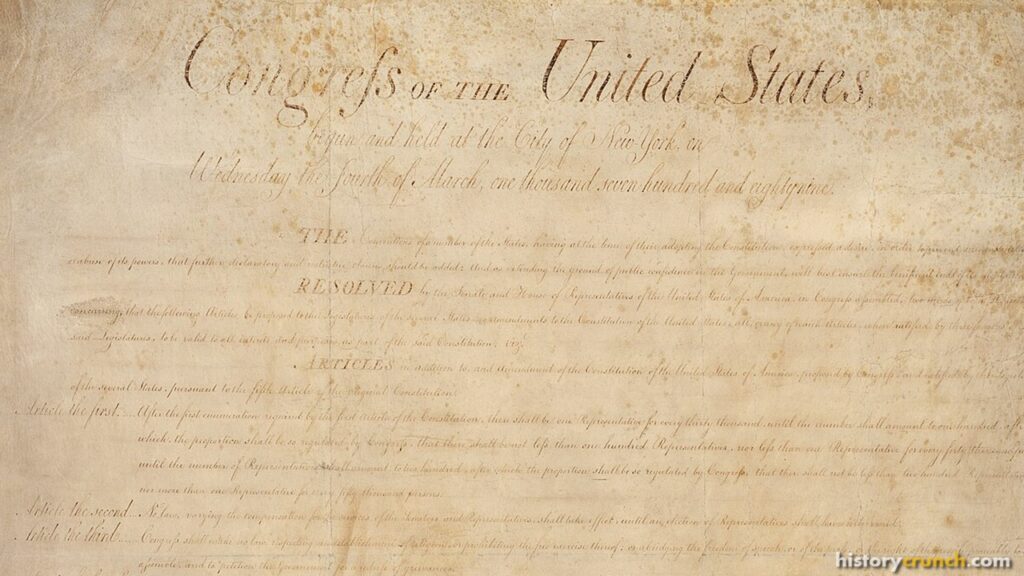
The Bill of Rights is the name given to the first ten amendments to the United States Constitution, ratified on December 15th, 1791. These ten amendments protect specific individual freedoms and limit the power of the federal government over the people. They cover rights including freedom of speech, freedom of religion, the right to a fair trial, and protection against unreasonable searches by the government. The Bill of Rights was added to the Constitution just a few years after the original document was written because many Americans feared that the Constitution on its own gave the government too much power and did not do enough to protect the rights of ordinary people.
What Was the American Revolution?
The American Revolution was the political and military struggle through which the Thirteen Colonies broke free from British rule and established the United States of America. The conflict grew out of more than a decade of disputes over taxation, self-government, and the rights of colonists as British subjects. After winning independence, the founders had to build a new government from scratch. The Bill of Rights was a direct product of that effort, reflecting both the lessons colonists had learned from living under British rule and a deep determination to make sure that the new American government could never treat its own people the way Britain had treated the colonies.
Background – Why the Bill of Rights Was Needed
When the Constitutional Convention met in Philadelphia in the summer of 1787, the delegates produced a remarkable document that established the structure of the new federal government. However, the original Constitution did not include a list of specific rights guaranteed to individual citizens. It explained what the government could do but said very little about what it could not do.
Near the end of the convention, Virginia delegate George Mason proposed adding a bill of rights. Mason had written the Virginia Declaration of Rights in 1776, one of the first such documents in American history, and he believed a national bill of rights was essential. The state delegations voted against his proposal, largely because they were exhausted after four months of difficult debate and because many believed that the Constitution’s structure of limited government was protection enough.
This decision came back to cause serious problems during the ratification debate. Anti-Federalists, those who opposed the Constitution because they feared it gave too much power to the central government, immediately seized on the absence of a bill of rights as one of their strongest arguments against ratification. Ordinary people across the country worried that without specific written protections, the new federal government could eventually restrict their freedoms, just as the British Parliament had tried to do. The debate over ratification in several key states, including Virginia and New York, was extremely close, and the Constitution’s supporters realized they had to promise to add a bill of rights after ratification in order to win.
James Madison and the Drafting Process
The man most responsible for writing the Bill of Rights was James Madison of Virginia. Madison had initially been skeptical about the need for a bill of rights, believing that the structure of the Constitution itself was sufficient protection. He changed his mind after extensive correspondence with Thomas Jefferson, who was serving as American ambassador to France at the time and argued strongly that a bill of rights was something the people were entitled to from every government on earth.
Madison was elected to the first House of Representatives and made it his immediate priority to fulfill the promise made during ratification. He carefully studied the amendments proposed by the state ratifying conventions, which had submitted more than 200 individual suggestions. He also drew heavily on existing documents, particularly Virginia’s Declaration of Rights, the English Bill of Rights of 1689, and the Magna Carta of 1215.
Madison proposed 19 amendments to Congress on June 8, 1789. The House of Representatives approved 17 of them. The Senate then narrowed the list to 12, which were sent to the states for ratification in September of 1789. Ten of those twelve were ratified by three-quarters of the states, and they became part of the Constitution on December 15th, 1791. Of the other two proposed amendments, one was eventually ratified more than 200 years later as the 27th Amendment in 1992, and one has never been ratified.
The Ten Amendments
The First Amendment is the most widely known and protects five basic freedoms: freedom of religion, freedom of speech, freedom of the press, freedom of peaceful assembly, and the right to petition the government about grievances. Congress cannot establish an official national religion, and it cannot prevent people from practicing their own faith. It cannot stop newspapers or individuals from speaking their minds, and it cannot prevent people from gathering peacefully to protest or to organize.
The Second Amendment protects the right of the people to keep and bear arms. The amendment connects this right to the importance of a well-regulated militia for the security of a free state. The exact meaning and scope of the Second Amendment has been one of the most debated constitutional questions in American history, particularly regarding how far the right extends and what limits the government may place on it.
The Third Amendment states that soldiers cannot be quartered, or housed, in private homes without the owner’s consent during peacetime, and that in wartime it can only be done in a way established by law. This amendment grew directly out of colonial anger at the Quartering Acts, which had required colonists to house British soldiers.
The Fourth Amendment protects people against unreasonable searches and seizures by the government. It states that government officials generally need a warrant to search a person’s home or belongings, and that a warrant can only be issued if there is good reason to believe a crime has been committed. This too grew out of colonial experience, specifically the use of writs of assistance by British customs officers to search colonists’ property without restriction.
The Fifth Amendment protects several rights of people accused of crimes. A person cannot be tried for a serious crime without first being indicted by a grand jury. No person can be tried twice for the same crime, a protection known as double jeopardy. No one can be forced to testify against themselves in court, which is known as the right against self-incrimination. The government cannot take away a person’s life, freedom, or property without due process of law. And the government cannot take private property for public use without paying the owner fairly.
The Sixth Amendment guarantees the right to a speedy and public trial by an impartial jury in criminal cases. The accused must be told what they are charged with, must be allowed to confront witnesses against them, must be able to call their own witnesses, and must have the help of a lawyer.
The Seventh Amendment guarantees the right to a jury trial in civil cases, meaning legal disputes between private parties rather than criminal prosecutions, when the amount of money involved exceeds twenty dollars.
The Eighth Amendment prohibits excessive bail, excessive fines, and cruel and unusual punishment. This amendment was influenced by the English Bill of Rights of 1689, which contained very similar language. What counts as cruel and unusual punishment has been debated and interpreted by courts throughout American history.
The Ninth Amendment states that just because certain rights are listed in the Constitution does not mean those are the only rights people have. This was included to address the concern that listing specific rights might be read to imply that any rights not listed were not protected.
The Tenth Amendment states that any powers not given to the federal government by the Constitution, and not prohibited to the states by it, are reserved to the states or to the people. This amendment was intended to make clear that the federal government only had the specific powers granted to it by the Constitution and that all other powers remained with state governments or with the people themselves.
The Bill of Rights in Practice
For the first hundred years or so after it was ratified, the Bill of Rights had relatively little practical impact on the daily lives of Americans. Initially, the amendments only applied to the federal government, not to state governments, meaning that states could restrict freedoms that the federal government could not. This changed significantly after the Civil War, when the Fourteenth Amendment was added to the Constitution in 1868. The Fourteenth Amendment prohibited states from depriving any person of life, liberty, or property without due process of law, and over the course of the twentieth century the Supreme Court used this clause to apply most of the protections in the Bill of Rights to the states as well, a process called incorporation.
The Bill of Rights has been at the center of some of the most important legal battles in American history, covering questions about free speech, religious freedom, gun rights, search and seizure, the rights of criminal defendants, and many other issues. Debates about the meaning and limits of these rights continue to shape American law and politics today.
Significance of the American Bill of Rights
The Bill of Rights was a pivotal moment in the history of democratic government. It took the principles the colonists had fought for during the Revolution, the ideas about natural rights and the limits of government power that appeared in the Declaration of Independence, and built them directly into the law of the land in specific, enforceable terms. For the first time in American history, individual rights were not just stated as ideals but written down as legally binding protections.
The Bill of Rights has influenced constitutions and legal systems around the world, serving as a model for how democratic governments can build specific protections for their citizens into their foundational law. At home, it has served as the basis for some of the most important expansions of civil rights and individual freedom in American history. Activists fighting for the rights of African Americans, women, religious minorities, and many others have drawn on the language and principles of the Bill of Rights to make their case. The document continues to shape what it means to be American and what Americans expect from their government more than two centuries after it was first written.