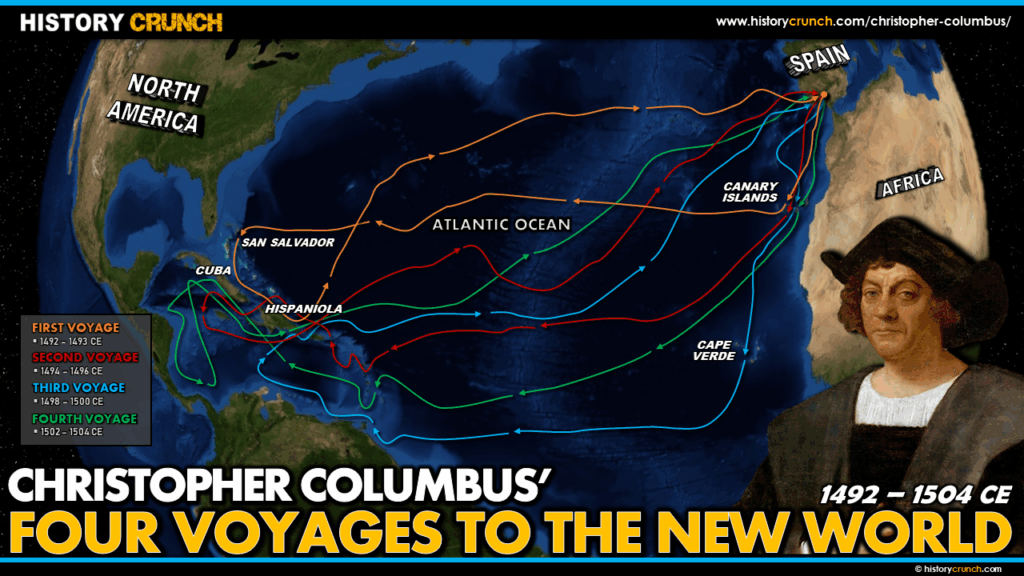
Columbus Day is a holiday held in the United States and other countries on the second Monday in October, and it commemorates Christopher Columbus’ landing in the New World on October 12th, 1492. Christopher Columbus is one of the most significant figures in all of World History and is particularly important to major world events such as the Age of Exploration and Renaissance. His four famous journeys to the New World in the late 15th century and early 16th century altered the history of the world and led to a mass migration of people from the Old World to the New World. Today, he is best remembered as a famous European navigator, explorer and colonizer.
CHRISTOPHER COLUMBUS
While Columbus was an Italian born explorer, he was officially financed by the Spanish monarchs of the time to chart a western sea route to China. At the time people believed that only the Atlantic Ocean was between Europe and the East Indies. However, when Columbus set sail, he discovered a land mass previously unknown to Europeans, which today is North and South America. In reality, on his first voyage in 1492, Columbus arrived in the Caribbean. While there, he explored several different islands, including Hispaniola and Cuba. This voyage meant that Columbus became the first European to explore the Americas since the Vikings in the 10th century.
COLUMBUS DAY – HISTORY
Columbus Day was celebrated unofficially in the United States as early as the 18th century (1792) in order to commemorate the 300th anniversary of the historic landing of Columbus in the Americas. Throughout the decades and centuries that followed, it was celebrated by many different groups. For instance, for Italian-Americans, it has been seen as a day of celebration for their heritage. As well, groups across the United States celebrated it (including the 400th anniversary in 1892) as a means of patriotism and national pride. However, it was not until 1934 that Columbus Day was recognized as a federal holiday by then American President, Franklin D. Roosevelt. following intense lobbying by the catholic fraternity of the Knights of Columbus. Since 1971, the day has been aligned with the second Monday in October.
Columbus Day is also celebrated across several countries in Latin America, where it is known as Día de la Raza. This translates to ‘day of the race’ or the ‘day of the [Hispanic] people’.
COLUMBUS DAY – CONTROVERSY
What all of that said, Columbus Day is also shrouded in controversy, with some people supporting the celebration of Columbus and other arguing that he should not be a celebrated figure. In terms of positives, some argue that Christopher Columbus should be celebrated today for the accomplishments he achieved on his famous voyages to the New World and the impact it left on world history. Whereas, other argue that he should not be celebrated due to the brutal and cruel actions against countless numbers of other people. For instance, reports from the time show that Columbus and his associated carried out brutal attacks against the indigenous peoples that he encountered and enslaved thousands of them for his own financial gain. Also, the arrival of Columbus (and Europeans) to the New World led to the spread of European diseases which decimated the indigenous peoples of the New World. For example, the Taino people, which Columbus first encountered on the island of Hispaniola, suffered from the spread of European diseases such as smallpox, influenza, measles and typhus. While Columbus did not purposefully spread these diseases to the indigenous peoples, it cannot be ignored that his arrival to the New World caused the mass deaths of many. Historians disagree on the how many indigenous people of the Americas died as a result of European diseases with estimates ranging from as low as 50% to as high as 90%. Regardless, the spread of Europeans diseases had a dramatic effect on the societies and cultures of indigenous peoples.
As a result of the opposition that exists, alternative days have been proposed that include the ‘Dia de la Raza’ which is a celebration of Hispanic culture’s diverse roots. Some American cities and states have replaced Columbus Day with days of remembrance for example, Hawaii has ‘Discoverers Day’. However, Columbus Day still exists in many parts of the United States.