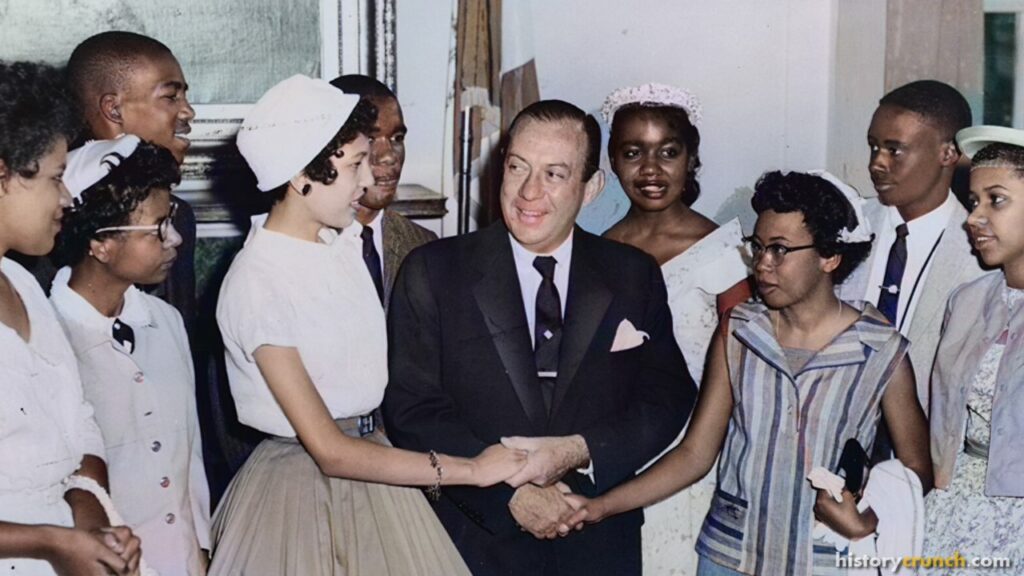
The Little Rock Nine were a group of nine African American teenagers who enrolled at the previously all-white Central High School in Little Rock, Arkansas, in September of 1957. The students were selected by the National Association for the Advancement of Colored People (NAACP) based on their strong academic records and personal character. Their attempt to attend Central High School was blocked by the Arkansas National Guard under orders from Governor Orval Faubus, and they faced a hostile white mob on their first day of school. After President Dwight D. Eisenhower sent federal troops to escort them into the building, the students endured a full year of harassment and abuse in order to complete their studies. The Little Rock Nine are considered to be among the most important figures of the Civil Rights Movement.
WHAT WAS THE CIVIL RIGHTS MOVEMENT?
The Civil Rights Movement was a widespread social and political campaign for equal rights that took place primarily during the 1950s and 1960s in the United States. The movement was driven by African Americans and their allies who sought to end the system of racial segregation and discrimination that had existed in the United States for centuries. Racial segregation meant that African Americans were legally separated from white Americans in schools, restaurants, transportation, hospitals, and other public spaces, and were routinely denied the same rights and opportunities available to white citizens.
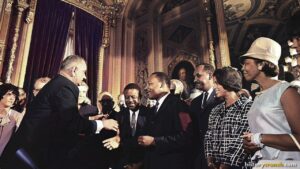
The Civil Rights Movement used a variety of methods to challenge this system, including: peaceful protests, legal challenges through the courts, boycotts, and political pressure on the United States government. Some of the most important events of the Civil Rights Movement included the Supreme Court ruling in Brown v. Board of Education in 1954, the Montgomery Bus Boycott of 1955, the March on Washington in 1963, and the passage of the Civil Rights Act of 1964 and the Voting Rights Act of 1965. The Little Rock Nine were among the earliest figures of the Civil Rights Movement, and their courage in the face of hostility and violence helped inspire the broader campaign for racial equality that followed.
LITTLE ROCK NINE – BACKGROUND
The enrollment of the Little Rock Nine at Central High School was a direct result of the Supreme Court’s ruling in Brown v. Board of Education in 1954, which declared racial segregation in public schools unconstitutional. Following the ruling, the Little Rock School Board developed a plan for gradual desegregation, beginning with the high schools in September of 1957. In response, the NAACP recruited African American students who lived in the Central High School district and were interested in enrolling. The students were selected based on their academic record, attendance, and ability to withstand the pressure and hostility they were expected to face. The recruitment and preparation of the students was organized by Daisy Bates, the president of the Arkansas branch of the NAACP.
The nine students selected were: Minnijean Brown, Elizabeth Eckford, Ernest Green, Thelma Mothershed, Melba Pattillo, Gloria Ray, Terrence Roberts, Jefferson Thomas, and Carlotta Walls. All nine were teenagers at the time. Many of the students and their families were motivated to enroll at Central High School because it offered far greater academic resources than the segregated schools they had previously attended, including a wider range of courses, better facilities, and more extracurricular opportunities.
LITTLE ROCK NINE – THE CRISIS
On September 2nd, 1957, the night before the first day of school, Governor Orval Faubus ordered the Arkansas National Guard to surround Central High School, claiming the action was necessary to prevent violence. On September 4th, the Little Rock Nine arrived to enroll and were blocked from entering by National Guard soldiers. Eight of the students traveled together and were turned away at the entrance. The ninth student, Elizabeth Eckford, arrived alone and was surrounded by a large and hostile white mob. Photographs and news reports of the confrontation attracted national and international attention to the situation in Little Rock.
After a federal judge ordered the National Guard removed, the students attempted again to enter the school on September 23rd, and briefly attended classes before being removed by police when a violent mob gathered outside. On September 24th, 1957, President Eisenhower ordered approximately 1,200 soldiers from the 101st Airborne Division to Little Rock. On September 25th, under federal military escort, the Little Rock Nine entered Central High School and attended their first full day of classes.
LITTLE ROCK NINE – THE SCHOOL YEAR
The presence of federal troops allowed the nine students to attend school, but their experience throughout the year was difficult. Each student was assigned a personal guard, though soldiers could not accompany them inside classrooms or other private spaces, leaving the students vulnerable to harassment at those times. Throughout the year the students endured verbal abuse, physical attacks, and deliberate intimidation from other students. In December of 1957, Minnijean Brown was suspended and eventually expelled following several confrontations with students who had been harassing her. She transferred to a school in New York for the remainder of the year.
The remaining eight students completed the school year at Central High School. On May 27th, 1958, Ernest Green became the first African American student to graduate from Central High School. Martin Luther King Jr. attended the graduation ceremony. The following school year, Governor Faubus closed all four of Little Rock’s public high schools rather than allow desegregation to continue. The schools remained closed for the entire 1958 to 1959 school year before being ordered to reopen by the Supreme Court.
LITTLE ROCK NINE – SIGNIFICANCE
The Little Rock Nine were significant for several reasons. First, the Little Rock Nine were significant because their actions forced the federal government to directly confront the defiance of a state government over civil rights. When Governor Faubus used the Arkansas National Guard to block the students from entering a public school, President Eisenhower had no choice but to respond with federal military force. This established the important precedent that the federal government would enforce the constitutional rights of African American citizens even against the direct opposition of state officials.
The Little Rock Nine were also significant because the images of their treatment at Central High School drew national and international attention to racial injustice in the United States. Photographs of Elizabeth Eckford walking alone through a hostile mob became some of the most powerful images of the Civil Rights Movement. The widespread coverage of events in Little Rock made it impossible for many Americans to ignore the reality of racial segregation in the South and helped build public support for further civil rights action.
Finally, the Little Rock Nine were significant because the personal courage they demonstrated became a lasting symbol of the Civil Rights Movement. Nine teenagers faced extraordinary hostility and danger, and endured a full year of abuse, in order to exercise a right that had been guaranteed to them by the Supreme Court. In 1999, President Bill Clinton awarded each member of the group the Congressional Gold Medal in recognition of their contributions to American history. Their example continues to be remembered as one of the most powerful demonstrations of determination and courage in the struggle for racial equality.