The Crossing of the Delaware is remembered as one of the most important moments of the American Revolution, because it rescued the American cause at the point when it seemed closest to collapse. The American Revolution was the struggle in which the Thirteen Colonies broke away from Great Britain and formed the United States, and by the winter of 1776 that struggle was going very badly for the Americans. On the freezing night of December 25th, 1776, General George Washington led his soldiers of the Continental Army across the ice-filled Delaware River in a daring surprise move. The next morning those troops attacked and defeated a garrison of Hessian soldiers at Trenton, New Jersey, in a victory that changed the direction of the war.
The Crossing of the Delaware refers to the nighttime movement of Washington’s army from the Pennsylvania side of the Delaware River to the New Jersey side. It was not a battle by itself. Instead, it was the risky first step in a larger plan that led directly to the Battle of Trenton. The event has become a lasting symbol of American courage and determination in the face of long odds.
What Was the American Revolution?
The American Revolution was the political and military struggle through which the Thirteen Colonies broke free from British rule and created the United States of America. Open fighting began in April of 1775 at the battles of Lexington and Concord, and the colonies formally declared their independence on July 4th, 1776. The war itself would last until 1783.
To fight the powerful British Empire, the colonies created the Continental Army and placed George Washington in command as commander in chief. The army was made up of soldiers from all thirteen colonies, and it was often short of money, food, clothing, and trained men. In fact, throughout much of the war the Americans were outnumbered and outgunned by the professional British forces, and they were forced to rely on clever strategy rather than sheer strength.
The British also hired thousands of German soldiers to fight for them. These soldiers were known as Hessians, because many of them came from a German region called Hesse-Kassel. Hessians were well trained and feared, and it was a force of these soldiers that Washington would target when he crossed the Delaware.
Why Was the American Cause in Trouble in 1776?
By late 1776, the war was going terribly for the Americans. British forces under General William Howe had landed near New York and launched a major campaign to crush the rebellion. Washington’s army lost the Battle of Long Island, gave up New York City, and then was chased across New Jersey and finally into Pennsylvania.
As stated above, the Continental Army was in a miserable condition. The soldiers were exhausted, hungry, and poorly clothed, and some of them had no shoes at all. Morale was low, and many officers were beginning to doubt whether Washington could lead them to victory.
Even worse, the enlistments of most of Washington’s soldiers were set to expire at the end of the year. This meant that on January 1st, 1777, a large part of his army was legally free to go home. Washington knew that if he did nothing, his army might simply melt away without another battle even being fought.
The British, for their part, believed the rebellion was nearly finished. They spread their troops out across New Jersey in winter quarters, confident that the Americans were beaten. More specifically, a garrison of about 1,400 Hessian soldiers was stationed in and around the town of Trenton, New Jersey, just across the Delaware River from Washington’s camp.
What Was Washington’s Plan?
Facing the possible loss of his army, Washington decided to gamble on a bold surprise attack. He held several councils of war with his officers and chose the night after Christmas for the operation, hoping the Hessians would be tired and off guard following their holiday celebrations. Secrecy was so important that most of the soldiers were told nothing about the mission until it was underway.
The plan called for three separate crossings of the Delaware River. Washington’s own main force of about 2,400 men would cross the river roughly 9 miles (14 km) north of Trenton at a spot called McConkey’s Ferry, then march south to attack the town before dawn. A second column under General James Ewing was ordered to cross and block the bridge south of Trenton to cut off any Hessian retreat.
A third group of militia under General John Cadwalader was to cross farther downstream to create a distraction and divide the enemy’s attention. In reality, only Washington’s main column managed to complete its crossing, because ice and stormy weather stopped the other two forces. This meant Washington would have to win the coming battle with fewer men than he had hoped.
How Did the Crossing Happen?
The crossing began on the evening of December 25th, 1776, in bitterly cold weather. Ice floated in the river, and later in the night the men were battered by sleet and a blinding snowstorm. The soldiers had to move not only themselves but also horses and heavy cannons across the dark, dangerous water.
Much of the crossing depended on large, flat-bottomed boats called Durham boats. These sturdy boats had been built to carry heavy loads of iron ore down the river, which made them well suited to moving troops and equipment. Weeks earlier, Washington had ordered boats up and down the river to be gathered or destroyed, partly to deny them to the British and partly to have them ready for his own use.
The difficult job of steering the boats fell to Colonel John Glover and his regiment of sailors and fishermen from Marblehead, Massachusetts. These experienced mariners guided the boats through the ice-choked river with remarkable skill. Meanwhile, Henry Knox, Washington’s chief of artillery, took charge of moving the cannons across the water.
Because of the storm and the ice, the crossing took far longer than Washington had planned. His hope of reaching Trenton well before sunrise slipped away, and the army did not finish crossing until the early hours of December 26th. Still, the men pressed on, and around 4:00 in the morning they began their cold march toward Trenton.
What Happened at the Battle of Trenton?
Washington’s army reached the outskirts of Trenton at about 8:00 in the morning on December 26th, having marched roughly 9 miles (14 km) through the snow. The soldiers were split into two columns that entered the town from different directions. The Hessians, groggy after their Christmas festivities and not expecting an attack in such terrible weather, were caught almost completely by surprise.
The wet weather had dampened many of the Americans’ muskets, so Henry Knox’s cannons played a key role in the fighting. The Hessian commander, Colonel Johann Rall, tried to rally his confused men, but he was fatally wounded during the battle. Surrounded and leaderless, the Hessians surrendered less than an hour after the fighting began.
The victory was stunning and one-sided. The Americans captured close to 900 Hessian prisoners along with valuable weapons and supplies, and they did so at the cost of very few casualties of their own. After the battle, Washington marched his men, his prisoners, and his captured goods back across the Delaware to the safety of Pennsylvania.
Significance of Crossing of the Delaware
The Crossing of the Delaware and the Battle of Trenton that followed are remembered as a turning point in the American Revolution. Coming after a long string of defeats, the surprise victory gave the Continental Army its first real success and proved that the professional Hessians and British could be beaten. In fact, many believe that without this bold action the Revolution might have collapsed in early 1777.
The victory gave a huge boost to American morale at exactly the moment it was needed most. News of the win convinced many soldiers to re-enlist rather than go home when their terms expired, keeping Washington’s army together for the fight ahead. It also encouraged ordinary colonists who had begun to lose hope, and it strengthened Washington’s reputation as a leader.
The success at Trenton was soon followed by more American victories at the Second Battle of Trenton and the Battle of Princeton in early 1777. Together these events kept New Jersey out of firm British control and shattered the belief that the rebellion was already dead. For these reasons, the Crossing of the Delaware remains one of the most famous events in American history, celebrated in art and honored each year with reenactments at the crossing site.
Frequently Asked Questions
When did the Crossing of the Delaware happen?
The Crossing of the Delaware took place on the night of December 25th and into the early morning of December 26th, 1776. Washington deliberately chose Christmas night so that the enemy would be relaxed and unprepared. The Battle of Trenton then followed just hours later on the morning of December 26th.
Where did Washington cross the Delaware River?
Washington’s main force crossed at McConkey’s Ferry, on the Pennsylvania side of the Delaware River about 9 miles (14 km) north of Trenton, New Jersey. Today the location is preserved as a historic park on both sides of the river. Visitors can see where the army launched its boats and where the soldiers landed before their march.
How many soldiers crossed the Delaware with Washington?
About 2,400 soldiers crossed the river with Washington in the main column. Two other planned crossings, led by General Ewing and General Cadwalader, were stopped by the ice and stormy weather. As a result, Washington had to carry out the attack on Trenton with only his own force.
Is the famous painting of the crossing accurate?
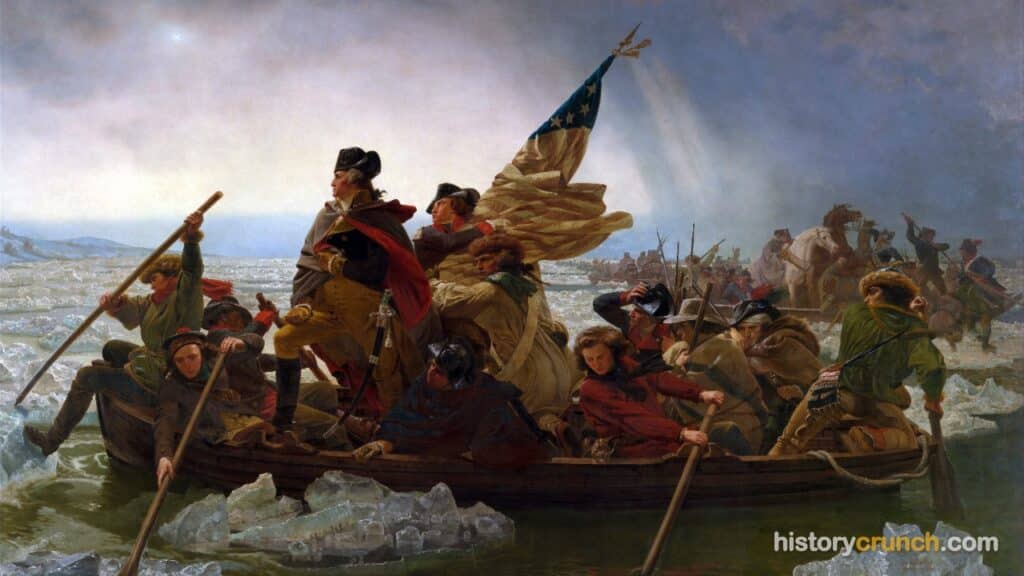
The famous painting titled Washington Crossing the Delaware was created by Emanuel Leutze in 1851, decades after the event, and it is not fully accurate. The boats shown are the wrong type, the flag pictured had not yet been designed in 1776, and the crossing actually happened at night rather than in daylight. Even so, the painting became a powerful and beloved symbol of American courage.
Who else took part in the crossing that later became famous?
Several men who later became important American figures were present during the crossing. Future President James Monroe and future Chief Justice John Marshall both served in the army at the time. Also present were Henry Knox, who managed the artillery, and Colonel John Glover, whose Marblehead sailors steered the boats.
Cite This Article
To cite this article as a source, use one of the formats below.
MLA: Millar, B. “Crossing of the Delaware: A Detailed Summary.” HistoryCrunch, 10 August 2026, https://historycrunch.com/crossing-of-the-delaware/.
APA: Millar, B. (2026). Crossing of the Delaware: A Detailed Summary. HistoryCrunch. https://historycrunch.com/crossing-of-the-delaware/
Chicago: Millar, B. “Crossing of the Delaware: A Detailed Summary.” HistoryCrunch. August 10, 2026. https://historycrunch.com/crossing-of-the-delaware/
Sources
- J.M. Roberts & Odd Arne Westad, The Penguin History of the World.
- Jerry Bentley & Herbert Ziegler, Traditions & Encounters: A Global Perspective on the Past.