The Praetorian Guard was one of the most powerful and feared military units in the history of Ancient Rome. Created to protect the emperor, the Guard grew into a force that could make or break the men it was supposed to serve. Over roughly three centuries, its members guarded, advised, and in many cases murdered the rulers of the Roman Empire, giving the Guard a reputation for intrigue and betrayal that has lasted to the present day.
The Praetorian Guard was an elite corps of Roman soldiers first organized as the personal bodyguard of the emperor. Stationed in and around the city of Rome, its members were responsible for protecting the imperial household, keeping order in the capital, and backing up the authority of the emperor. In time, though, the Guard became far more than a group of bodyguards, and it used its closeness to power to shape Roman politics in dramatic ways.
What Was the Roman Empire?
To understand the Praetorian Guard, it helps to understand the time period it belonged to. Ancient Rome is generally divided into three periods of history, which included the Roman Kingdom, the Roman Republic, and the Roman Empire. The Roman Empire lasted from 27 BCE until 476 CE, and it was governed by an autocracy, which means that the government was made up of a single person. In Rome, this person was the emperor.
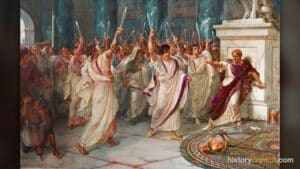
The empire grew out of a long period of unrest and civil war that brought the earlier Roman Republic to an end. In 49 BCE, Julius Caesar‘s rise to power marked the end of the Republic’s political balance, and after his assassination in 44 BCE, his adopted heir, Augustus, emerged as the sole ruler of Rome. Augustus became the first Roman emperor, and it was during his reign that the Praetorian Guard was born.
The empire itself was enormous. Roman civilization is remembered for its contributions to law, government, architecture, language, and culture. It began as a small city-state on the Italian peninsula and grew over many centuries into a vast empire that stretched from Britain in the northwest to Egypt in the southeast. At its height, the Roman Empire controlled much of Europe, North Africa, and parts of the Middle East. Ruling such a huge territory required a strong emperor, and a strong emperor needed loyal soldiers close at hand.
Where Did the Praetorian Guard Come From?
The roots of the Praetorian Guard reach back to the earlier period of the Roman Republic. The origins of the Guard were rooted in a practice common to the armies formed by Republican Rome, and beginning in the third century BCE, Roman military commanders created a small body of soldiers to act as their bodyguards. These units traveled with a general on campaign and protected him in the field.
The name of the Guard came from the way a Roman army camp was set up. At camp, the cohors praetoria, a cohort of praetorians guarding the commander, was posted near the praetorium, the tent of the commander. A cohort was a standard unit of the Roman army, so a “praetorian cohort” simply meant the group of soldiers who guarded the leader’s tent. Such units first appeared in the armies raised by the Scipio family in 275 BCE, and during the siege of Numantia, which ended in 133 BCE, Scipio Aemilianus formed a bodyguard of about 500 men, roughly the size of a normal Roman cohort.
The Guard as it is remembered today, however, did not appear until Augustus came to power. Rome’s first emperor Augustus went a step further and, in 27 BCE, created a permanent bodyguard of nine cohorts totaling at least 4,500 men to protect himself and the royal family, the Praetorian Guard. For the first time, this was a standing unit whose main job was to protect one ruler and his family, rather than a temporary group raised for a single campaign.
How Was the Praetorian Guard Organized?
Augustus was careful about how he placed his new Guard. Initially, Augustus organized the guard into nine cohorts, each of around 500 men, and three were stationed in Rome while the rest were distributed across Italy to avoid the appearance of military occupation within the capital. As stated above, Augustus wanted to hold on to the appearance of the old Republic, so he tried not to make Rome look like a city under armed control.
This changed under the next emperor. In 23 CE, Tiberius relocated the Guard into a permanent base within Rome called the Castra Praetoria, a rectangular fort built just outside the Servian Wall that placed the Guard close to the emperor’s decisions, palace movements, and the Senate’s sessions. Housing the entire Guard together inside a fortress in the capital gave it far greater strength, and it also made the Guard a serious political force.
The size of the Guard changed over time. During the reign of Tiberius, the Guard was expanded to 12 cohorts, and Vitellius expanded it again in 69 CE by adding some of his Rhine army so that the Guard now had sixteen 1,000-man cohorts. Domitian then reduced the number to ten 1,000-man cohorts, each commanded by a tribune. Its most important officer, though, stood above these units.
The highest authority within the Guard was the Praetorian Prefect. In 2 BCE Augustus appointed two Prefects to command the Praetorian Guard, both directly responsible to the emperor, and they were the only men allowed to carry a sword in the emperor’s presence. Over time these Prefects were made members of the emperor’s advisory council and even acquired some judicial, financial, and army logistics functions. The Prefect quickly became one of the most powerful people in Rome, and some Prefects even seized the throne for themselves.
What Privileges Did the Praetorians Enjoy?
Serving in the Praetorian Guard came with real rewards. Prior to 13 BCE, Praetorians served for 12 years while legionaries served 20, and after reforms in 5 CE, Praetorians served for 16 years and legionaries 25 years. A shorter term of service was a major benefit, and it meant a Praetorian could finish his career and pursue other opportunities at a younger age.
Pay was another advantage. The Guards enjoyed over three times the pay given to ordinary legionaries, and their higher status was clearly signaled when Augustus left each member 1,000 sestertii in his will compared to the 300 a legionary received. On top of their regular pay, Praetorians expected special cash gifts from each new emperor. Under Nero, the pay of a Praetorian was three and a half times that of a legionary, augmented by prime additions of donativum granted by each new emperor, and this additional pay was often repeated at important events such as birthdays, births, and marriages.
The Praetorians also looked different from ordinary soldiers. The Praetorians were distinguished by their finer armor and an oval shield, as opposed to the rectangular shield of other legions, and they had their own standard when in battle, probably an eagle and wreath. These special marks made them easy to recognize and added to their prestige as the emperor’s own men.
What Did the Praetorian Guard Actually Do?
The main job of the Guard was to protect the emperor, but its duties reached much further. Its members were tasked with protecting the imperial household, maintaining order in the capital, and supporting the authority of the emperor. In Rome itself, they escorted the emperor through the streets, stood beside him at public games, and acted as a police force during times of riot.
The Guard was also used for tasks beyond simple bodyguard work. The Praetorians were known to engage in espionage, intimidation, arrests, and killings to protect the interests of the Roman emperor, and for secret operations they may have employed a special wing of troops known as speculatores, who served as couriers and intelligence operatives. In this sense they acted like an early secret service, gathering information and dealing with the emperor’s enemies.
Over time, the Guard was also called on to fight. Increasingly, from the 2nd century CE, the Praetorian Guard was used as a useful army reserve, and they often took to the field of battle, aiding their emperor to defend the empire or helping their candidate for emperor achieve his goal. Because Italy was lightly defended compared with the frontier provinces, the Guard was an important reserve force in times of crisis.
Why Was the Praetorian Guard So Dangerous?
The very closeness that made the Guard useful also made it dangerous. Over the years, the Guard became a dangerous threat to imperial power, and emperors were forced to gain its favor in order to ensure their reign. In the 1st and 2nd century CE many an emperor was murdered with Praetorian Guard involvement, and once one of their number, Macrinus, was even declared emperor. The body specifically created to protect the emperor’s person had become his greatest liability.
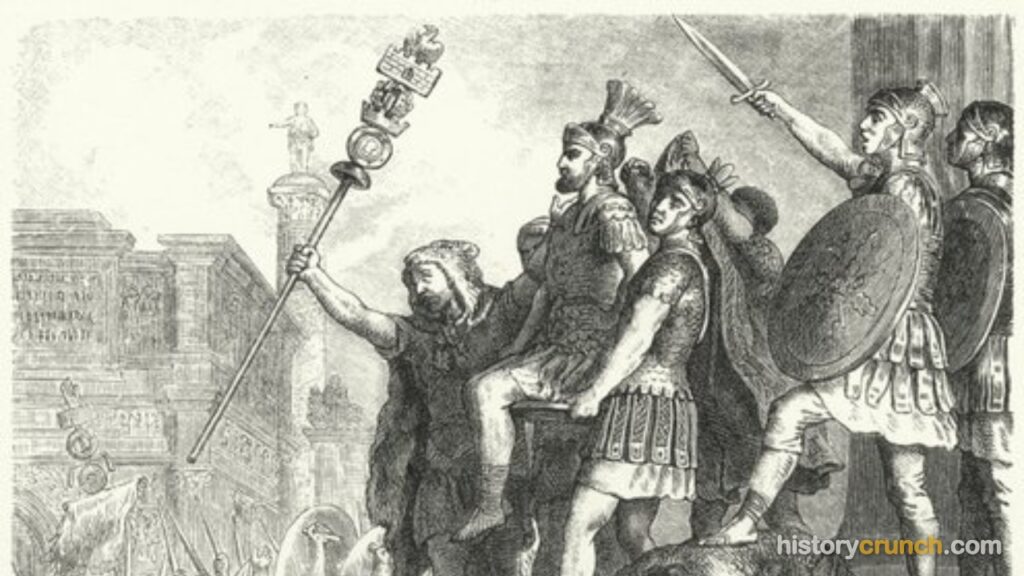
The Guard could both create and destroy rulers. Disgruntled Praetorians famously engineered the assassination of Caligula and the selection of Claudius as his successor in 41 CE. In some cases they turned on the very men they had helped to power. Galba took the throne in 68 CE after winning the support of the Guard, only to be killed at their hands the following year after he neglected to properly reward them.
The list of emperors who died with the Guard’s involvement is long. The Guard or its prefect also played a part in the murder of Commodus in 192, Caracalla in 217, Elagabalus in 222, and Pupienus and Balbinus in 238. This pattern of making, betraying, and killing emperors is exactly why the Guard became a symbol of treachery in Roman history.
How Did the Praetorian Guard End?
The Guard’s long history came to a violent close in the early 4th century CE during a struggle for control of the empire. The Praetorian Guard gave its allegiance to Maxentius and proclaimed him emperor. This set the stage for a showdown with a rival for the throne.
That rival was Constantine I. By 312 CE, Constantine I marched on Rome to eliminate Maxentius, facing off against an army that included the bulk of the Praetorian Guard at the Battle of the Milvian Bridge on the River Tiber. Maxentius’s forces were pushed back against the river, and the weight of soldiers fleeing caused the bridge to collapse, stranding elements of the Guard who were either killed or taken prisoner. In the end, the Praetorian Guard was dissolved by Emperor Constantine I in the early 4th century.
Significance of Praetorian Guard
The Praetorian Guard is significant because it shows how a force built to protect power could end up controlling it. Over time, the Praetorian Guard became far more than a protective force, as their proximity to power allowed them to exert enormous political influence, and they developed a reputation for making and unmaking Roman emperors, sometimes through violence, coercion, or outright assassination. For over three centuries, the Praetorians stood at the center of imperial power, feared as much for their political interference as respected for their elite status.
The Guard also reveals a deeper weakness in how the Roman Empire was ruled. Because the emperor held nearly all authority in his own person, whoever controlled the soldiers closest to him could shape the future of the entire empire. In reality, the Guard’s power grew because it had no real check on it. Its legal protection set it apart, as Guards operated within the city without control by provincial governors or military tribunals, and they arrested senators, executed rivals, and enforced imperial decrees without challenge.
For these reasons, the story of the Praetorian Guard remains one of the most famous examples in history of a bodyguard becoming a threat to the very ruler it served. Its rise and fall helped define the unstable politics of the Roman Empire, and its name has come to stand for the idea that those trusted with protecting power can be tempted to seize it for themselves.
Frequently Asked Questions
Who created the Praetorian Guard?
The Praetorian Guard was created by Augustus, the first emperor of Rome, in 27 BCE. Augustus had learned during years of civil war how valuable it was to have soldiers loyal to a person rather than to an office, and he built the Guard as a permanent unit to protect himself and the imperial family. Similar bodyguard units had existed earlier under Republican generals, but Augustus was the first to make the Guard a lasting institution.
How many soldiers were in the Praetorian Guard?
The Guard began with about 4,500 men, organized into nine cohorts of roughly 500 soldiers each. The number changed many times over the Guard’s history, growing to twelve and even sixteen cohorts under some emperors before being reduced again. At certain points, individual cohorts were expanded to about 1,000 men each, which greatly increased the total size of the Guard.
Where was the Praetorian Guard stationed in Rome?
The Guard was housed in a fortress called the Castra Praetoria, built inside Rome in 23 CE under the emperor Tiberius. Before this, Augustus had deliberately spread the Guard across Italy so that Rome would not look like a city under military occupation. Gathering the whole Guard into one fort near the heart of the capital made it far more powerful and placed it close to the emperor and the Senate.
Why were the Praetorian Guard so feared?
The Praetorian Guard was feared because it had the ability to remove and even kill emperors it no longer supported. Since the Guard was stationed in the capital and had direct access to the ruler, it could quietly plot against an emperor or openly demand rewards in exchange for loyalty. Many rulers spent large sums of money simply to keep the Guard satisfied and avoid becoming its next victim.
When was the Praetorian Guard disbanded?
The Praetorian Guard was disbanded by the emperor Constantine I in the early 4th century CE. The Guard had backed his rival Maxentius, and after Constantine defeated Maxentius at the Battle of the Milvian Bridge in 312 CE, he ended the unit for good. This brought a close to more than three centuries of Praetorian power in Rome.
Cite This Article
To cite this article as a source, use one of the formats below.
MLA: Millar, B. “Praetorian Guard: A Detailed Summary.” HistoryCrunch, 7 July 2026, https://historycrunch.com/praetorian-guard/.
APA: Millar, B. (2026). Praetorian Guard: A Detailed Summary. HistoryCrunch. https://historycrunch.com/praetorian-guard/
Chicago: Millar, B. “Praetorian Guard: A Detailed Summary.” HistoryCrunch. July 7, 2026. https://historycrunch.com/praetorian-guard/
Sources
- J.M. Roberts & Odd Arne Westad, The Penguin History of the World.
- Jerry Bentley & Herbert Ziegler, Traditions & Encounters: A Global Perspective on the Past.