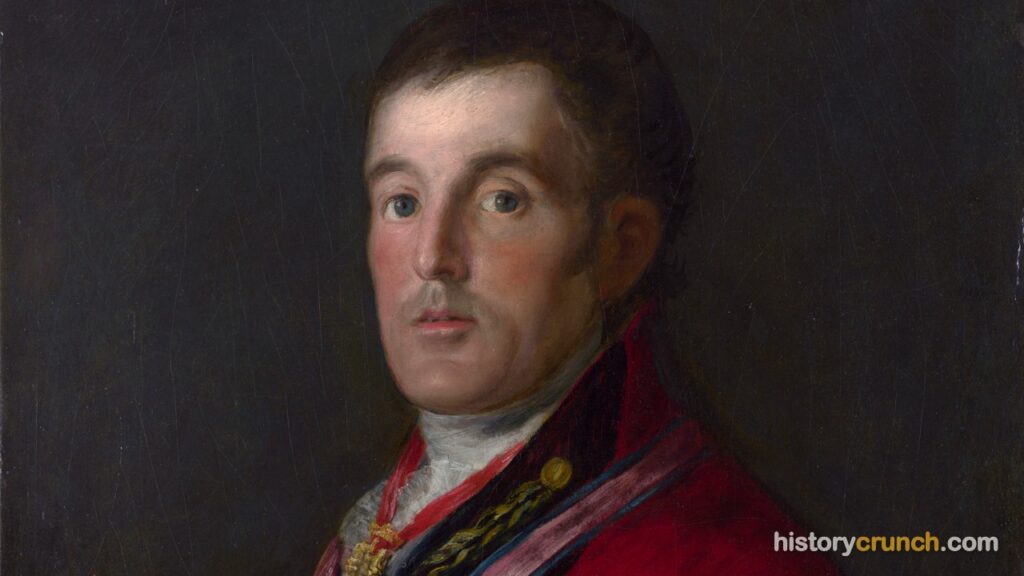
Arthur Wellesley, the 1st Duke of Wellington, was one of the most important military and political figures in British history, and he is best remembered for defeating Napoleon Bonaparte at the Battle of Waterloo in 1815. Over a long career, he rose from a young officer in an aristocratic family to become a celebrated general, a national hero, and twice the Prime Minister of Britain. His life stretched across the Napoleonic Era, a period of French and European history dominated by Napoleon that lasted from 1799 to 1815, and his victories helped bring that era to a close.
The title “Duke of Wellington” is a hereditary peerage in Britain, meaning it is a rank of nobility that passes down through a family. It was created in 1814 to reward Arthur Wellesley for his services against France, and the name comes from the town of Wellington in the county of Somerset in England. Because he was the first and by far the most famous holder of the title, the name “Duke of Wellington” almost always refers to Arthur Wellesley himself.
Early Life and Background
Arthur Wellesley was born on May 1st, 1769, in Dublin, Ireland, into a wealthy Anglo-Irish family. The Anglo-Irish were a class of Protestant landowners of English descent who held much of the wealth and power in Ireland at the time. His father, Garret Wesley, held the title of Earl of Mornington, and Arthur was one of several children in the household.
As a boy, Arthur was educated in Ireland and then sent to Eton, a famous boarding school in England. His father died in 1781, when Arthur was only twelve, which left the family in difficult financial circumstances. His mother later withdrew him from Eton, and he continued his education in Belgium and France, where he attended a military academy and learned to speak French, a skill that would serve him well in his later career.
Arthur was not seen as a promising young man in his early years, and he showed little interest in a scholarly life. In 1787, at the age of eighteen, he was commissioned as an officer in the British Army. In the years that followed, he purchased and earned a series of promotions, and he also served for a time as a member of the Irish Parliament, beginning a lifelong involvement in politics alongside his military duties.
Rise to Power
Wellesley’s reputation as a soldier grew rapidly during his service in India in the late 1790s and early 1800s. There he commanded troops in several campaigns and won an important victory at the Battle of Assaye in 1803. In fact, his experiences in India taught him lessons about supply, discipline, and careful planning that would shape the way he fought for the rest of his life.
His greatest opportunity came with the Peninsular War, a conflict fought from 1808 to 1814 in which Spain, Portugal, and Britain resisted Napoleon’s occupation of the Iberian Peninsula. When Napoleon forced the Spanish royal family to give up their throne and placed his own brother Joseph in power, the peoples of Spain and Portugal rose in revolt. Britain sent an army to support them, and Wellesley was among the commanders who landed in Portugal in 1808.
The British and their Portuguese and Spanish allies fought a long and grinding campaign against French forces across the Iberian Peninsula for six years. Wellesley proved to be a highly capable commander who combined defensive skill with the ability to strike decisively when the chance arose. His victories at battles such as Salamanca in 1812 and Vitoria in 1813 gradually wore down French strength in the region and eventually drove Napoleon’s armies out of Spain entirely.
As his fame grew, so did his honors and titles. He was made a viscount, then an earl, then a marquess, and finally, in 1814, he was raised to the highest rank of the British nobility as the Duke of Wellington. Along with these titles, Parliament granted him large sums of money in recognition of his achievements, and he used part of this reward to buy a country estate in England.
Major Achievements
The achievement for which Wellington is most famous came in 1815 at the Battle of Waterloo. After Napoleon was first defeated and exiled to the island of Elba in 1814, he escaped and returned to France in 1815, quickly regaining power in a dramatic period known as the Hundred Days. The nations of Europe united once more to oppose him, and Wellington was placed in command of a large allied army.
The Battle of Waterloo was fought on June 18th, 1815, near the village of Waterloo, about 12 miles (19 km) south of Brussels in what is now Belgium. It pitted Napoleon’s French army of roughly 72,000 men against a British-led allied force of around 68,000 under the Duke of Wellington. Later in the day, three corps of the Prussian army under Field Marshal Blucher arrived to reinforce Wellington’s exhausted troops.
Wellington was known above all for his skill in defensive warfare, and at Waterloo he placed his troops along a ridge and held his position against repeated French assaults throughout the day. In reality, the outcome hung in the balance for hours, but the timely arrival of the Prussians and the failure of a final charge by the French Imperial Guard turned the battle into a decisive allied victory. Napoleon’s army was routed and collapsed in disorder by the evening, suffering enormous casualties.
The victory at Waterloo ended the Napoleonic Wars, which had produced more than two decades of recurrent conflict across Europe. Napoleon abdicated four days later, on June 22nd, 1815, and was exiled to the remote island of Saint Helena in the South Atlantic, where he died in 1821. For his part in the triumph, Wellington was celebrated across Britain and Europe as the hero of Waterloo, a reputation that would follow him for the rest of his life. More information on the battle can be found in the HistoryCrunch article on the Battle of Waterloo.
Later Life and Political Career
After Waterloo, Wellington turned increasingly from the battlefield to politics. He took part in the Congress of Vienna, the great meeting of European powers that redrew the map of the continent and worked to secure a lasting peace after the wars. As one of the most respected men in Britain, he joined the government and held a series of important offices during the 1820s.
In 1828, Wellington became Prime Minister of Britain as a member of the Tory Party, the conservative party of the day. His time in office was marked by difficult political struggles, especially over demands for reform. Although he personally disagreed with the idea, he came to support Catholic Emancipation in 1829, a law that granted Roman Catholics important civil rights they had long been denied, including the right to sit in Parliament.
Wellington was far more resistant to changing the way Parliament itself was elected. His firm opposition to reform of the voting system made him unpopular with many people and helped bring down his government in 1830. He served briefly as Prime Minister again in 1834, and he remained an influential figure in the House of Lords and in public life for years afterward.
In his final years, Wellington continued to serve as commander-in-chief of the British Army, a position he held until near the end of his life. He was often stubborn about military change, but he remained a revered symbol of duty and steadiness to the British public. He earned the nickname the “Iron Duke,” a name that reflected both his firmness in politics and his reputation for discipline.
Wellington died on September 14th, 1852, at the age of 83, at Walmer Castle in the county of Kent. He was honored with a grand state funeral, one of the largest ever held in Britain, and he was laid to rest in the crypt of St. Paul’s Cathedral in London, near the tomb of the naval hero Lord Nelson. His death was mourned across the nation as the passing of the man widely seen as the greatest hero of his age.
Significance of Duke of Wellington
The Duke of Wellington was one of the leading military and political figures of nineteenth-century Britain, and his career left a lasting mark on both European history and British society. Above all, his victory over Napoleon at Waterloo helped bring an end to more than twenty years of warfare and settled permanently the question of whether Napoleon could rebuild his empire. That triumph reshaped the balance of power in Europe and ushered in a long period of relative peace among the great nations.
As a general, Wellington was renowned for his careful defensive tactics and his talent for choosing strong positions and holding them under pressure. His battle plans and campaigns have been studied in military schools ever since, and his success in the Peninsular War showed that Napoleon’s armies could be beaten by patience and skill. In this way, he stands among the most influential commanders in modern military history.
Wellington’s importance was not limited to the battlefield. As a two-time Prime Minister, he shaped major decisions of his era, including the granting of civil rights to Catholics, even when doing so went against his own beliefs. More broadly, he came to represent an ideal of the honest and dependable public servant, and his fame ensured that his name was attached to streets, monuments, and even everyday objects such as the Wellington boot, keeping his memory alive long after his death.
Frequently Asked Questions
What was the Duke of Wellington’s real name?
The Duke of Wellington’s real name was Arthur Wellesley. He was born into the Wellesley family in Dublin, and he only became known as the Duke of Wellington in 1814, when he was granted the title as a reward for his military service. Before that, he had already earned the lesser titles of viscount, earl, and marquess.
Why was the Duke of Wellington called the Iron Duke?
The Duke of Wellington was called the “Iron Duke” because of his firm and unbending character in both war and politics. The nickname also became linked to a time when angry crowds threw stones at his London home over his opposition to reform, and he had iron shutters fitted to protect the windows. The name captured his reputation for toughness and steadiness under pressure.
Did the Duke of Wellington ever meet Napoleon?
No, the Duke of Wellington and Napoleon never actually met in person, even though they were the most famous rivals of their age. They faced each other directly on the battlefield only once, at Waterloo, but they commanded their armies from separate positions and never spoke. Wellington did, however, come to own several items connected to Napoleon after the war.
How did the Duke of Wellington become Prime Minister?
The Duke of Wellington became Prime Minister in 1828 as the leader of the Tory Party, drawing on the huge respect he had earned as a war hero. His national fame and his standing in the House of Lords made him a natural choice to lead the government during a period of political tension. He served two separate terms as Prime Minister during his political career.
Where is the Duke of Wellington buried?
The Duke of Wellington is buried in the crypt of St. Paul’s Cathedral in London. He was given an enormous state funeral in 1852 that drew huge crowds, reflecting how deeply the nation admired him. His tomb lies close to that of Lord Nelson, another great British hero of the wars against France.
Cite This Article
To cite this article as a source, use one of the formats below.
MLA: Millar, B. “Duke of Wellington: A Detailed Biography.” HistoryCrunch, 11 August 2026, https://historycrunch.com/duke-of-wellington/.
APA: Millar, B. (2026). Duke of Wellington: A Detailed Biography. HistoryCrunch. https://historycrunch.com/duke-of-wellington/
Chicago: Millar, B. “Duke of Wellington: A Detailed Biography.” HistoryCrunch. August 11, 2026. https://historycrunch.com/duke-of-wellington/
Sources
- J.M. Roberts & Odd Arne Westad, The Penguin History of the World.
- Jerry Bentley & Herbert Ziegler, Traditions & Encounters: A Global Perspective on the Past.