The Fall of Constantinople took place on May 29th, 1453, when the Ottoman army under Sultan Mehmed II captured the city of Constantinople after a 53-day siege. The fall of the city brought an end to the Byzantine Empire, which had lasted for over one thousand years as the eastern half of the Roman Empire. It is one of the most significant events in the history of the Middle Ages and is widely considered by historians to mark the end of the medieval period and the beginning of the modern era.
What Was Constantinople?
Constantinople was the capital city of the Byzantine Empire, also known as the Eastern Roman Empire. It was founded in 330 CE by the Roman Emperor Constantine I, who moved the capital of the Roman Empire from Rome to the ancient Greek city of Byzantium and renamed it after himself. The city was located on a narrow strip of land between Europe and Asia, sitting at the crossroads of major trade routes between the Black Sea and the Mediterranean Sea. For instance, this location made Constantinople one of the wealthiest and most important trading cities in the world for much of the Middle Ages. In fact, the routes of the Silk Road travelled through Constantinople, meaning it was an important trading hub. The city was also protected by a remarkable set of defensive walls known as the Theodosian WallsMassive defensive walls built in the 5th century CE that protected Constantinople for roughly one thousand years., built in the 5th century CE, which had successfully defended the city against countless sieges and attacks over the previous one thousand years.
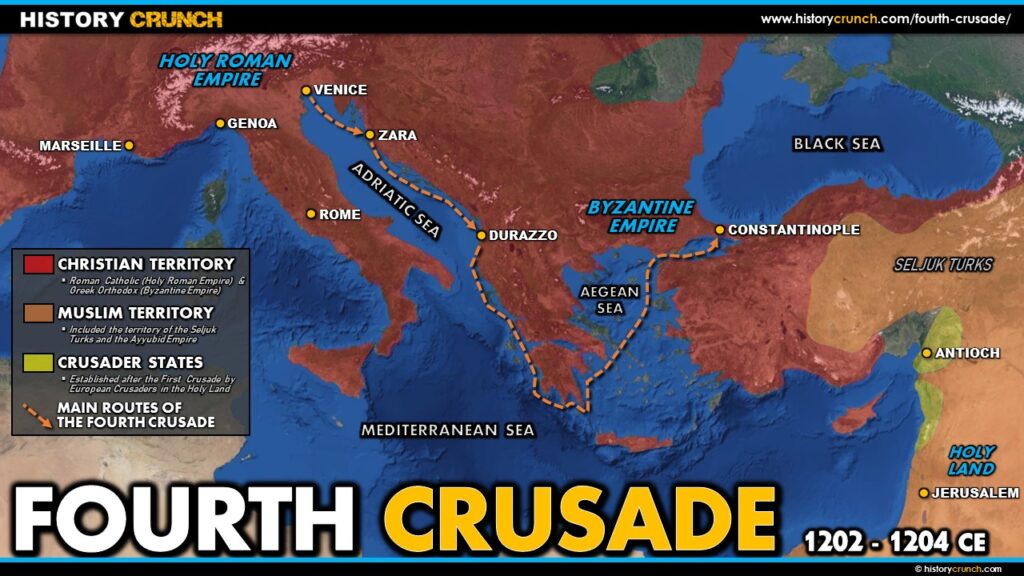
By the middle of the 15th century, however, Constantinople was a shadow of what it had once been. The city’s population had fallen dramatically, from approximately 400,000 people in the 12th century to between 40,000 and 50,000 people by the 1450s. Large areas within the city walls had been abandoned and the once great Byzantine EmpireThe eastern half of the Roman Empire, based in Constantinople, that lasted over one thousand years until 1453. had shrunk to little more than the city itself and a small amount of surrounding land. The Black Death had killed almost half of the city’s population between 1346 and 1349, and the damage caused by the Fourth Crusade in 1204, when western Crusaders had sacked the city, had never been fully repaired. As such, by the time of the Ottoman siege in 1453, the city was heavily weakened and its defenders were vastly outnumbered.
European kingdoms sent large armies to rescue Constantinople during the Ottoman siege of 1453.

Rise of the Ottoman Empire
To understand the Fall of Constantinople, it is important to understand the rise of the Ottoman Empire in the century before the siege. The Ottoman Turks were a Muslim people who had built a powerful empire based in what is now Turkey and had been expanding their territory steadily throughout the 14th and 15th centuries. Over several decades, the Ottomans had conquered much of the Balkans and most of the surrounding region, capturing Byzantine cities one by one until Constantinople itself was the only significant territory remaining under Byzantine control. For example, the important city of Thessaloniki fell to the Ottomans in 1387, and the Ottoman victory at the Battle of Kosovo in 1389 effectively ended Serbian power in the region and opened the door to further expansion westward.
When Sultan Mehmed II came to power in 1451 at the age of nineteen, many people in Europe assumed that the young ruler would not be a serious threat. With that said, Mehmed had grand ambitions and viewed the capture of Constantinople as one of the most important goals of his reign. He began preparing for the siege almost immediately after taking power. As well, Mehmed commissioned the construction of a powerful new fortress called the Rumelihisarı on the European side of the BosporusA narrow strait of water between Europe and Asia that Mehmed II controlled by building the Rumelihisarı fortress beside it. strait in 1452, which allowed him to control the passage of ships through the waterway and cut off Constantinople from receiving supplies by sea. Mehmed also employed a Hungarian engineer named Urban to design and build a series of massive cannons specifically intended to break through the famous walls of Constantinople. The largest of these cannons was approximately 30 feet (9 metres) long and could fire a stone ball weighing around 1,100 pounds (500 kilograms) over a distance of more than half a mile (1 kilometre).
 FactsthatCrunch
Urban's giant cannons gave the Ottoman army a way to crack the famous Theodosian Walls of Constantinople, walls that had held off attackers for roughly one thousand years.
Siege of Constantinople
The Ottoman army arrived outside the walls of Constantinople on April 2nd, 1453, and the siege officially began on April 6th, 1453. The Byzantine Emperor Constantine XI Palaiologos led the defence of the city with approximately 7,000 soldiers, including around 2,000 soldiers sent from the Italian city-states of Venice and Genoa. This was a desperately small force compared to the Ottoman army, which modern historians estimate numbered between 60,000 and 80,000 men, along with a large fleet of ships that blockadedWhen a military force surrounds a place by sea to stop supplies and people from getting in or out. the city from the sea.
Constantine XI had appealed to the Christian kingdoms of Europe for help, but very little assistance arrived in time. Hungary refused to send forces, and the Pope in Rome used the crisis as an opportunity to push for the reunification of the Eastern Orthodox and Roman Catholic churches rather than sending immediate military support. Venice sent 800 soldiers and 15 ships, and Genoa sent 700 soldiers under the command of the experienced military commander Giovanni Giustiniani, who arrived in January of 1453 and was placed in charge of the defence of the land walls. With that said, the bulk of any promised help arrived too late or not at all.
For 53 days, the Ottoman cannons pounded the walls of Constantinople relentlessly, while the defenders worked through the night to repair the damage as best they could. The Ottomans also attempted to move their ships into the Golden HornThe harbor on the northern side of Constantinople that the Byzantines tried to protect with a large defensive chain., the harbor on the northern side of the city, but were blocked by a large defensive chain the Byzantines had stretched across the harbor entrance. Mehmed overcame this obstacle by ordering his sailors to drag approximately 70 ships overland using logs and grease, hauling them around the chain and lowering them into the harbor from the other side. This bold move allowed the Ottomans to attack the city from the water as well as the land, placing enormous additional pressure on the exhausted defenders.
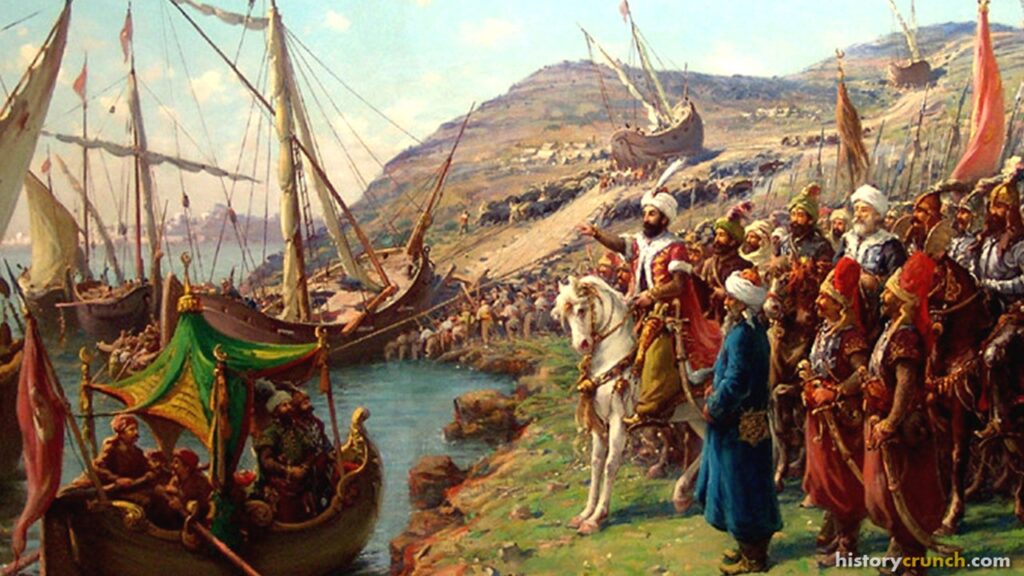
How many Ottoman ships were dragged overland to bypass the Golden Horn chain during the Fall of Constantinople?
Fall of the City
By the night of May 28th, 1453, it was clear to the defenders that the end was near. Emperor Constantine XI gathered his soldiers and allies for a final ceremony at the Hagia Sophia, the great church of the Byzantine Empire. Early in the morning of May 29th, 1453, Mehmed launched his final assault. Wave after wave of Ottoman soldiers attacked the walls, and after hours of fierce fighting, the walls were finally breached. Giovanni Giustiniani was seriously wounded during the fighting and had to be carried from the walls, which badly damaged the morale of the defenders at a critical moment. Shortly afterward, Ottoman forces broke through the walls and flooded into the city.
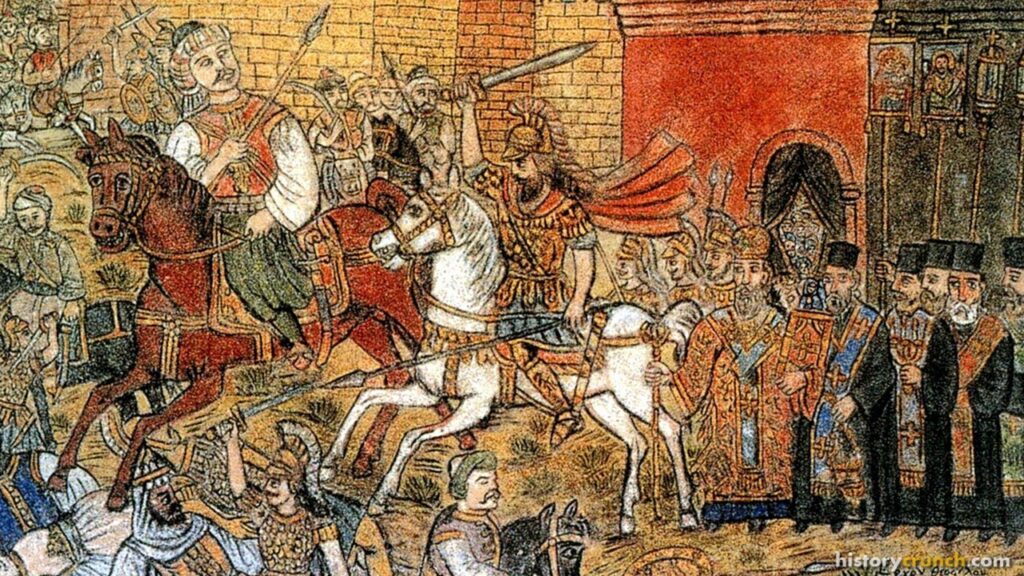
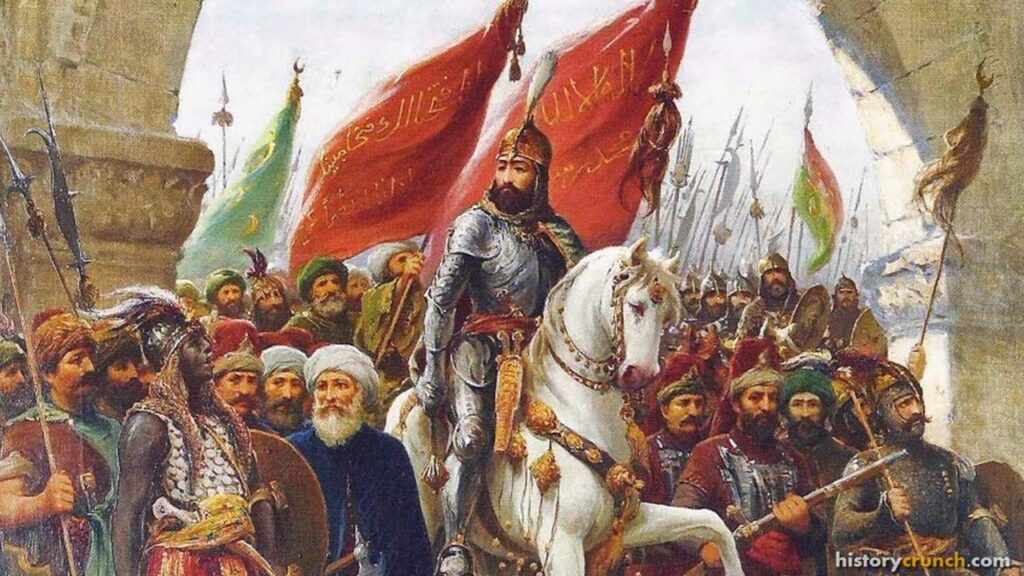
Emperor Constantine XI refused to flee or surrender. According to accounts of the battle, he removed his imperial robes and threw himself into hand-to-hand combat alongside his soldiers as the Ottomans entered the city. He was never seen again after that moment, and most historians believe he died fighting in the final defense of the city. By the morning of May 29th, 1453, Constantinople had fallen. Sultan Mehmed II entered the city later that day and made his way to the Hagia Sophia, which was converted into a mosque. The city was renamed Istanbul and became the new capital of the Ottoman Empire.
FactsthatCrunchConstantine XI died fighting as Ottoman forces broke through the walls of Constantinople
Significance of the Fall of Constantinople
The Fall of Constantinople had enormous consequences for both Europe and the wider world. For the Byzantine Empire, it meant the end of over one thousand years of history stretching all the way back to the Roman Empire of ancient times. For the Ottoman Empire, the capture of the city marked the beginning of a new period of power and expansion, and Istanbul remained the capital of the Ottoman Empire for the next four and a half centuries until the empire itself collapsed after World War I.
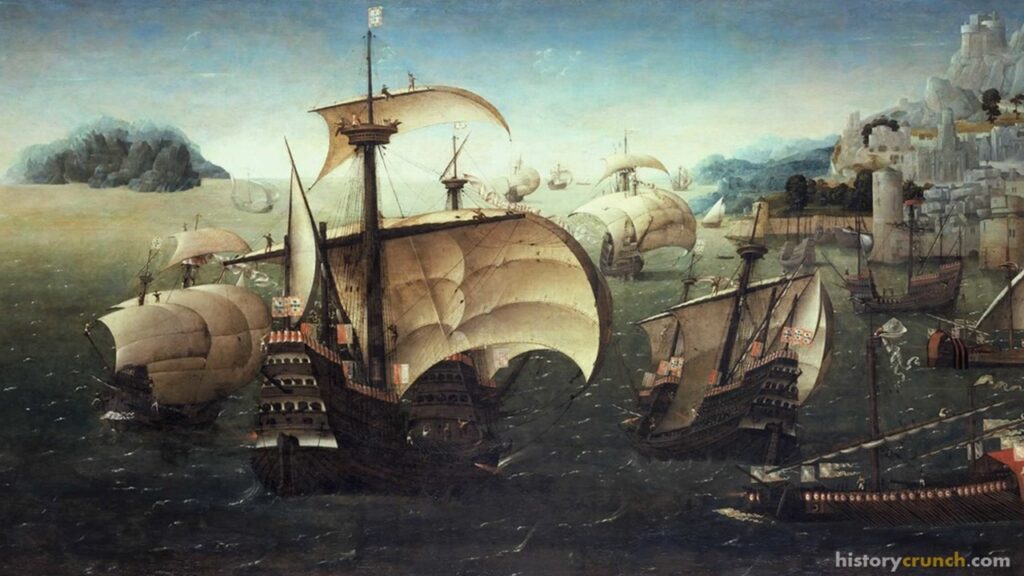
For Europe, the fall of the city had several major effects. As well, many Byzantine scholars and intellectuals fled westward to Italy, bringing with them ancient Greek manuscripts and a tradition of learning that helped fuel the intellectual movement of the Renaissance. For instance, historians have pointed to this influx of Byzantine knowledge as an important contribution to the revival of classical learning that took place in Italy during the 15th and 16th centuries. As well, the Ottoman control of Constantinople gave the empire control over important overland trade routes between Europe and Asia. This made it more difficult and expensive for European merchants to trade with the East, which was one of the factors that encouraged European powers to begin searching for new sea routes to Asia. In this way, the Fall of Constantinople contributed to the beginning of the Age of Exploration.
In general, historians consider the Fall of Constantinople on May 29th, 1453, to be one of the most important events in world history. It marked the end of the Byzantine Empire, the end of the Middle Ages, and the beginning of a new era in which the Ottoman Empire dominated much of the eastern world while European powers began to look outward across the oceans. As stated above, the effects of this single event rippled outward for centuries and continue to be studied and discussed by historians to this day.
 FactsthatCrunch
Follow the chain from top to bottom. Tap any step to read what happened.
Explore Middle Ages · 476 – 1500 CE
Keep exploring Middle Ages with these History Crunch resources.
Key Vocabulary
Byzantine Empire
Theodosian Walls
Bosporus
Blockaded
Golden Horn
Renaissance
Age of Exploration
Frequently Asked Questions
When did the Fall of Constantinople happen?
Constantinople fell on May 29th, 1453, after a siege that lasted 53 days. The siege itself began on April 6th, 1453, when the Ottoman army attacked the city walls. The Ottoman forces were led by Sultan Mehmed II, who was only in his early twenties at the time.
Why did Constantinople fall to the Ottomans?
Constantinople fell because its defenders were badly outnumbered and the Ottomans used powerful new cannons. About 7,000 defenders faced an Ottoman army of 60,000 to 80,000 men. The city was also weakened after centuries of plague, past attacks, and a shrinking population.
How did the Ottomans get past the Theodosian Walls?
The Ottomans used massive cannons to smash the famous walls over many days. The largest cannon was about 30 feet (9 meters) long and could fire a huge stone ball more than half a mile (1 kilometer). The walls had protected the city for a thousand years before this.
What happened to Emperor Constantine XI?
Constantine XI refused to flee or surrender and chose to fight to the end. Accounts say he threw off his imperial robes and joined the fighting as the Ottomans broke in. He was never seen again, and most historians believe he died defending the city.
Why was the Fall of Constantinople so important?
The fall ended the Byzantine Empire after more than a thousand years of history. Many historians treat it as the end of the Middle Ages and the start of the modern era. Fleeing scholars helped spark the Renaissance, and blocked trade routes pushed Europe toward the Age of Exploration.
What is Constantinople called today?
Constantinople was renamed Istanbul and became the new capital of the Ottoman Empire. The great church of Hagia Sophia was turned into a mosque after the city fell. Istanbul stayed the Ottoman capital for about four and a half centuries, until the empire collapsed after World War I.
Cite This Article
To cite this article as a source, use one of the formats below.
MLA: Millar, B. “Fall of Constantinople: A Detailed Summary.” HistoryCrunch, 15 October 2026, https://historycrunch.com/fall-of-constantinople/.
APA: Millar, B. (2026). Fall of Constantinople: A Detailed Summary. HistoryCrunch. https://historycrunch.com/fall-of-constantinople/
Chicago: Millar, B. “Fall of Constantinople: A Detailed Summary.” HistoryCrunch. October 15, 2026. https://historycrunch.com/fall-of-constantinople/
Sources
- Barbara Rosenwein, A Short History of the Middle Ages.
- Jacques Le Goff, Medieval Civilization 400-1500.
- Chris Wickham, Medieval Europe.
- Fordham Medieval Sourcebook