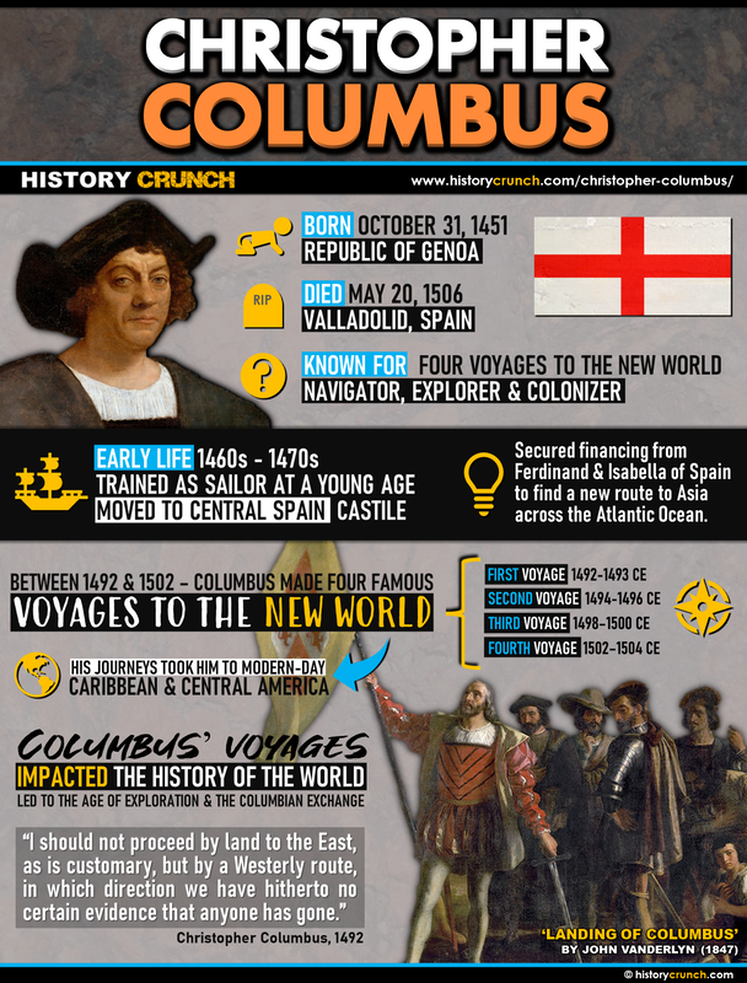
Christopher Columbus was one of the most significant and controversial figures in all of world history. An Italian-born explorer sailing under the Spanish flag, Columbus carried out four voyages to the New World between 1492 and 1503, making contact between Europe and the Americas for the first time and setting in motion events that permanently changed the history of the world. He is celebrated by some for his extraordinary achievements as an explorer and condemned by others for the violence and exploitation that his voyages brought to the indigenous peoples of the Americas. This infographic was designed for students to visually summarize the key aspects of Christopher Columbus’s life and significance and is based on the History Crunch article titled Christopher Columbus.
Christopher Columbus – Infographic
About This Infographic
This Christopher Columbus infographic was created by the History Crunch team to help students and teachers quickly understand the life and significance of one of the most important and debated figures of the Age of Exploration. It is designed as a visual learning and study tool, summarizing the essential information covered in our full article on Christopher Columbus. Teachers may use it as a classroom display, a discussion prompt, or a study aid for students preparing for assessments.
What This Infographic Covers
The infographic begins with Columbus’s background and motivations. Born in Genoa, Italy around 1451, Columbus grew up during the Age of Exploration when European nations were competing to find new trade routes to Asia. He developed a plan to reach Asia by sailing westward across the Atlantic rather than eastward around Africa. He believed the Earth was smaller than it actually is, which led him to underestimate the distance involved. After years of seeking funding, he convinced the Spanish monarchs Ferdinand and Isabella to finance his voyage in 1492.
The infographic covers all four of Columbus’s voyages to the New World. The first voyage in 1492 saw him sail with three ships, the Nina, the Pinta and the Santa Maria, arriving in the Caribbean on October 12th, 1492 and making contact with indigenous peoples including the Lucayan, Taino and Arawak. The second voyage in 1493 was far larger in scale with 17 ships and approximately 1,200 settlers, and marked the beginning of the Columbian Exchange as Columbus brought seeds, plants and livestock to the New World for the first time. The third voyage in 1498 took a more southerly route and resulted in Columbus becoming the first European to make contact with the South American mainland at the Paria Peninsula in modern-day Venezuela. The fourth and final voyage in 1502 saw Columbus explore the Central American coastline including Honduras, Nicaragua, Costa Rica and Panama before his ships became wrecked and he was stranded on Jamaica for over a year.
The infographic also covers the Columbian Exchange, which is considered one of the most important consequences of Columbus’s voyages. The exchange of plants, animals and diseases between the Old World and the New World that began with Columbus’s second voyage in 1493 fundamentally altered both hemispheres. European crops and livestock transformed agriculture in the Americas while American crops such as potatoes, corn and tomatoes changed diets across Europe, Africa and Asia. The spread of European diseases to which indigenous peoples had no immunity was catastrophic, with some estimates suggesting that up to 90 percent of the indigenous population of the Americas died as a result.
Finally the infographic covers the controversy surrounding Columbus’s legacy. While Columbus opened the Americas to European exploration and his voyages were extraordinary achievements of navigation, they also led directly to the enslavement and brutal treatment of indigenous peoples, the depopulation of entire communities and centuries of European colonization. Columbus himself was arrested and returned to Spain in chains at the end of his third voyage following reports of his tyrannical rule over settlers and indigenous peoples alike. His legacy remains deeply debated today.
How to Use This Infographic in the Classroom
This infographic works well as a visual introduction to Christopher Columbus before students read the full biography article or the individual voyage articles. It can also be used as a review tool before an assessment, or as a discussion prompt asking students to evaluate Columbus as a historical figure and consider whether he should be celebrated or condemned for his role in history. Teachers may use it alongside the individual voyage maps and the Columbian Exchange map to give students both a biographical overview and a geographic understanding of the impact of Columbus’s journeys.
Related Articles
To learn more about the topics covered in this infographic, visit the following History Crunch articles:
- Christopher Columbus
- Christopher Columbus First Voyage
- Christopher Columbus Second Voyage
- Christopher Columbus Third Voyage
- Christopher Columbus Fourth Voyage
- Columbian Exchange
- Age of Exploration Overview
- Impacts of the Age of Exploration
- Should Christopher Columbus Be Celebrated?
- Christopher Columbus Legacy