James Watt was one of the most important inventors of the Industrial Revolution. A Scottish inventor and engineer, Watt is best remembered for his significant improvements to the steam engine in the 1760s, transforming it from a limited mining tool into a powerful source of energy that could drive factories, locomotives and ships. His work helped accelerate the Industrial Revolution and laid the foundation for the age of steam power. This infographic was designed for students to visually summarize the key aspects of James Watt’s life and significance and is based on the History Crunch article titled James Watt.
James Watt – Infographic
About This Infographic
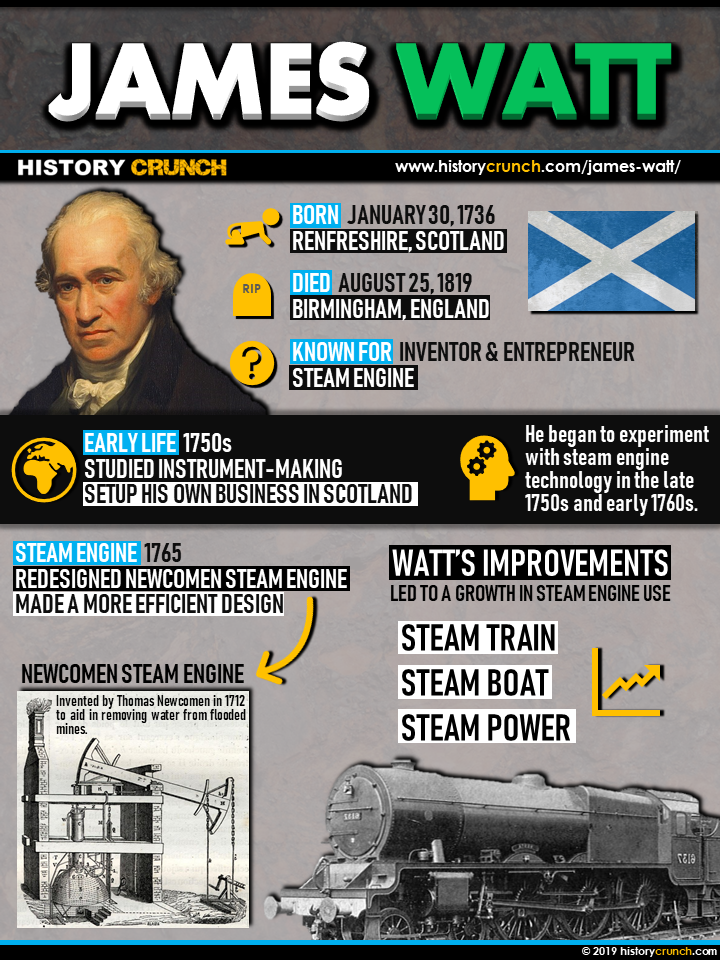
This James Watt infographic was created by the History Crunch team to help students and teachers quickly understand the life and significance of one of the most important inventors of the Industrial Revolution. It is designed as a visual learning and study tool, summarizing the essential information covered in our full article on James Watt. Teachers may use it as a classroom display, a discussion prompt, or a study aid for students preparing for assessments.
What This Infographic Covers
The infographic begins by covering the origins of the steam engine, which provides the essential context for understanding James Watt’s contribution. The first practical steam engine was invented by Thomas Newcomen in 1712. Newcomen was an English ironmonger who developed a piston pump engine to help mine owners remove floodwater from their mines. While Newcomen’s engine was a groundbreaking invention, it was also highly inefficient, losing large amounts of energy through escaping steam.
The centerpiece of the infographic is James Watt’s improvement of the steam engine in the 1760s. In 1764 Watt was given a Newcomen engine to repair and quickly recognized its fundamental inefficiency. He worked to redesign it and found a solution by adding a separate condensing chamber, which prevented steam from escaping and made the engine far more powerful and efficient. Watt patented his improved design and continued refining it over the following years. His improvements transformed the steam engine from a specialized mining tool into a versatile source of mechanical power that could be used across many different industries.
The infographic also covers the wide range of applications that Watt’s improved steam engine made possible. Mine owners, cotton mills and waterworks all adopted the new steam engines, allowing once entirely manual work to be powered by machines. This had a transformative effect on industrial production across Britain and beyond. Later inventors built on Watt’s work to develop further applications for steam power. In 1807 Robert Fulton used steam power to create the first steamboat, revolutionizing travel and trade by water. In 1814 George Stephenson developed the first steam locomotive, which transformed land transportation and allowed goods and people to move across the country faster than ever before.
Finally the infographic covers Watt’s legacy. His improvements to the steam engine are considered one of the defining innovations of the entire Industrial Revolution. The unit of power known as the watt, used in electrical and mechanical measurements around the world today, was named in his honor, a lasting tribute to the scale of his contribution to science and industry.
How to Use This Infographic in the Classroom
This infographic works well as a visual introduction to James Watt before students read the full biography article or the article on the invention of the steam engine. It can also be used as a review tool before an assessment, or as a discussion prompt asking students to consider why the steam engine is often described as the single most important invention of the Industrial Revolution. Teachers may also use it alongside related articles on the steam engine, George Stephenson and the broader story of Industrial Revolution inventions to help students understand how Watt’s work connected to and enabled so many other developments.
Related Articles
To learn more about the topics covered in this infographic, visit the following History Crunch articles: