Alexander Graham Bell was one of the most significant inventors in the history of the Industrial Revolution. Born in Scotland in 1847, Bell is best remembered for inventing the first practical telephone in 1876, a development that transformed communication around the world forever. He was also a successful entrepreneur who founded what eventually became AT&T, one of the largest telecommunications companies in American history. This infographic was designed for students to visually summarize the key aspects of Alexander Graham Bell’s life and significance and is based on the History Crunch article titled Alexander Graham Bell.
Alexander Graham Bell – Infographic
About This Infographic
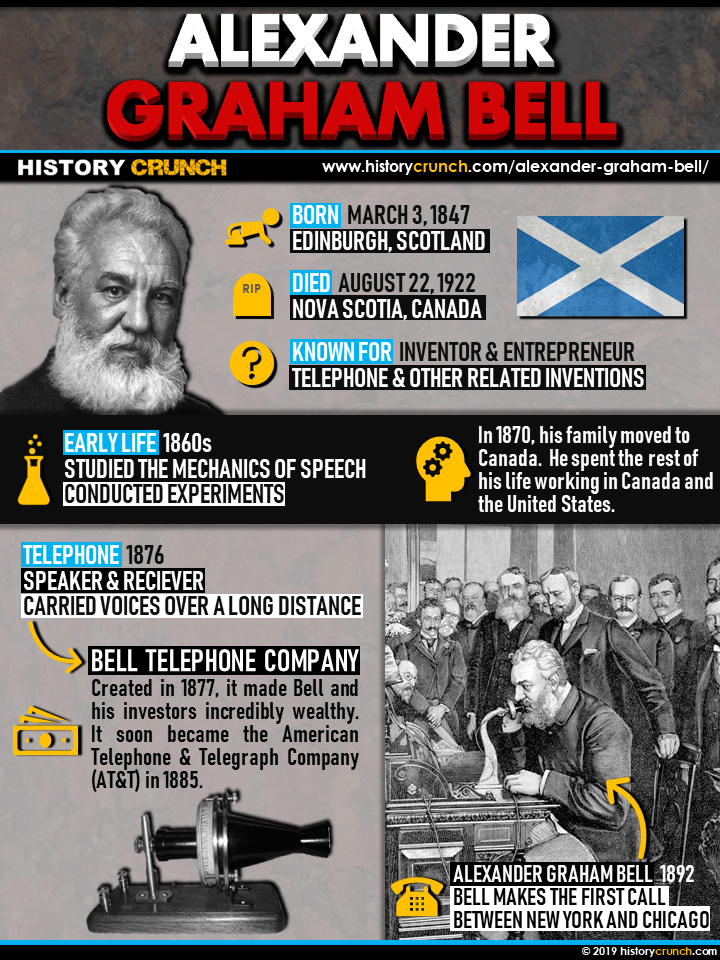
This Alexander Graham Bell infographic was created by the History Crunch team to help students and teachers quickly understand the life and significance of one of the most important inventors of the Second Industrial Revolution. It is designed as a visual learning and study tool, summarizing the essential information covered in our full article on Alexander Graham Bell. Teachers may use it as a classroom display, a discussion prompt, or a study aid for students preparing for assessments.
What This Infographic Covers
Alexander Graham Bell was born on March 3rd, 1847 in Edinburgh, Scotland. He showed curiosity and inventiveness from a very young age, reportedly building a working device to help de-husk wheat at just twelve years old. His father was a phonetician, someone who studied human speech and linguistics, and Bell developed a similar fascination with the mechanics of speech from an early age. He studied in Edinburgh and London before spending the 1860s conducting experiments related to speech patterns and the use of electricity.
The infographic covers Bell’s move to Canada in 1870 and then to the United States, where he worked as a teacher of deaf children and developed a system called Visible Speech to help them learn to speak. Alongside his teaching work he continued experimenting with the idea of transmitting sound over wires. In 1873 he was appointed professor of vocal physiology at Boston University, where he developed a receiver that could convert electricity into sound. He patented this acoustic telegraphy device in 1875 and continued improving the technology.
The centerpiece of the infographic is Bell’s invention of the telephone. There was intense competition from other inventors at the time, most notably American engineer Elisha Gray, who had also developed a telephone prototype. Bell secured his patent on February 14th, 1876, and just three days later successfully tested the device, speaking the now famous words to his assistant Thomas Watson. Bell went on to test his telephone over longer distances, running wires along fences and telegraph posts near his family farm in Canada and successfully transmitting voices over several miles.
The infographic also covers the founding and growth of Bell’s telephone companies. The Bell Telephone Company was created in 1877 and made Bell and his investors very wealthy. Through a series of mergers it eventually became the American Telephone and Telegraph Company, known as AT&T, in 1885. Bell made the first transcontinental telephone call in January 1915, speaking from New York to his former assistant Watson in San Francisco.
Finally the infographic covers Bell’s later life and legacy. He held 18 patents in his own name and collaborated on 12 more, covering inventions ranging from hearing devices to early breathing aids. He was also a founding member of the National Geographic Society in 1888. Bell died on August 22nd, 1922 in Nova Scotia, Canada, and is remembered today as one of the greatest inventors in history.
How to Use This Infographic in the Classroom
This infographic works well as a visual introduction to Alexander Graham Bell before students read the full biography article. It can also be used as a review tool before an assessment, or as a discussion prompt asking students to consider how the invention of the telephone changed daily life and communication, and what modern technology might be considered an equivalent leap forward today. Teachers may also use it alongside related articles on the invention of the telephone and the Second Industrial Revolution to help students place Bell’s work in the broader context of industrial and technological change.
Related Articles
To learn more about the topics covered in this infographic, visit the following History Crunch articles: