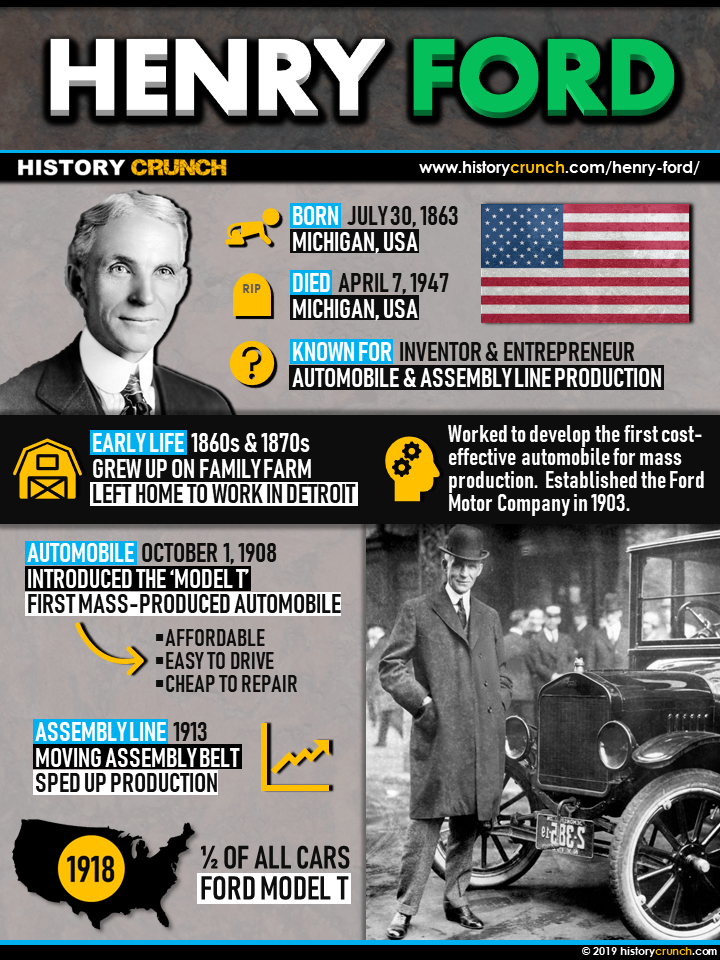
Henry Ford was one of the most significant figures in the history of the United States and the Industrial Revolution. As the founder of the Ford Motor Company, he revolutionized the automotive industry by developing the Model T and introducing the assembly line method of production, which transformed manufacturing forever. This infographic was designed for students to visually summarize the key aspects of Henry Ford’s life and significance and is based on the History Crunch article titled Henry Ford.
Henry Ford – Infographic
About This Infographic
This Henry Ford infographic was created by the History Crunch team to help students and teachers quickly understand the life and significance of one of America’s most important industrialists and inventors. It is designed as a visual learning and study tool, summarizing the essential information covered in our full article on Henry Ford. Teachers may use it as a classroom display, a discussion prompt, or a study aid for students preparing for assessments.
What This Infographic Covers
Henry Ford was born on July 30, 1863 in the state of Michigan. From an early age he showed a natural interest in machines and how they worked. After leaving his family’s farm as a young man, he moved to Detroit where he worked as an apprentice machinist and later as an engineer with the Edison Illuminating Company. It was during this time that he began experimenting with gasoline engines, eventually developing his first self-propelled vehicle, the Ford Quadricycle, in 1896.
The infographic covers the founding of the Ford Motor Company in 1903, which was one of the most important events in American industrial history. Ford and his investors developed a series of automobiles, but it was the Model T, first introduced in 1908, that transformed American society. The Model T was relatively affordable, easy to drive and built with parts that were inexpensive to replace. By 1918 half of all the cars in the United States were Model T’s, a remarkable achievement that demonstrated how Ford had made the automobile accessible to ordinary Americans for the first time.
A central focus of the infographic is Ford’s development of the assembly line method of production. Under this system, parts traveled along a conveyor belt and each worker performed a single repeated task rather than completing multiple stages of production. This dramatically increased the speed and efficiency of manufacturing and allowed Ford to produce automobiles faster while lowering their cost. The assembly line became one of the most important innovations of the late Industrial Revolution and remains a standard method of production in factories around the world today.
The infographic also highlights Ford’s labor policies, which set him apart from many other industrialists of the era. In 1914 he introduced a five-dollar daily wage for his workers, more than double what other industrial workers were earning at the time. He later introduced the five-day working week, limiting workers to eight hours a day and forty hours a week. These policies made Ford an early pioneer of welfare capitalism in the United States and significantly improved the quality of life for his employees.
Finally the infographic covers Ford’s later years and legacy. He opposed American involvement in both World War I and World War II, though his factories produced significant military equipment during both conflicts. Ford died on April 7, 1947 and is remembered today as one of the greatest inventors and entrepreneurs in American history.
How to Use This Infographic in the Classroom
This infographic works well as a visual introduction to Henry Ford before students read the full biography article. It can also be used as a review tool before an assessment, or as a discussion prompt asking students to consider whether Ford’s innovations were more significant for their impact on transportation, manufacturing or labor conditions. Teachers may also use it alongside related articles on the assembly line, the Model T and the Second Industrial Revolution to help students understand Ford’s place in the broader story of industrialization.
Related Articles
To learn more about the topics covered in this infographic, visit the following History Crunch articles: